
#83🔄 Digital Transformation, Policy Governance & Customer Experience: Where the Gaps Really Are 🔄 数码化转型、政策治理与客户体验:真正的差距在哪里
中文版在英文刊文下方。
We often hear about digital transformation; AI, cloud, automation. But transformation is meaningless if the customer experience remains riddled with inefficiencies, inflexibility, and silence.
Let me start with one case many Singaporeans will recognise: broadband subscriptions.
📑 Case 1: Singtel Broadband – When Billing Breeds Confusion
I recently subscribed to a broadband plan at S$49.90/month. (Note: this is a figurative and indicative number representing a typical broadband subscription plan.) Straightforward? Not quite.
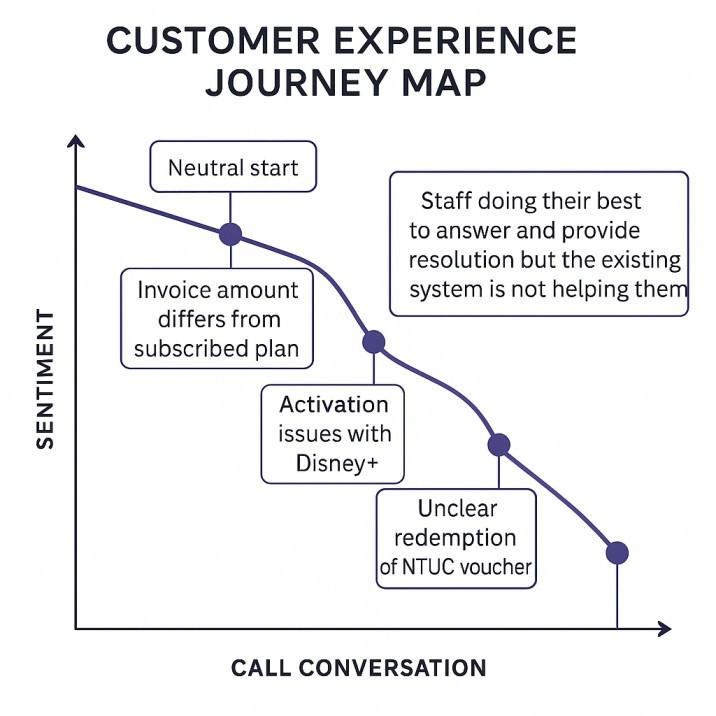
0️⃣ Authentication at the Start of the Call
- When I called on behalf of my family, I introduced myself as the one managing the broadband subscription.
- The officer insisted on speaking directly with the account holder.
- Verification was “completed” once another voice briefly spoke; without deeper checks.
- This is a serious gap:
👉 Companies need clear procedures for family authorization that balance security with caregiving realities. Otherwise, authentication risks being either too rigid (blocking legitimate help) or too superficial (weak verification).
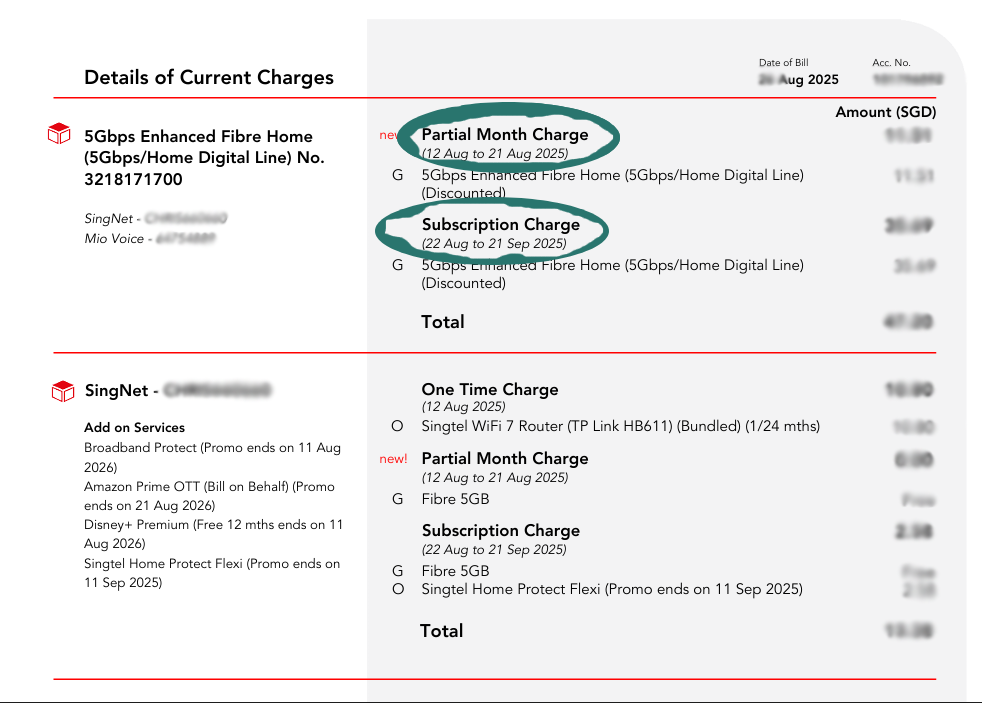
1️⃣ Invoice Misalignment
- The first invoice never matches the subscribed plan.
- Why? Because the customer’s service start date is force-aligned to the provider’s internal billing cycle.
- Consequence: Customers inevitably call in the first two months to clarify, and again at contract end when the final tally looks “off.”
2️⃣ Complex Bundles
- Amazon Prime: smooth activation.
- Disney+: painful with 4 calls, repeated activations, 1-hour expiry emails sent at random.
- NTUC voucher: promised in 2 weeks, still missing after a month.
3️⃣ Verbal vs Written Confirmation
- Rebates are often promised verbally, but not visible unless requested in writing.
- This creates a trust gap.
4️⃣ Inefficient Call Handling
- Queries bounce between 4 departments, each needing checks and supervisor approval.
- Customers are placed on hold multiple times.
- My calculation: one full man-day wasted across 5 staff + 1 customer and over 6 phone calls for what should be a simple clarification.
🙏 A Word on the Frontline Staff
The officers were doing their best by being patient, polite, and genuinely trying to resolve issues. The frustration lies with systems and processes that don’t support them.
As a customer, the experience felt like being a pinball, bounced between departments. Still, I thank the staff for their effort. The real failure is in process design.
Lesson: This isn’t a technology problem. It’s a process redesign problem crying out for transformation.
📊 Back-of-the-envelope Cost Projection
- Households in Singapore: ~1.39 million
- Singtel market share: ~43% → ~600,000 households
- Assumption: 50% haircut for conservatism
- Time wasted per household: ~4 hours (0.5 manday) due to billing + bundle confusion
- Valuation of time: S$100 per man-hour (reasonable proxy for skilled labour cost)
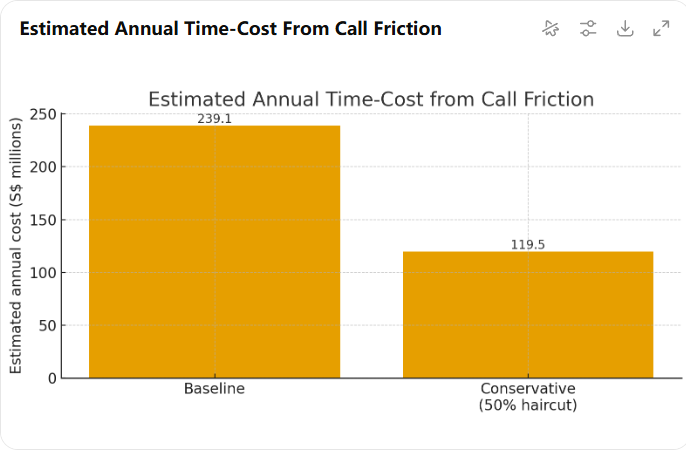
Calculation: 1.39m × 43% × 4 hours × S$100 = ~S$240 million per year
With 50% haircut, this is savings of ~S$120 million per year.
🔍 Why This Matters
- This isn’t just customer frustration — it’s a hidden economic tax on Singapore households.
- For Singtel, the cost isn’t only reputational. Every wasted call:
Opportunity: Streamlining the customer journey could unlock hundreds of millions in collective savings annually, while boosting Singtel’s own efficiency and Net Promoter Score.
🎯 The Leadership Angle
Here’s the irony: Yuen Kuan Moon (Singtel Group CEO) rose through the ranks as an operations guy. If anyone should understand the cost of inefficient workflows, it’s him.
Yet, the day-to-day broadband experience tells another story:
- Misaligned billing,
- Confusing bundle activations,
- Multiple handoffs,
- Weak authorization procedures.
It begs the question: 👉 Is Singtel’s leadership too focused on big-ticket strategy (5G, enterprise, regional plays), while neglecting the small leaks draining customer trust — and costing hundreds of millions?
🌱 Closing Thought
Improving process flow at the frontline isn’t glamorous. It won’t make headlines like 5G launches or overseas acquisitions.
But for households, and for Singapore’s economy, the impact is real: ~S$240 million per year in wasted time could be saved.
✅ Sometimes the most transformative act of leadership is to fix the basics.
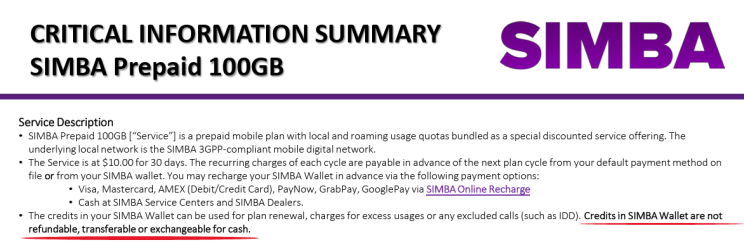
📑 Case 2: SIMBA – Seniors Trapped by Inflexible Balances
- Seniors top up lump sums for convenience.
- SIMBA wallet balances are non-transferable, even to family members managing accounts for them.
- This locks up money and creates stress.
👉 Poor digital design? Or rigid policy governance under IMDA rules? Likely both.
📑 Case 3: CaseTrust – When Silence Erodes Trust
- A family laptop was sent for repair under warranty. The provider (Atrix) shut outlets and disappeared from platforms. The laptop was never returned.
- My enquiry to CaseTrust went unanswered; not even an automated receipt.
👉 If CaseTrust only serves paying members, say so. Otherwise, silence equals whitewashing.
📑 Case 4: Education Systems – Students Juggling 3 Logins
Feedback from a reader:
“My child in secondary school has to manage 3 different logins — Apple ID, MOE ID, and the school’s own ID. Different assignments, different portals. Why not single sign-on, or at least clear instructions?”
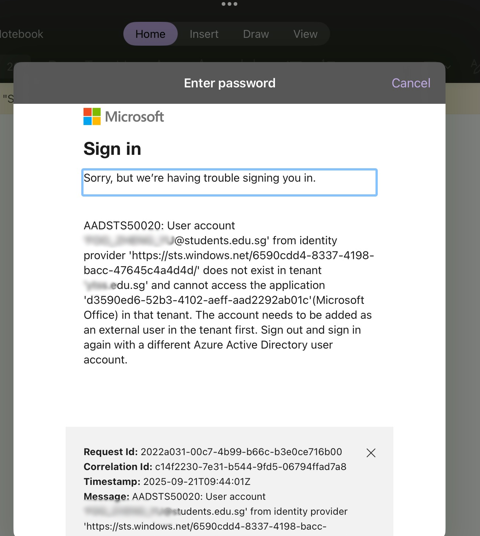
👉 For students, learning should be about knowledge, not troubleshooting logins over the weekend for an assignment given on a Friday to be submitted on Monday.
📑 Case 5: Privacy in Healthcare – NRIC on Medical Certificates
- Both public and private clinics continue to issue medical certificates with NRIC numbers printed.
- This is despite repeated reminders that NRIC should not be displayed unnecessarily for privacy and confidentiality reasons.
👉 Once again, the technology exists, but practice lags policy.
🤔 The Irony: NCS vs. Singtel
Here’s the kicker: NCS, a subsidiary of Singtel, markets itself as a leading consultancy in digital transformation and customer experience.
Yet its parent company struggles with:
- Misaligned billing cycles,
- Confusing bundles,
- Repeated handoffs,
- Lack of transparency in credits and rebates,
- And outdated verification practices.
It raises uncomfortable questions:
- Is this politics with consultancy and operations in silos?
- Or is it overselling capabilities; projecting expertise externally while overlooking home ground?
🌱 Closing Reflection
Whether it’s broadband bills, seniors’ balances, silent watchdogs, students juggling logins, or privacy lapses in healthcare; the message is the same:
Digital transformation must begin at home.
Before selling solutions, organisations must fix their own inefficiencies. Because customers, whether households, seniors, students, or patients don’t care about positioning. They care about clarity, empathy, and trust.
✅ Technology can impress. But experience decides loyalty.
Two Questions to Leave You With:
- Should consultancies be judged not just by what they advise, but by how their parent companies perform in practice?
- When companies market themselves as sustainable or transformative, but fail to deliver at the most basic level, are we simply rewarding sustainability in marketing, rather than in operations?
👉 What do you think? Is digital transformation in Singapore still too much about pitch decks and too little about lived experience?
This article is also published on LinkedIn.
#83 🔄 数码化转型、政策治理与客户体验:真正的差距在哪里
我们常常听到“数码化转型”——人工智能、云计算、自动化。 但如果客户体验仍然充斥着低效、僵化和沉默,那么所谓的转型就毫无意义。
先从一个许多新加坡人都能体会的案例开始:宽带网订阅。
📑 案例一:Singtel 宽带——账单引发的困惑
我最近申请了一个每月 49.90 新元的宽带网配套。(注:这是一个比喻性的参考数字,代表一般的宽带网配套价格。)看似简单,但实际操作却并不顺利。
0️⃣ 通话开始时的身份验证
- 我以家庭管理者的身份拨打客服热线,说明我负责管理家里的宽带网账户。
- 客服坚持要与账户持有人本人通话。
- 最终,只是让另一把声音在电话中简单说了几句,验证就算“完成”。
- 这暴露了一个严重的问题:
👉 企业必须制定更清晰的家庭授权程序,在安全性与照护现实之间取得平衡。否则,验证要么过于僵硬(阻止了合法代办),要么过于流于形式(验证过于表面)。
1️⃣ 账单不一致
- 第一份账单永远与套餐金额对不上。
- 原因在于服务开始日期会被强制对齐到公司内部的账单周期。
- 结果:客户在前两个月必然会打电话澄清,合同结束时又会因金额不符再次致电。
2️⃣ 复杂的捆绑优惠
- Amazon Prime:激活顺利。
- Disney+:极度痛苦——4 次电话、重复激活、随机发送的 1 小时内失效的邮件。忙碌的客户很容易错过。
- NTUC 购物券:承诺两周内发放,一个月后仍未收到。
3️⃣ 口头承诺 vs. 书面确认
- 客服常常口头承诺会有返利或优惠,但在系统中却不可见,除非客户特别要求书面确认。
- 这造成了信任缺口。
4️⃣ 低效的电话处理
- 一个简单问题可能要经过 4 个部门。
- 客户被多次要求等待,客服还需要主管批准。
- 我估算:一次电话的总耗时相当于 5 个员工 + 1 个客户 + 6 通电话= 整整一个工作日。
🙏 对一线员工的肯定
客服人员确实尽了最大努力——他们耐心、礼貌,真心想要解决问题。问题并不在他们,而在于系统和流程没有给他们足够支持。
作为客户,这感觉就像被当作弹珠一样,在部门之间不断被弹来弹去。尽管如此,我仍感谢这些客服的付出。真正的失败是流程设计。
启示:这不是技术问题,而是一个亟需重新设计流程的转型问题。
📊 粗略成本估算
- 新加坡家庭数:约 139 万户
- Singtel 市场份额:约 43% → 约 60 万户
- 假设:保守起见,削减 50%
- 每户浪费时间:约 4 小时(0.5 个工作日),主要因账单与捆绑套餐问题
- 时间价值:每工时 100 新元(合理代表熟练劳动力成本)
计算公式: 139 万 × 43% × 4 小时 × 100 新元 = 约 2.4 亿新元/年
若再打 50% 折扣,节省约 1.2 亿新元/年。
👉 公众追求的是便利,运营追求的是成本控制。
🔍 为什么重要
这不仅仅是客户的烦恼 —— 它实际上是对新加坡家庭的一种隐性经济税负。
对于 Singtel 来说,损失不只是声誉。每一通被浪费的电话意味着:
- 内部资源被消耗(客服、主管、后台)
- 客户流失率增加
- 阻碍了更高价值的互动(如增值、留存)
机遇:如果能简化客户旅程,每年可为社会整体释放数亿新元的节省,同时提升 Singtel 的效率与客户口碑(NPS)。
🎯 领导层角度
讽刺的是:Singtel 集团 CEO 袁观文(Yuen Kuan Moon),是从运营岗位一路晋升的。如果有人最该理解低效流程的成本,那就是他。
然而,日常的宽带体验却讲述着另一个故事:
- 账单对不上
- 套餐激活混乱
- 多次转接部门
- 授权验证薄弱
问题在于: 👉 Singtel 的领导层是否过于专注于 5G、企业业务、区域扩张等“大项目”,而忽视了这些小漏洞 —— 它们正在不断消耗客户信任,也在造成数亿的损失?
🌱 最后的思考
改善一线流程并不光鲜亮丽。它不会像 5G 发布、海外并购那样登上头条。
但对家庭、对新加坡经济而言,影响是真实的: 每年可节省约 2.4 亿新元的时间成本。
✅ 有时候,最具变革性的领导力,就是从修补最基本的环节开始。
📑 案例二:SIMBA —— 长者资金的困境
- 长者通常会一次性充值大笔金额图方便。
- 但 SIMBA 的账户余额无法转让,即便是给帮忙管理账户的家人也不行。
- 这导致资金被锁死,引发焦虑。
👉 这是糟糕的数字化设计?还是 IMDA 政策下的僵化监管问题?答案可能是二者兼有。
📑 案例三:CaseTrust —— 当沉默侵蚀信任
- 家人送去维修的笔记本电脑,在保修期内送修。结果维修商 Atrix 一周后关闭所有门店,并在电商平台上消失,电脑至今未归还。
- 我向 CaseTrust 提交了投诉,却没有收到任何回音,甚至连自动回执都没有。
👉 如果 CaseTrust 只服务付费会员,请明确告知。否则,这种沉默就是粉饰太平。
📑 案例四:教育系统 —— 学生要记住 3 个账号
有读者反馈:
“我家孩子上中学,要记住 3 个不同的账号 —— Apple ID、教育部学生 ID、学校自己的 ID。不同作业要用不同门户。对 13 岁的孩子来说,这太复杂了。为什么不能用单点登录,或者至少给出更清晰的说明?”
👉 学生的时间应该花在学习上,而不是解决登录问题。
📑 案例五:医疗体系 —— 病假单上仍然印 NRIC
- 目前,无论是公立还是私立诊所,病假单上仍然会印出完整 NRIC 号码。
- 这尽管多次提醒过,不应随意暴露 NRIC,以保障隐私和保密。
👉 问题再次在于:技术和政策已经存在,但执行落后。
🤔 讽刺之处:NCS 与 Singtel
更讽刺的是:NCS 是 Singtel 的子公司,却在市场上大力宣传自己是数字化转型与客户体验咨询的专家。
但它的母公司仍然困于:
- 账单错配、
- 捆绑混乱、
- 部门踢皮球、
- 返利不透明、
- 验证流程落后。
这引发了不舒服的疑问:
- 这是政治问题——咨询与运营各自为政?
- 还是过度营销——对外夸耀能力,却忽视最基本的内部执行?
🌱 总结与思考
无论是宽带账单、长者余额、沉默的监管机构、学生登录问题,还是医疗隐私漏洞——结论都是一致的:
数字化转型必须从自身做起。
在对外推销解决方案之前,组织必须先解决内部低效。因为客户——无论是家庭、长者、学生,还是患者——并不在乎企业的宣传,他们在乎的是清晰、共情与信任。
✅ 技术可以令人印象深刻,但真正决定忠诚度的,是体验。
留给大家的两个问题:
- 咨询公司是否应该不仅仅看它们提供的建议,而更要看它们母公司自身的表现?
- 当企业在市场上大谈“可持续”或“转型”,但在最基本的层面都无法兑现,我们是否只是在奖励可持续的营销,而不是可持续的运营?
👉 你怎么看?新加坡的数字化转型是否依然停留在展示型 PPT 上,而缺乏真实的用户体验落地?
![[Innovation Meets Impact: IES INCA – Deep Tech Accelerator Community Evening]](https://marvinfoo.com/wp-content/uploads/2025/03/IMG20250328174255-768x576.jpg)