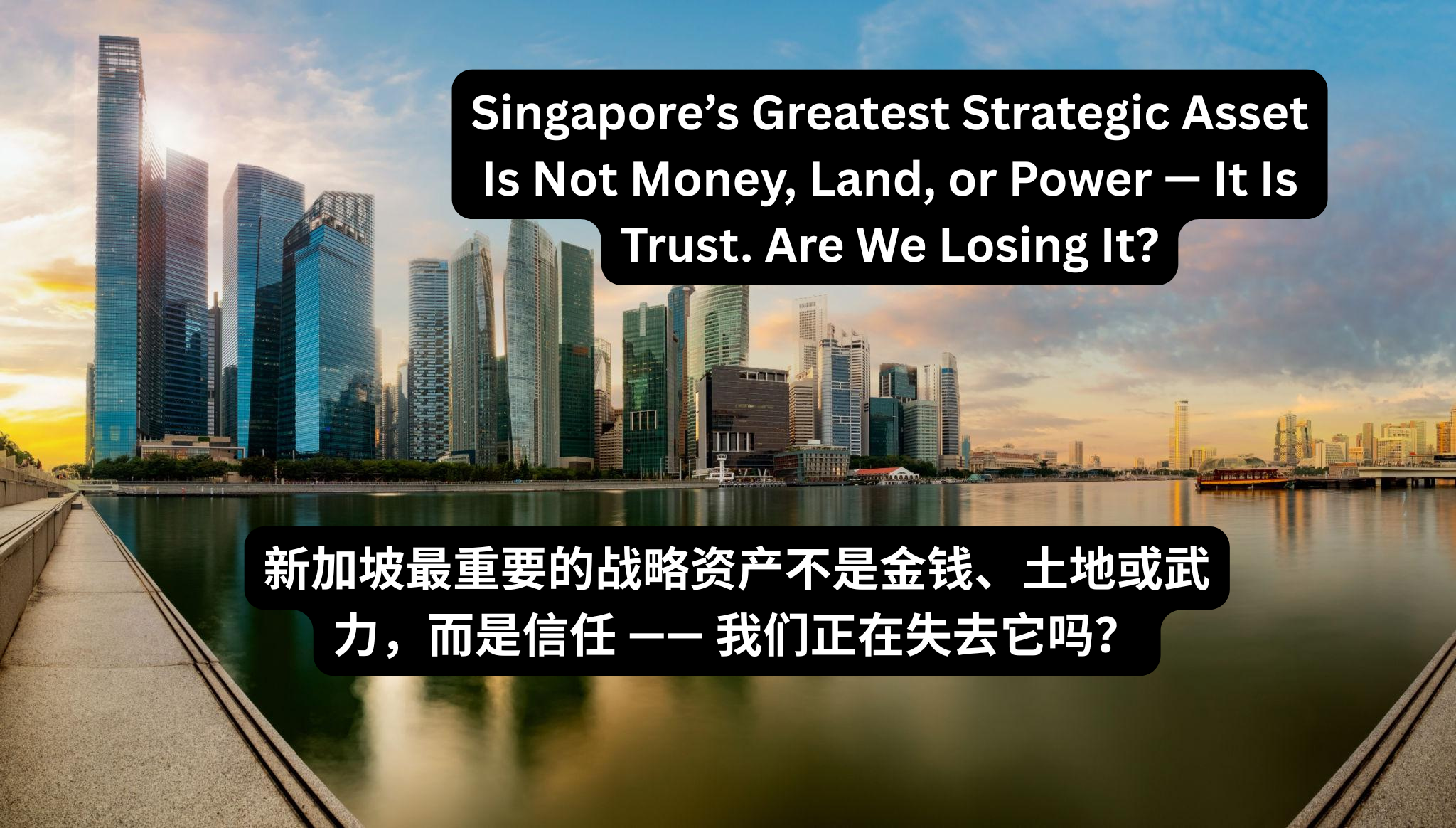
#123 Singapore’s Greatest Strategic Asset Is Not Money, Land, or Power — It Is Trust. Are We Losing It?
Singapore was never supposed to succeed.
We had no natural resources. We had no strategic depth. We had no hinterland.
What we had instead was something far more powerful — trust.
Trust that institutions were clean. Trust that systems worked. Trust that agreements would be honoured. Trust that the state would act with discipline.
That invisible infrastructure became the foundation on which Singapore built one of the most successful city-states in modern history.
But for small nations, trust is not permanent.
It must be constantly protected.
And once it begins to erode, the consequences can be far more dangerous than many realise.
Why Israel Should Concern Singaporeans
Israel occupies roughly 22,000 square kilometres.
Singapore occupies 734 square kilometres.
Different regions. Different politics.
But the strategic reality is similar.
Both are small states surrounded by a larger world.
Small states cannot rely on geography or population to absorb shocks. They rely on something far more fragile:
Internal cohesion and institutional trust.
Once that breaks down, even strong economies and powerful militaries cannot compensate.
Large countries can survive institutional failures.
Small countries cannot.

Reputation vs Reality
Singapore’s public housing system is often celebrated globally as one of the most successful housing programmes in the world, housing nearly 80% of the population.
But reputation alone cannot sustain trust.
Systems must continuously earn it.
In several earlier writings, I explored how subtle institutional failures can quietly undermine confidence.
In “Reality vs Reputation: Is the Housing Development Board Losing Its Way?”, I examined the widening gap between Singapore’s international housing reputation and the frustrations faced by some citizens navigating the system.
In “Singapore’s Quiet Squeeze: When Misclassification, Housing Policies and Bureaucratic Delays Reveal a Deeper Pattern,” I explored how administrative classifications and policy rigidity can trap families in prolonged uncertainty.
In “Inequality in Public Housing Which Singapore Is Proud Of,” I documented how a system celebrated for fairness can sometimes feel very different for those caught inside procedural loops.
Most troubling was the case described in “Treason From Within.”

An applicant discovered that their contact details had disappeared from the housing portal, effectively cutting off communication with the housing authority.
The question is simple:
How does critical information disappear from a government system?
A technical error?
An administrative oversight?
Or something more troubling?
Institutional erosion rarely begins with dramatic collapse.
It begins with small anomalies.
Missing records. Unanswered correspondence. Opaque processes.
Left unchecked, these anomalies slowly erode confidence in the system.
When Trust Is Broken: A Personal Experience
Institutional trust is mirrored in professional ecosystems.
And in my own professional experience, I encountered a situation that illustrates how fragile that trust can be.
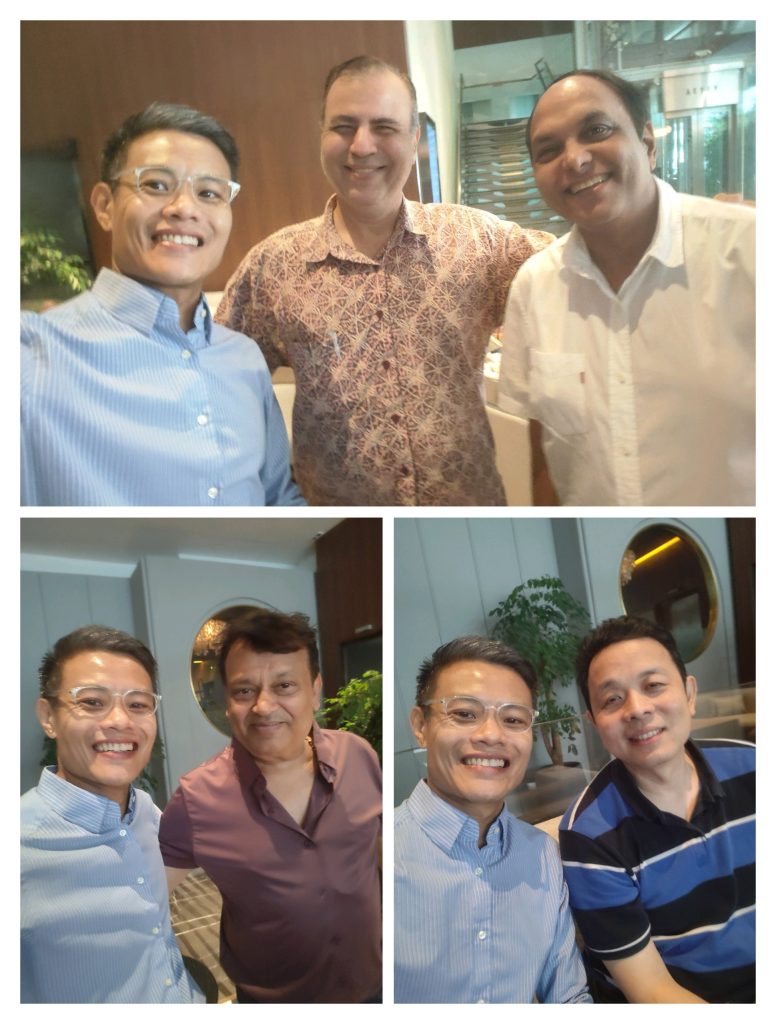
Several months ago, Andy Andrew Wee, General Manager of the Institution of Engineers, Singapore, approached me with what he described as a potential opportunity. He introduced me to Linda Yan from JE Synergy regarding collaboration on waste-processing technologies and system architecture.
It is important to clarify that I did not seek this introduction.
Andy Andrew Wee actively encouraged the engagement.
To ensure professional clarity, I provided him with a referral agreement, which he acknowledged and agreed to support.
Over the following months, I shared specialised knowledge relating to waste-processing technologies, operational frameworks, and strategic system architecture — knowledge built over years of industry experience.
JE Synergy acknowledged that this would be a paid professional engagement, and a quotation was issued.
The Meeting That Raised Questions
During a technical discussion, another participant from JE Synergy, Li Kan, joined the meeting.
Unlike others present, Li Kan deliberately attended virtually instead of physically.
Just before the meeting began, Linda Yan informed me that the collaboration link she had provided was “not working.”
I was asked to provide my own meeting link so the meeting could proceed.
This detail later proved significant.
Because the meeting was conducted on my link, it created the appearance that the information shared during the session was voluntarily provided, rather than part of a structured professional consultation.
At the same time, Li Kan’s virtual presence enabled the session to be recorded, capturing the technical presentation and strategic insights shared during the meeting.
These included:
- waste-processing system architecture
- operational models
- strategic frameworks developed over years of industry work
All of this was shared in good faith as part of a paid expert consultation.
Yet after receiving the information, JE Synergy ultimately failed to honour the payment agreement.
Communication ceased.
A legal letter was issued clearly stating that the knowledge shared constituted privileged professional consultation and could not be used without payment.
They did not respond.
Silence in such situations speaks loudly.
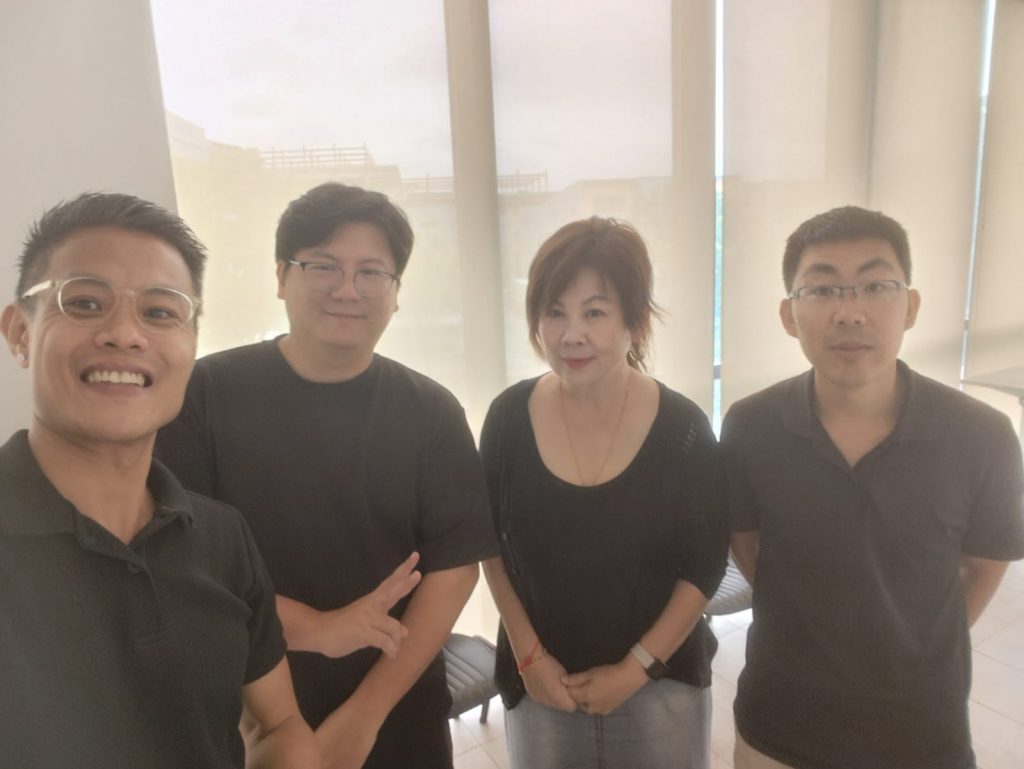
The companies that JE Synergy are related to include, JE Green Solutions Pte Ltd, Eastern Green Power Pte Ltd. I am hearing distress in these companies of late, hence please exercise caution when dealing with them.
Responsibility and Character
Because Andy Andrew Wee had initiated the introduction and encouraged the collaboration, I later raised the matter with him.
To my surprise, he sided with JE Synergy and stated that I was in the wrong.
I chose not to escalate further after issuing the legal notice.
However, approximately two months later, Andy Andrew Wee contacted me again asking for further information about Haily and the Thousand Ships initiative.
I reminded him that if he wished to obtain more information, he should first help resolve the outstanding payment owed by JE Synergy.
His reply was simple:
“This is between you and JE Synergy.”
At that point I offered a hypothetical example.
“If you introduced a male friend to your sister and he later violated her trust, would you feel responsible?”
He replied immediately:
“Of course I would. She is my sister.”
I thanked him for his honesty.
Because his answer revealed something important.
His sense of responsibility extended only to his own family — not to professional partners he had encouraged into an engagement.
That moment revealed the character of the situation clearly.
Why This Matters
This is not simply about one unpaid consultation.
It is about something much larger:
Trust.
When knowledge can be taken without honouring agreements, and when those who facilitated the engagement refuse to acknowledge responsibility, the damage spreads beyond the individuals involved.
It erodes confidence in the ecosystem itself.
For Singapore — a country whose global standing rests heavily on reliability, fairness, and institutional integrity — that erosion is dangerous.
Because small states survive on trust capital.
And trust capital, once depleted, is extremely difficult to rebuild.
Discipline Is the Only Cure
Singapore’s only real safeguard is discipline.
When trust is abused — whether by Singaporeans within our own institutions or by foreign actors exploiting our systems — it must be confronted decisively.
Small states cannot afford complacency.
They must defend their institutional integrity relentlessly.
Trust must be protected.
Those who misuse it must face consequences.
The Question Singapore Must Now Ask
Singapore’s success was built on something rare:
Leadership with iron discipline.
The kind that confronted corruption. The kind that corrected institutional failures early. The kind that placed national integrity above personal comfort.
The uncomfortable question today is this:
Do our current leaders still possess the iron to defend the trust that built Singapore?
Because if they do not, the greatest strategic asset this country has ever possessed may quietly disappear.
And once trust disappears, even the strongest economy cannot bring it back.
This article is also published on LinkedIn.
新加坡最重要的战略资产不是金钱、土地或武力,而是信任 —— 我们正在失去它吗?
新加坡原本是不应该成功的。
我们没有天然资源。 我们没有战略纵深。 我们没有腹地。
但我们拥有一种更强大的东西——
信任。
对制度的信任。 对法治的信任。 对政府体系的信任。 对承诺会被履行的信任。
正是这种看不见的基础设施,让新加坡建立起世界上最成功的城市国家之一。
然而,对于小国来说,信任从来不是永久的。
它必须被不断守护。
一旦开始流失,其后果可能远比许多人想象的更严重。
为什么以色列的处境值得新加坡人深思
以色列的国土面积约 22,000平方公里。
新加坡约 734平方公里。
地区不同,政治环境不同。
但在战略现实上,两者却有一个共同点:
都是小国。
小国无法依靠广阔的国土或庞大的人口来承受冲击。
它们依赖的是一种更脆弱却更重要的力量:
内部的凝聚力与制度信任。
一旦这种信任崩塌,再强的经济或军队都难以弥补。
大国可以承受制度失灵。
小国往往不能。
名声与现实之间
新加坡的公共住房制度常被世界誉为最成功的住房模式之一,覆盖约 80% 的人口。
但制度不能只靠名声维持。
它必须不断赢得人民的信任。
在我过去的一些文章中,我探讨过一些制度中出现的细微裂缝,如何逐渐侵蚀公众信心。
在 《现实与名声:建屋发展局是否正在迷失方向?》 一文中,我讨论了新加坡住房制度的国际声誉与部分申请者真实体验之间的落差。
在 《新加坡的无声挤压:当错误分类、住房政策与官僚延误揭示更深层模式》 中,我分析了行政分类与政策僵化如何让一些家庭陷入长期的不确定状态。
在 《新加坡引以为豪的公共住房中的不平等》 中,我记录了一些案例,显示一个被认为公平的制度,在具体执行时可能呈现不同的体验。
而最令人担忧的是我在 《来自内部的背叛》 一文中描述的一件事情。
一位申请人发现,自己在住房系统中的联系方式竟然消失了,导致政府部门无法与其沟通。
问题很简单:
这些信息是如何消失的?
技术错误? 行政疏忽? 还是更令人不安的原因?
制度的侵蚀往往不会以戏剧性的方式出现。
它通常从一些小异常开始:
消失的数据。 无人回复的信件。 不透明的流程。
如果不及时纠正,这些异常会慢慢侵蚀公众信任。
当信任被破坏:一次个人经历
制度信任同样体现在专业合作关系中。
在我的职业经历中,我遇到了一件事情,让我深刻体会到信任是多么脆弱。
几个月前,新加坡工程师学会(Institution of Engineers, Singapore)总经理 Andy Andrew Wee 联系我,介绍了一项合作机会。
他把我介绍给 JE Synergy 的 Linda Yan(JE Synergy),讨论有关废弃物处理技术与系统架构的合作。
需要说明的是:
这次介绍并不是我主动要求的。
是 Andy Andrew Wee 主动推动这项合作。
为了确保专业合作的清晰性,我向他提供了一份 推荐协议(Referral Agreement),他表示同意并支持该合作。
随后几个月里,我与 JE Synergy 进行了多次交流,分享了自己在废弃物处理技术、系统架构和运营模式方面积累多年的专业知识。
JE Synergy 也确认,这将是一次 付费的专业咨询合作,并要求我提供报价。
那次令人疑问的会议
在一次技术讨论会上,JE Synergy 的另一位成员 Li Kan 参与了会议。
与其他人不同的是:
他没有到现场,而是选择线上参与。
就在会议开始前,Linda Yan 表示她提供的会议链接 “无法使用”。
于是我被要求提供 自己的会议链接,会议才得以继续。
后来才发现,这一点并不简单。
因为会议是在 我的链接 上进行的,这在形式上看起来就像是我主动组织会议并分享信息。
与此同时,Li Kan 的线上参与也使得会议可以 被录制。
会议中,我展示了详细的技术内容,包括:
- 废弃物处理系统架构
- 运营模式设计
- 多年行业经验形成的战略框架
这些内容是在 双方确认是付费专业咨询的前提下,基于善意分享的。
然而在获得这些信息之后,JE Synergy 没有履行支付协议。
沟通随之停止。
我随后发出法律信函,明确说明这些知识属于 受保护的专业咨询内容,未经付款不得使用。
他们没有回应。
沉默,在这种情况下,往往意味着很多事情。
责任与品格
因为 Andy Andrew Wee 是最初促成合作的人,我后来向他反映了此事。
让我惊讶的是,他站在 JE Synergy 一方,并表示问题在我。
我随后没有继续升级冲突。
然而 两个月后,Andy Andrew Wee 又联系我,希望了解更多关于 Haily 以及 Thousand Ships 计划 的信息。
我提醒他,如果希望继续获取信息,至少应该先帮助解决 JE Synergy 欠下的费用问题。
他的回答很简单:
“这是你和 JE Synergy 之间的事情。”
于是我问了他一个假设问题:
“如果你介绍一个男性朋友给你的妹妹,而他后来伤害了她,你会不会觉得自己有责任?”
他回答:
“当然会,因为她是我妹妹。”
我感谢他的诚实。
因为这说明了一件事:
他的责任感,只适用于 自己的家人。
而不是他亲自推动合作的专业伙伴。
为什么这件事重要
这不仅仅是一笔咨询费用的问题。
这是关于 信任。
当知识可以被拿走却不支付报酬,当促成合作的人选择完全置身事外,这种行为会破坏整个专业生态的信任。
对于新加坡来说,这尤其危险。
因为新加坡的国际地位,很大程度上建立在 可靠、诚信与制度完整性 之上。
而小国最宝贵的资本就是:
信任资本。
一旦失去,重建极其困难。
纪律,是唯一的解药
新加坡唯一的保障,就是 纪律。
当信任被滥用——无论是 内部人员还是外部利用系统的人——都必须被严肃对待。
小国不能对制度问题视而不见。
必须及早纠正。
新加坡必须面对的一个问题
新加坡的成功,来自一种罕见的领导力:
铁一般的纪律。
敢于打击腐败。 敢于纠正制度问题。 敢于把国家利益放在个人舒适之上。
今天,新加坡人必须问一个不太舒服的问题:
我们的领导人,是否还拥有这种“铁”?
因为如果没有,
那么新加坡最重要的战略资产——
信任
可能会在不知不觉中消失。
而一旦消失,再强大的经济也无法轻易把它带回来。