#162 Digital First, But Are We Truly Integrated and First-class? 数码优先,但我们头等体验的系统真的已经整合了吗?
Singapore prides itself on being a digital nation.
We digitise forms.
We digitise appointments.
We digitise payments.
We digitise applications.
But digitisation is not the same as integration.
Recently, a reader shared an experience that raised an uncomfortable question:
Are our systems talking to one another?
Or are citizens still acting as couriers between departments that happen to share the same logo?
A S$17.37 Question
On 9 May 2026, the reader attended a specialist consultation at Khoo Teck Puat Hospital.
The reader was a recipient of ComCare financial assistance but did not have the physical assistance letter on hand during the visit.
He asked a simple question:
“Can I submit the financial assistance letter digitally afterwards so that the bill can be considered for waiver or subsidy?”
The answer was yes.
An email address was provided by the department for submission of the supporting documents.

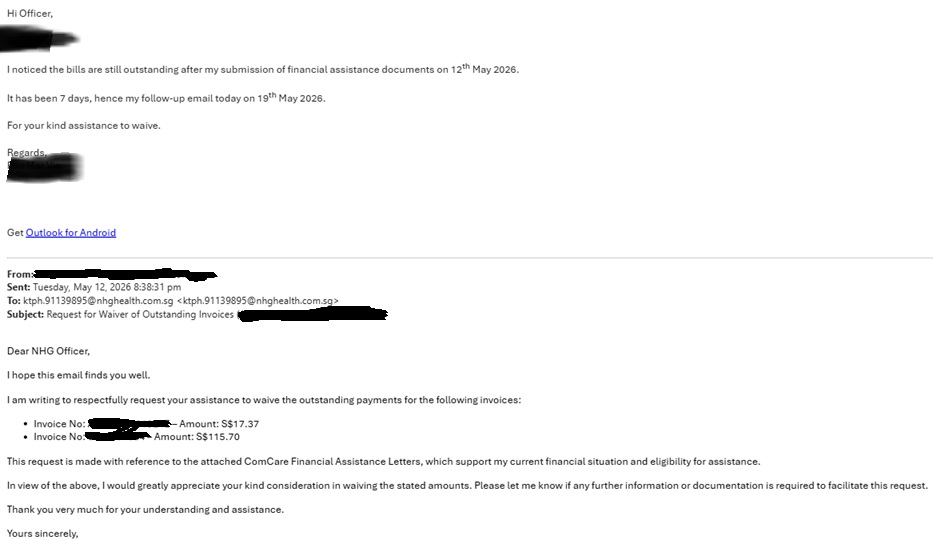
The reader dutifully submitted the documents on 12 May 2026, together with the relevant ComCare financial assistance letter.
Follow-up reminders were sent thereafter.
Weeks passed.
No response.
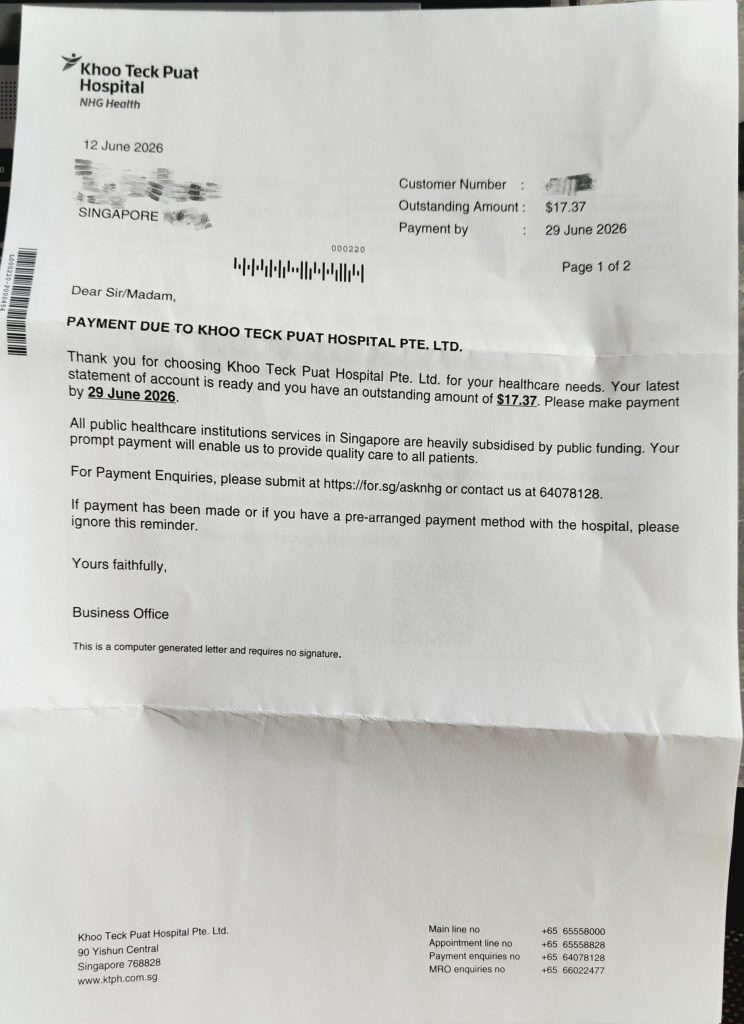
Then on 12 June 2026, a letter arrived.
The bill remained outstanding.
Payment was requested.
The amount?
S$17.37.
The question is not whether S$17.37 should be paid.
The question is:
Was the email inbox connected to the billing department?
If the documents were received, was the request processed?
If the request was rejected, was the patient informed?
If further action was required, why was this not communicated?
If the documents were never received, how would the patient know?
Digital submission without digital workflow integration simply moves paperwork from paper trays into email inboxes.
The Story Gets More Interesting
During a subsequent visit to the same specialist clinic, the reader brought along the physical financial assistance letter.
The letter clearly stated that outpatient consultations and medication for the family were fully subsidised.
Interestingly, the consultation charges for that day’s visit were successfully subsidised.
However, the two earlier invoices remained outstanding.
The reader was informed during the earlier visits that no further action was required and that the matter would be taken care of.
Apparently, it had not been.
This naturally raises further questions.
Were the earlier charges considered different in nature?
Were they categorised differently?
Were they private services rather than subsidised public services?
If so, was this communicated clearly to the patient?
Because if a financially distressed patient is knowingly referred into a private service pathway within a public hospital system, surely there should be clear explanation of the financial implications beforehand.
Public Patient. Private Charges. Public Hospital.
Another reader shared a similar experience involving a referral pathway for a child requiring specialist dental treatment.
The family was under ComCare financial assistance and had repeatedly highlighted that they did not possess the financial means to pay private medical fees unless government assistance or waivers were available.
Yet they found themselves being referred into what appeared to be a private specialist service within a public hospital.

One experienced medical social worker later suggested that referral to the National Dental Centre could potentially have been a more suitable pathway.
The family was left asking a simple question:
If affordability concerns were already known to the healthcare system, why was there confusion over the referral pathway in the first place?
The Problem May Not Be Technology
Singapore’s healthcare system contains some of the best professionals in the world.
The issue may not be people.
The issue may be systems.
Billing teams.
Call centres.
Specialist clinics.
Medical social workers.
Financial assistance departments.
Referral coordinators.
Each team may be functioning exactly as intended.
Yet from the patient’s perspective, they can feel like entirely separate organisations.
Departments optimise for their own processes.
Patients experience the gaps between those processes.
The irony is that Singapore is often described as “Digital First”.
But integration is not measured by how many forms can be submitted online.
Integration is measured by whether the next department already knows what the previous department knows.
Kampung Spirit, Work Spirit
Singapore often talks about losing the kampung spirit.
Perhaps there is another spirit we should be careful not to lose.
The work spirit.
The willingness to own a problem even when it technically belongs to another department.
The instinct to ask:
“If this were my parent, my child or my family member, would I simply redirect them elsewhere?”
Technology can digitise forms.
Only people can integrate experiences.
The Real Question
This article is not about S$17.37.
It is not about a single hospital.
It is not about any individual staff member.
It is about whether our increasingly digital institutions are becoming genuinely integrated at both the system level and the human level.
Because citizens do not experience government one department at a time.
They experience government as one system.
And the quality of that experience is often determined not by what happens inside departments —
but by what happens between them.
P.S.
Since drafting this article, yet another reader has shared another unresolved healthcare billing issue involving approximately S$75.
Individually, S$17 or S$75 may appear insignificant.
Collectively, however, these stories reveal something larger.
Increasingly, I find myself functioning less like a commentator and more like an informal Meet-the-People Session.
People write in with their stories.
They explain their circumstances.
They describe the departments they have spoken to, the forms they have submitted, the calls they have made, and the promises of follow-up they are still waiting for.
And very often, the experience feels remarkably similar:
“I hear you.”
“I’m sorry to hear that.”
“We’ll look into it.”
Sometimes action follows.
Sometimes it does not.
For citizens, what matters most is not empathy alone.
It is closure.
It is knowing who owns the issue.
It is knowing whether someone has the authority to move the matter forward.
Listening is important.
Compassion matters.
But trust in institutions is ultimately built when empathy is accompanied by action, ownership and accountability.
Singapore has invested heavily in becoming a Smart Nation.
Perhaps the next frontier is not simply becoming more digital.
Perhaps it is becoming more integrated.
Because citizens rarely care which department owns the problem.
They simply want to know that someone owns the solution.
And perhaps that is what the old kampung spirit really meant.
Not merely knowing your neighbour’s name.
But refusing to leave a problem behind simply because it technically belonged to someone else.
This article is published on LinkedIn.
数码优先,但我们头等体验的系统真的已经整合了吗?
新加坡一直以数码国家自居。
我们把表格数码化。
把预约数码化。
把付款数码化。
也把申请流程数码化。
但数码化,并不等于系统整合。
最近,一位读者向我分享了一段经历,也引出了一个令人不安的问题:
我们的公共服务系统,真的会彼此沟通吗?
还是说,市民依然必须充当不同部门之间的“人工传递员”,即使这些部门使用的是同一个机构名称、同一个品牌标志,甚至同一套公共医疗体系?
一个关于 S$17.37 的问题
2026年5月9日,这名读者到邱德拔医院接受专科门诊服务。
他当时正接受 ComCare 经济援助,但当天没有随身携带相关的经济援助证明信。
于是,他询问柜台人员:
“我是否可以过后以电子方式提交经济援助证明,让这笔 S$17.37 的医疗账单按照援助信所说明的条件,获得豁免或全额补贴?”
工作人员表示可以,并提供了一个电邮地址,让他提交相关证明文件。
读者随后于2026年5月12日,按照指示把 ComCare 经济援助信及相关账单资料发送到指定电邮地址。
之后,他也发出了跟进邮件和提醒。
然而,电邮始终没有获得回复。
一个月后的2026年6月12日,他却收到医院寄来的付款通知,告知账单依然未结清,并要求他在指定日期前付款。
金额是:
S$17.37。
问题从来不只是这笔 S$17.37 应不应该支付。
真正的问题是:
接收电邮的部门,是否与账单部门相互连接?
如果文件已经收到,申请是否有人处理?
如果豁免申请未获批准,为什么没有人通知病人?
如果还需要进一步资料,为什么没有人说明?
如果电邮根本没有进入处理流程,病人又要如何知道?
所谓电子提交,如果背后没有整合的电子工作流程,只不过是把纸张从实体文件盘,转移到无人回应的电子邮箱。
表格虽然数码化了,问题却没有消失。
它只是换了一个地方继续等待。
后续经历更令人困惑
在最近一次到同一专科诊所复诊时,这名读者特地带上了实体版的 ComCare 经济援助信。
援助信清楚说明,他及其家庭成员的门诊咨询与药物费用应获得全额补贴。
有趣的是,当天新产生的门诊费用成功获得了补贴。
然而,之前的两张账单——分别涉及他本人和孩子——却仍然显示为未结清。
这名读者此前已经提醒有关工作人员处理这些账单,也曾被告知无需再采取任何行动,相关金额将会获得处理。
显然,事情并没有真正解决。
这自然引出了更多问题。
之前的费用是否属于不同的收费类别?
它们是否被归类为私人医疗服务,而不是受补贴的公共医疗服务?
如果确实如此,为什么没有事先清楚告知病人?
如果一个已经被公共援助体系识别为面对经济困难的家庭,被转介到公立医院内的私人专科服务,那么有关部门是否应该在接受治疗之前,明确说明收费性质、补贴范围及可能产生的自付费用?
病人不应该在接受治疗后,才发现自己走进了一个完全不同的收费体系。
公立医院、私人收费与公共援助
另一名读者也分享了类似经历。
他的孩子原本在政府牙科诊所接受治疗,之后被转介到邱德拔医院内的牙科专科诊所。
这户家庭正接受 ComCare 经济援助,并且已经多次说明,除非相关费用能够获得政府补贴或豁免,否则他们没有能力承担私人专科收费。
可是,他们最终似乎仍然被转入了一个私人收费性质的专科服务渠道。
当读者与孩子前往医疗社会服务部门寻求协助时,其中一名工作人员的态度并不友善;幸好,另一名较有经验、态度亲切且愿意认真了解情况的医疗社会工作者,协助他们进一步查看这个“公立系统转介到私人服务”的问题。
这位资深工作人员也提到,国家牙科中心或许本来可以是另一条更适合的转介路径。
之后,读者被要求致电热线了解情况。
热线人员表示,根据现行政策,有关服务必须收费。
读者再次说明家庭的经济状况,并提出一个合理的问题:
如果政府医疗系统已经知道这个家庭无力承担私人费用,为什么政府牙科诊所仍会把病人转介到公立医院内的私人专科服务?
热线人员似乎也能理解他的处境,并表示他们人手不足,只有三名工作人员处理相关事务。
读者被告知将会接到进一步的回电。
然而,一个星期过去了,仍然没有人联系他作出说明。
这又令人回到最基本的问题:
究竟是谁负责把整个问题处理到底?
问题可能不在科技本身
新加坡的公共医疗体系拥有许多优秀、尽责并且富有同理心的专业人员。
问题未必是个人。
问题很可能在于系统之间缺乏整合。
账单部门有自己的流程。
专科诊所有自己的流程。
热线中心有自己的流程。
医疗社会服务部门有自己的流程。
经济援助部门也有自己的流程。
转介单位同样有自己的程序和责任范围。
每一个部门,或许都在按照自己的工作要求正常运作。
但从病人的角度来看,他们却像是在与几家完全不同的机构交涉。
部门优化了各自内部的工作流程。
市民承受的,却是不同流程之间留下的缝隙。
新加坡经常强调“数码优先”。
但真正的系统整合,并不是看多少表格可以在网上提交。
真正的整合,是当病人进入下一个部门时,那个部门已经知道前一个部门掌握了什么资料、作出了什么承诺,以及下一步应该由谁负责。
失去的不只是甘榜精神
新加坡人经常感叹,过去的“甘榜精神”已经逐渐消失。
或许,我们也应该警惕另一种精神正在消失:
工作精神。
那种即使问题严格来说属于另一个部门,也愿意多走一步、协助病人把事情处理完成的责任感。
那种愿意停下来思考:
“如果今天面对这个问题的是我的父母、孩子或家人,我是否也会只给他们一个电话号码,再把他们转到另一个部门?”
科技可以把表格数码化。
但只有人,才能把服务体验连接起来。
真正的服务精神,不应该只是把个案转交出去。
它应该包括确认下一名负责人员已经接手,确认病人知道下一步该做什么,也确认问题最终获得解决。
真正的问题
这篇文章不是为了争论 S$17.37。
也不是为了针对某一家医院,或某一位工作人员。
它讨论的是一个更大的问题:
我们越来越数码化的公共机构,是否也真正实现了系统层面与人性层面的整合?
市民不会按照组织架构图,一个部门一个部门地体验政府服务。
他们感受到的是一个完整的公共系统。
而一个系统的服务质量,往往并不取决于各部门内部做得多好。
真正决定体验的,是部门之间如何衔接。
如果一个病人必须重复说明同一个情况、重复提交同一份文件、重复致电不同热线,并不断等待无人确认的跟进,那么无论系统拥有多少电子表格、应用程序或线上门户,都不能称为真正的整合。
没有整合的数码化,只是电子化的孤岛。
附言(P.S.)
在整理这篇文章期间,又有另一名读者向我反映一张约 S$75 的医疗账单问题。
单独来看,S$17.37 或 S$75 似乎都不是庞大的金额。
但当类似反馈不断出现时,它们所揭示的,已经不再只是个别账单。
不知不觉间,我发现自己越来越像是在主持一个非正式的“接见选民活动”。
读者写信给我。
他们讲述自己的家庭情况。
说明曾经联系过哪些部门、提交过哪些表格、拨打过多少次电话,以及仍在等待哪些迟迟没有出现的回覆。
整个体验有时非常熟悉:
“我听见你的问题。”
“很遗憾听到你的遭遇。”
“我们会帮你了解。”
又或者:
“你现在怎样才能感觉好一点?”
有时候,之后确实会有人采取行动。
但有时候,什么都没有发生。
对市民而言,仅仅被聆听并不足够。
他们需要的是结果。
他们需要知道谁真正负责这个问题。
他们需要知道,有没有人拥有推动事情向前发展的权限。
同理心当然重要。
聆听也非常重要。
但公众对制度的信任,最终建立在同理心之后是否有行动、责任归属和问责。
否则,这份工作确实显得相当轻松:
听别人倾诉,表达同情,然后不必真正解决问题。
这让人想起早期的电话聊天服务——孤单的人付费拨电话,只为了有人愿意听他们说话。
不同之处在于,如今这类“聆听服务”,最终可能是由纳税人的钱来承担。
这句话听起来尖锐,但问题值得认真面对。
因为市民不是为了获得一句安慰而求助。
他们是在寻找解决方案。
新加坡已经投入大量资源建设智慧国家。
或许,下一个阶段不只是继续数码化。
而是让制度真正互相连接。
毕竟,市民通常不在意问题属于哪个部门。
他们只想知道:
是否有人真正负责解决问题。
或许,这才是过去所谓甘榜精神的真正意义。
不仅是认识邻居的名字。
而是当有人面对困难时,不会因为那件事“技术上属于别人负责”,便把问题留在原地。