#147 Professionalism, Restraint, and the Standards We Choose to Uphold 专业、克制,以及我们选择维护的标准
In recent years, Singapore has worked hard to strengthen regional business connectivity across ASEAN.
Professional institutions, chambers of commerce, engineering bodies, startup ecosystems, and sustainability communities are increasingly interconnected. This is a good thing.
However, with growth also comes an important question:
Are we preserving the standards that made these institutions respected in the first place?
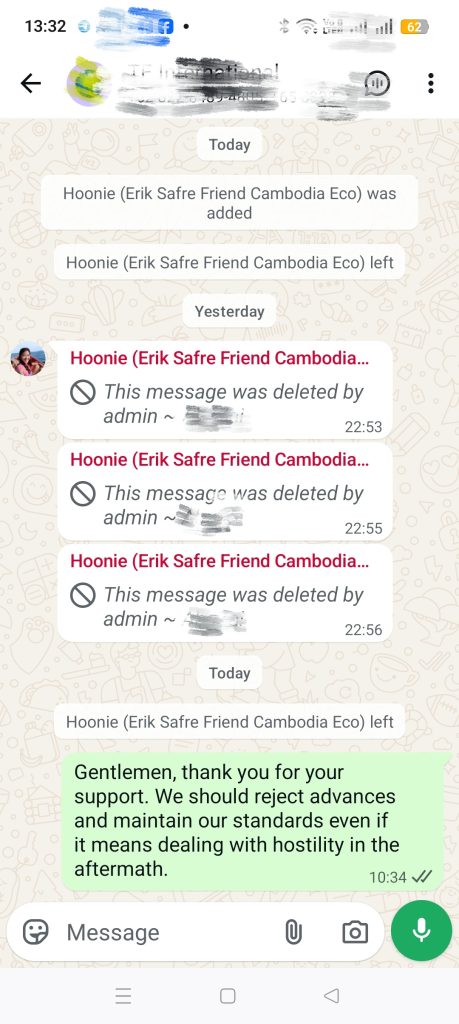
Recently, I experienced a series of interactions across professional chatgroups and social media discussions that left me deeply concerned about how personal emotions, hostility, and online behaviour are increasingly spilling into professional ecosystems.
This was not merely about disagreement.
Disagreement is normal.
What concerned me was:
- vulgarity appearing in business communities,
- emotionally charged conduct,
- mockery in public discussions,
- and the gradual erosion of restraint that professional environments traditionally uphold.
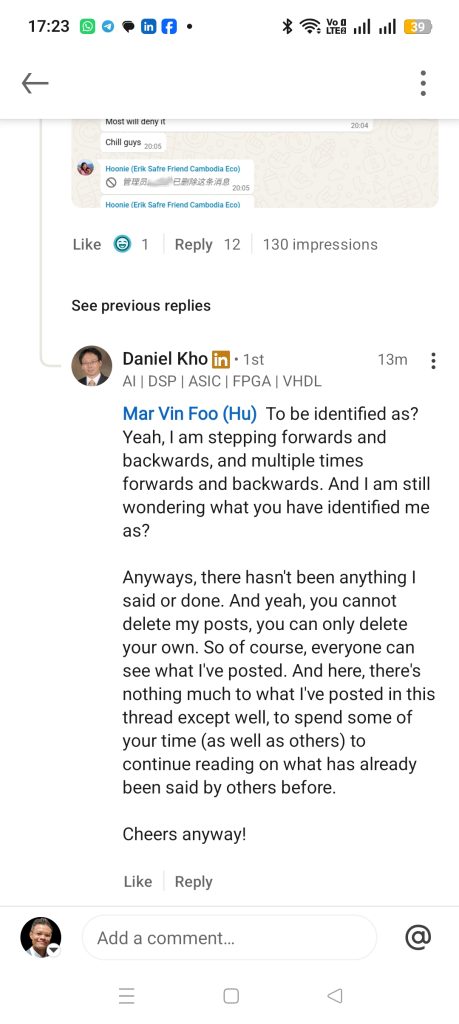
In one instance, vulgar comments in a predominantly Malay and Muslim business chat environment reportedly had to be removed by an administrator monitoring the group.
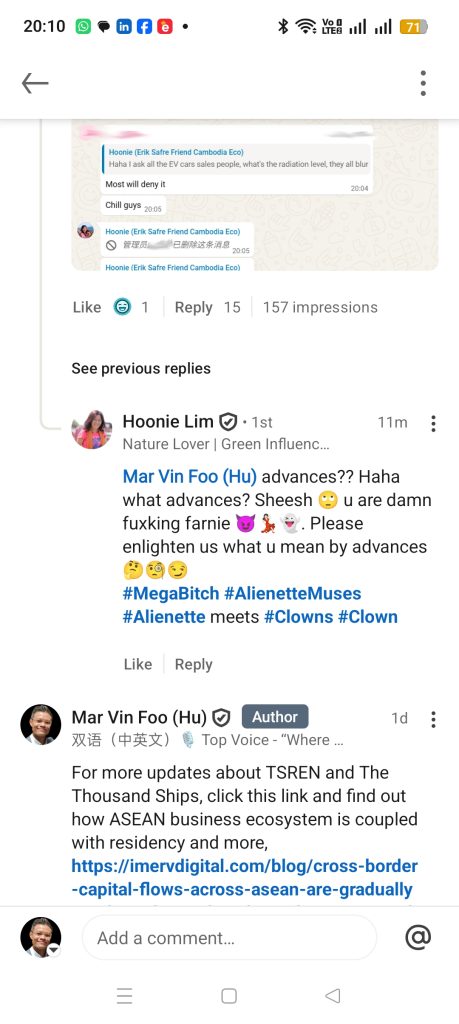
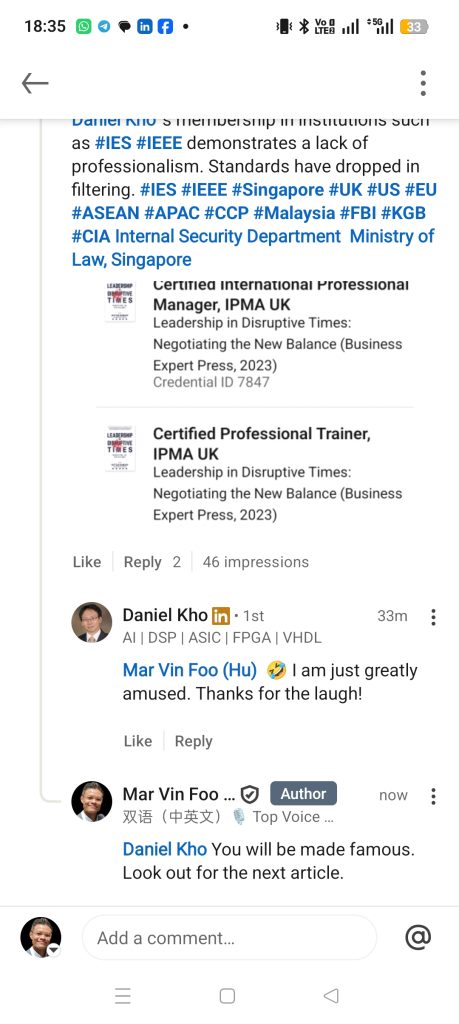
In another, public LinkedIn discussions connected to cross-border property and investment stakeholders devolved into sarcasm and performative ridicule instead of constructive engagement.
These incidents raise larger questions beyond individuals.
Institutions Matter Because Standards Matter
Organizations such as:
- engineering institutions,
- chambers of commerce,
- sustainability networks,
- startup ecosystems,
- and industry accelerators
carry reputational weight because society expects their members to exercise discipline, professionalism, and maturity.
The concern is not whether people disagree.
The concern is whether:
- professionalism is being replaced by online tribalism,
- influence networks are becoming emotionally reactive,
- or social ecosystems are rewarding provocation over restraint.
Singapore’s reputation was not built on noise.
It was built on:
- discipline,
- competence,
- multi-racial sensitivity,
- and controlled conduct even during disagreement.

Chinese Clan Associations and Modern Expectations
Singapore has also encouraged greater participation in clan and cultural organizations to preserve heritage and identity in an increasingly globalized world.
This objective is understandable.
But growth in numbers should never come at the expense of:
- culture,
- ethics,
- professionalism,
- or emotional discipline.
Heritage organizations carry responsibility because they indirectly shape how communities are perceived externally.
The same applies to sustainability leadership roles.
Titles alone do not define leadership.
Conduct does.
When Filling the Room Becomes More Important Than Filtering the Room
Another uncomfortable reality that many organizers quietly understand — but seldom discuss openly — is the growing tendency to prioritize attendance numbers over attendee quality.
Across:
- networking events,
- sustainability forums,
- startup ecosystems,
- professional associations,
- clan organizations,
- and business communities,
there is increasing pressure to:
- fill seats,
- inflate participation,
- create the appearance of momentum,
- and demonstrate “community engagement.”
The result is that filtering standards sometimes weaken.
But a room full of people is not necessarily a room full of professionalism, maturity, or constructive intent.
In fact, one disruptive or emotionally unstable individual can:
- derail discussions,
- poison community culture,
- create reputational risk,
- intimidate quieter professionals,
- and discourage serious stakeholders from participating altogether.
This becomes even more dangerous when:
- organizers tolerate repeated behavioural issues,
- problematic conduct is excused as “personality,”
- or emotionally aggressive behaviour becomes normalized for the sake of maintaining attendance numbers.
Quality matters.
Especially in Singapore, where business ecosystems are tightly interconnected and reputational signals travel quickly across industries and borders.
A smaller room with:
- disciplined professionals,
- respectful dialogue,
- and constructive engagement
is often far more valuable than a crowded room driven by noise, theatrics, emotional volatility, or online tribalism.
The same principle applies to:
- chambers of commerce,
- accelerator ecosystems,
- engineering communities,
- sustainability groups,
- and cross-border investor networks.
Strong communities are not built merely by increasing numbers.
They are built by maintaining standards.
Because once standards collapse internally, the external reputation of the entire ecosystem eventually follows.

The Real Risk: Reputational Contagion
In today’s digital environment:
- screenshots spread internationally,
- investors observe silently,
- partners evaluate behaviour,
- and reputations compound over time.
A single emotionally charged interaction can affect:
- startups,
- fundraising,
- cross-border partnerships,
- investor confidence,
- and institutional credibility.
ASEAN is becoming increasingly interconnected.
Professional ecosystems cannot afford to normalize hostility, vulgarity, or performative aggression in business spaces.
Leadership Is Restraint Under Pressure
Anyone can behave professionally when praised.
The true test of leadership is whether professionalism remains intact during disagreement, rejection, criticism, or emotional tension.
That standard should apply equally to:
- founders,
- engineers,
- sustainability leaders,
- chamber representatives,
- volunteers,
- and business communities.
Especially in Singapore.
Because once standards decline quietly, rebuilding trust becomes far more difficult than preserving it in the first place.
When Trust Is Broken: A Personal Experience
In an earlier article titled, “Singapore’s Greatest Strategic Asset Is Not Money, Land, or Power — It Is Trust. Are We Losing It?”, I wrote that Singapore’s real strength was never merely:
- capital,
- military capability,
- infrastructure,
- or geography.
It was trust.
Trust in:
- institutions,
- systems,
- governance,
- professionalism,
- and the people appointed to represent these organizations publicly.
That trust is fragile.
And once damaged internally, no amount of branding or international positioning can easily restore it.
One important principle often overlooked is this:
The credibility of an institution is inseparable from the conduct of the people representing it.
Titles matter because representation matters.
Appointment holders shape:
- organizational culture,
- external perception,
- member behaviour,
- and the standards tolerated within ecosystems.
This is why leadership conduct cannot be dismissed lightly.
It becomes concerning when influential figures within professional ecosystems appear dismissive toward respected national figures or institutions themselves.
For example, hearing remarks that former Temasek Holdings Chairperson Ho Ching was “just a member” and therefore inconsequential within a professional ecosystem raises broader concerns about judgment, humility, and institutional respect.
There is another uncomfortable question that deserves reflection.
Could dismissing a respected female leader as “just a member” also reflect remnants of an outdated mindset that parts of the engineering and technical sectors have spent decades trying to move away from?
Engineering, technology, and infrastructure industries were historically male-dominated.
But even more than twenty years ago, many professionals already understood that competence, leadership, and strategic ability are not determined by gender.
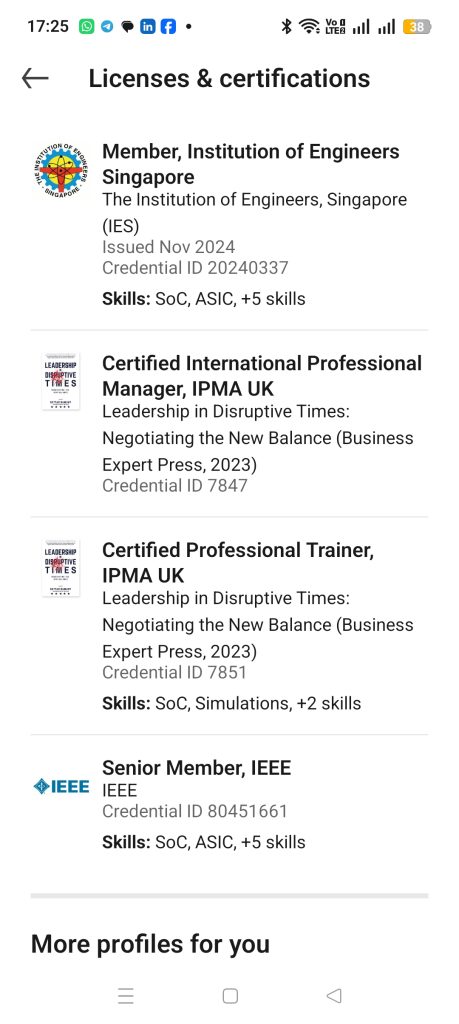
During my university days more than two decades ago, I had the opportunity through networking circles to know Principal Engineer Shai Kim, a Malaysian Chinese engineer who frequently worked on engineering projects alongside men in demanding site environments under the sun.
What stood out was not gender.
It was professionalism, resilience, technical competence, and the ability to command respect through capability and conduct.
Even back then, many engineers already understood clearly that:
- leadership required respect,
- institutions required integrity,
- and capable women in technical ecosystems deserved equal recognition and authority.
This is why dismissive attitudes toward accomplished female leaders can become deeply concerning in modern contexts.
Particularly in sectors like:
- engineering,
- sustainability,
- venture ecosystems,
- infrastructure,
- and institutional governance,
where Singapore should already be operating at globally mature standards.
Whether one agrees politically or personally with Ho Ching is not the issue.
The issue is whether influential voices within professional ecosystems casually normalize dismissiveness toward highly accomplished women leaders in ways that may indirectly reinforce unhealthy cultural undercurrents.
That naturally raises broader questions:
- Are there still outdated internal attitudes within segments of engineering culture?
- Are female professionals fully respected in practice — not merely in official statements?
- Are some women within associations quietly tolerating behaviour they may feel uncomfortable speaking against?
- Have certain informal ecosystems become too insulated from accountability?
Perhaps this is precisely why stronger female leadership representation inside professional institutions matters.
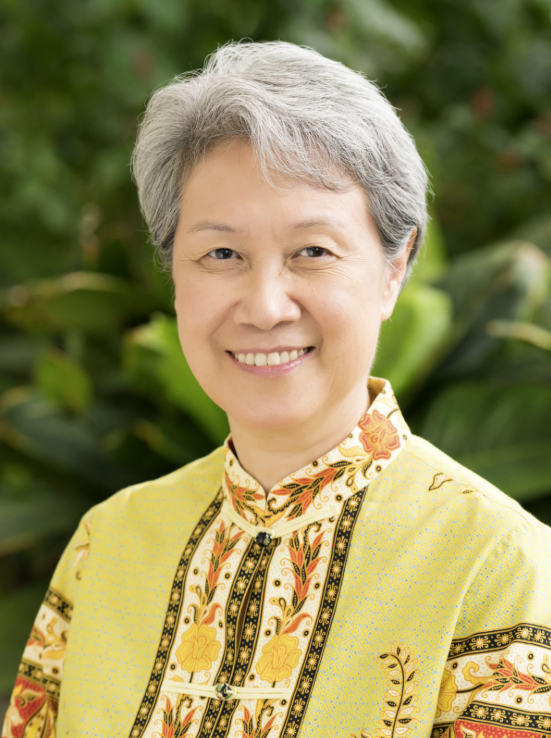
And perhaps there is value in considering whether individuals such as Ho Ching — who led one of the world’s most respected sovereign investment institutions through transformation and global expansion — could contribute meaningfully toward reviewing organizational culture, professionalism standards, governance maturity, and leadership conduct within engineering and technical ecosystems.
Because institutional credibility is not measured only by:
- technical capability,
- membership size,
- or branding.
It is also measured by:
- culture,
- restraint,
- professionalism,
- inclusiveness,
- and the psychological safety felt by members within the ecosystem itself.
Similarly, when members associated with respected professional institutions publicly engage in sarcastic mockery, emotionally provocative commentary, or unprofessional exchanges on visible international platforms such as LinkedIn, observers naturally begin asking difficult questions:
- Are standards slipping?
- Is professionalism still being upheld?
- What behavioural culture is being normalized internally?
- Are organizations actively protecting their reputational integrity?
This matters because Singapore operates heavily on reputational trust.
International investors, governments, founders, and partners do not interact only with buildings or institutions.
They interact with people.
And increasingly, those interactions happen publicly and digitally for the world to observe.
Singapore’s advantage was never simply efficiency.
It was the perception that:
- systems were disciplined,
- institutions were credible,
- leaders exercised restraint,
- and professionalism remained intact even during disagreement.
Sometimes the voices that matter most are not the loudest voices in the room.
They are the quieter professionals who observe silently, endure quietly, and choose not to speak publicly for fear of social, professional, or political consequences.
A mature institution must ensure such voices never feel invisible.
Once trust begins eroding quietly from within, rebuilding it becomes extraordinarily difficult.
Reference: “Singapore’s Greatest Strategic Asset Is Not Money, Land, or Power — It Is Trust. Are We Losing It?”
Reference: 林 Lin (Lim) family name standing in Singapore versus the rest in Singapore. Surname Power Representation in Singapore’s Elite (A Deeper Look)
P.S: In the next article, we will talk about Ho Ching’s achievements — 一个懂得扮演好角色的女士 — in business, leadership, and as a woman supporting her husband’s endeavours while carrying immense responsibilities of her own.
This article is also published on LinkedIn.
专业、克制,以及我们选择维护的标准
近年来,新加坡一直努力加强与东盟区域商业生态的联系。
专业机构、宗乡会馆、工程协会、创业生态圈以及可持续发展社群之间的联系越来越紧密。这本来是一件好事。
然而,随着规模扩大,也带来了一个重要问题:
我们是否还在维护那些曾经让这些机构受到尊敬的标准?
最近,我在多个专业聊天群组与社交媒体讨论中,经历了一系列事件,让我对个人情绪、敌意与网络行为逐渐渗透进专业生态圈感到深深担忧。
这不仅仅是意见分歧的问题。
分歧本来就是正常的。
真正令人担忧的是:
- 粗俗语言出现在商业社群中,
- 情绪化行为,
- 公开场合中的嘲讽,
- 以及专业环境中原本应有的克制精神正在逐渐消失。
其中一次事件里,在一个以马来人与穆斯林企业家为主的商业聊天群中,有人发表粗俗言论,最终需要管理员介入删除。
另一次,则是在与跨境房地产及投资利益相关者有关的 LinkedIn 公开讨论中,对话逐渐演变成讽刺与表演式嘲笑,而不是建设性的交流。
这些事件已经超越了个人之间的矛盾。
机构之所以重要,是因为标准重要
像以下这些组织:
- 工程专业机构,
- 商会与宗乡组织,
- 可持续发展网络,
- 创业生态圈,
- 以及行业加速平台,
之所以拥有公信力,是因为社会默认其成员应具备纪律、专业精神与成熟度。
问题并不在于人们是否有不同意见。
真正的问题在于:
- 专业精神是否正被网络部落化取代,
- 影响力圈子是否越来越情绪化,
- 又或者社群生态是否开始奖励挑衅,而不是克制。
新加坡的声誉,从来不是建立在喧闹之上。
而是建立在:
- 纪律,
- 能力,
- 多元种族敏感度,
- 以及即使在分歧中也能保持克制的文化之上。
宗乡会馆与现代社会的期待
新加坡近年来也鼓励更多人参与宗乡会馆与文化组织,以在全球化时代中保留文化根源与身份认同。
这个目标本身是可以理解的。
但人数增长,绝不能以牺牲以下价值为代价:
- 文化,
- 道德,
- 专业精神,
- 以及情绪纪律。
文化组织肩负责任,因为它们间接塑造了外界对社群的观感。
可持续发展领域的领导角色也是如此。
头衔本身并不能定义领导力。
行为才可以。
当“填满会场”比“筛选会场”更重要时
还有一个许多主办方心知肚明,却很少公开讨论的现实,那就是:越来越多人开始把“人数”看得比“质量”更重要。
在:
- 商务交流活动,
- 可持续发展论坛,
- 创业生态圈,
- 专业协会,
- 宗乡组织,
- 与商业社群中,
主办方越来越倾向于:
- 填满座位,
- 提高出席数字,
- 营造“场面热闹”的感觉,
- 以及展示所谓的“社群参与度”。
结果就是,筛选标准逐渐松动。
但一个坐满人的房间,并不代表里面充满专业人士、成熟人士或建设性参与者。
事实上,一个情绪不稳定或具有破坏性的人,就足以:
- 扰乱讨论,
- 污染社群文化,
- 制造名誉风险,
- 让安静而专业的人感到被压制,
- 甚至让真正认真的利益相关者不再愿意参与。
更危险的是:
- 主办方长期容忍重复性的行为问题,
- 把有问题的行为解释成“个性”,
- 或为了维持人数,而默认情绪化攻击行为的存在。
质量,很重要。
尤其是在新加坡这种商业生态高度互联、声誉传播极快的社会。
一个较小但拥有:
- 有纪律的专业人士,
- 尊重性的交流,
- 与建设性互动的空间,
往往远比一个充满噪音、戏剧化、情绪波动与网络部落化的拥挤场合更有价值。
这个原则同样适用于:
- 商会,
- 加速器生态,
- 工程社群,
- 可持续发展组织,
- 以及跨境投资网络。
真正强大的社群,并不是靠人数堆积出来的。
而是靠标准维持出来的。
因为一旦内部标准崩塌,整个生态圈的外部声誉最终也会跟着崩塌。
真正的风险:声誉传染效应
在今天这个数字化时代:
- 截图会被全球传播,
- 投资人会默默观察,
- 合作伙伴会评估行为,
- 名誉也会随着时间不断累积。
一次情绪化的互动,就可能影响:
- 创业公司,
- 融资能力,
- 跨境合作,
- 投资者信心,
- 以及机构公信力。
东盟正在越来越紧密地连接在一起。
专业生态圈不能再把敌意、粗俗语言与表演式攻击视为正常商业文化的一部分。
真正的领导力,是在压力下依然保持克制
任何人在被赞美时,都可以表现得很专业。
真正的领导力测试,是在面对:
- 分歧,
- 被拒绝,
- 批评,
- 或情绪压力时,
是否依然能够保持专业精神。
这个标准应该平等适用于:
- 创业者,
- 工程师,
- 可持续发展领袖,
- 商会代表,
- 志愿者,
- 以及商业社群。
尤其是在新加坡。
因为一旦标准在内部悄悄下降,重建信任将远比维持信任困难得多。
当信任被破坏:一次个人经历
在我之前的一篇文章《新加坡最伟大的战略资产,不是金钱、土地或权力,而是信任。我们是否正在失去它?》中,我曾写道:
新加坡真正的强大,从来不仅仅来自:
- 资本,
- 军事能力,
- 基础设施,
- 或地理位置。
而是来自信任。
对:
- 机构,
- 制度,
- 治理体系,
- 专业精神,
- 以及代表这些机构的人,
所建立起来的信任。
这种信任,其实非常脆弱。
一旦内部受损,再多的品牌包装与国际宣传,也很难真正修复。
其中一个经常被忽视的重要原则是:
一个机构的公信力,与代表它的人之行为,是无法分开的。
头衔之所以重要,是因为代表性重要。
被委任的人,会影响:
- 组织文化,
- 外界观感,
- 会员行为,
- 以及整个生态圈所容忍的标准。
因此,领导层的言行,绝不能被轻视。
当一些专业生态圈中的影响人物,对国家级人物或机构表现出轻蔑态度时,问题就值得深思。
例如,把前淡马锡控股主席何晶形容成“只是一个会员”,因此无足轻重,这种说法本身就反映出更深层的问题——包括判断力、谦逊,以及对机构的尊重。
这里还有另一个令人不安的问题值得反思。
把一位杰出的女性领导者轻描淡写地称为“只是一个会员”,是否也反映出某些工程与技术领域里,仍然残留着过时的性别思维?
工程、科技与基础设施行业,历史上长期由男性主导。
但即使在二十多年前,很多专业人士早已明白: 能力、领导力与战略眼光,并不由性别决定。
二十多年前,在大学时期的社交圈里,我有机会认识一位资深工程师 —— Principal Engineer Shai Kim。
她是一位马来西亚华人工程师,经常在烈日下与男性工程团队并肩参与工程项目。
真正令人敬佩的,从来不是她的性别。
而是她的专业精神、韧性、技术能力,以及以实力与行为赢得尊重的能力。
即使在当年,很多工程师其实已经很清楚:
- 领导力需要尊重,
- 机构需要诚信,
- 女性在技术生态中的能力与贡献,理应获得平等认可。
因此,在今天的环境下,对杰出女性领导者表现出轻视态度,确实令人担忧。
尤其是在:
- 工程界,
- 可持续发展领域,
- 创投生态,
- 基础设施行业,
- 与机构治理体系中,
新加坡本应早已达到国际成熟标准。
无论个人是否认同何晶的政治立场或个人风格,都不是重点。
重点在于:
某些专业生态中的影响人物,是否正在轻率地正常化对杰出女性领导者的轻视,从而间接强化一些不健康的文化潜流?
这自然也带出了更多问题:
- 工程文化中是否仍存在过时思维?
- 女性专业人士是否真正被尊重,而不只是停留在官方口号?
- 是否有女性会员长期忍受某些行为,却不敢公开发声?
- 某些非正式生态圈,是否已经变得缺乏问责机制?
或许,这正是为什么专业机构内部需要更强女性领导力代表性的原因。
也许,像何晶这样的人物——一位曾领导全球最受尊敬主权基金之一,并推动其国际化转型的女性领导者——反而能够为工程与技术生态圈中的:
- 组织文化,
- 专业标准,
- 治理成熟度,
- 与领导行为,
带来有价值的检视与改革。
因为一个机构的公信力,并不仅仅取决于:
- 技术能力,
- 会员人数,
- 或品牌形象。
它同样取决于:
- 文化,
- 克制,
- 专业精神,
- 包容性,
- 以及成员在组织内部所感受到的心理安全感。
同样地,当一些与受尊敬专业机构有关联的成员,在 LinkedIn 等国际公开平台上,以讽刺、挑衅与不专业的方式互动时,外界自然会开始提出问题:
- 标准是否正在下降?
- 专业精神是否仍然存在?
- 内部到底在正常化什么样的行为文化?
- 这些组织是否仍在保护自己的公信力?
这很重要。
因为新加坡高度依赖“信誉型信任”。
国际投资者、政府、创业者与合作伙伴,接触的从来不只是建筑物或机构。
他们接触的是人。
而如今,这些互动越来越多是在公开、数字化的平台上,被全世界同时观察。
新加坡真正的优势,从来不只是效率。
而是外界相信:
- 制度有纪律,
- 机构可信,
- 领导人懂得克制,
- 即使面对分歧,也依然保持专业。
有时候,最重要的声音,并不是房间里最大声的人。
而是那些安静观察、默默忍受、因为担心职业、社交或政治后果,而不敢公开发声的专业人士。
一个成熟的机构,必须确保这些声音不会被忽视。
因为一旦信任在内部悄悄流失,重建它,将会异常困难。
P.S:在下一篇文章里,我们将谈谈何晶的成就 —— 一个懂得扮演好角色的女士 —— 她不仅在商业与领导领域展现能力,也在支持丈夫事业的同时,承担着属于自己的巨大责任。