#166 When Subsidies Fail to Reach the Vulnerable: Why Public Healthcare Vendor Relationships Deserve an Independent Audit 当补贴无法惠及弱势群体:为何公共医疗机构与供应商的关系值得接受独立审计
Outsourcing may transfer work, but it must never transfer accountability
Outsourcing is frequently promoted as a solution.
It is supposed to reduce costs, bring in specialist expertise and allow public institutions to focus on their core responsibilities.
But outsourcing can also become a convenient way to move responsibility out of sight.
The contractor blames the hospital.
The hospital refers the patient to the contractor.
The agency says the matter belongs to another organisation.
The complaint is acknowledged, redirected or rejected.
Eventually, the person with the least money, influence and ability to navigate the system bears the cost.
It resembles the way wealthy economies export waste elsewhere and then describe their own surroundings as clean. The problem has not disappeared. It has merely been transferred to someone with less power to resist it.
Singapore is a founding member of ASEAN and frequently presents itself as a regional leader in governance, sustainability and institutional capability.
But regional leadership must begin at home.
A country cannot credibly ask Southeast Asia to prevent plastic and waste leakage across borders while allowing responsibility to leak between its own hospitals, contractors, subcontractors and agencies.
Two reader accounts raise questions that deserve proper answers—not assumptions, accusations or another empathetic reply that produces no resolution.
Case One: A subsidised patient placed on a non-subsidised pathway
Case One: A subsidised patient placed on a non-subsidised pathway—and then referred for debt recovery
In an earlier article, I described the experience of a financially distressed family receiving ComCare assistance.
The family says a government dental clinic referred the child to a specialist dental service located within Khoo Teck Puat Hospital. They repeatedly explained that they could not afford private treatment unless the service was subsidised or waived.
Nevertheless, charges arose.
The family says different personnel subsequently offered different explanations:
- the service was private;
- the charges had to be paid under policy;
- the matter would be examined;
- no further action was necessary;
- the earlier invoices would be taken care of.
Yet the bills for both father and child from the vulnerable segment of society that the government claims are helping remained outstanding.
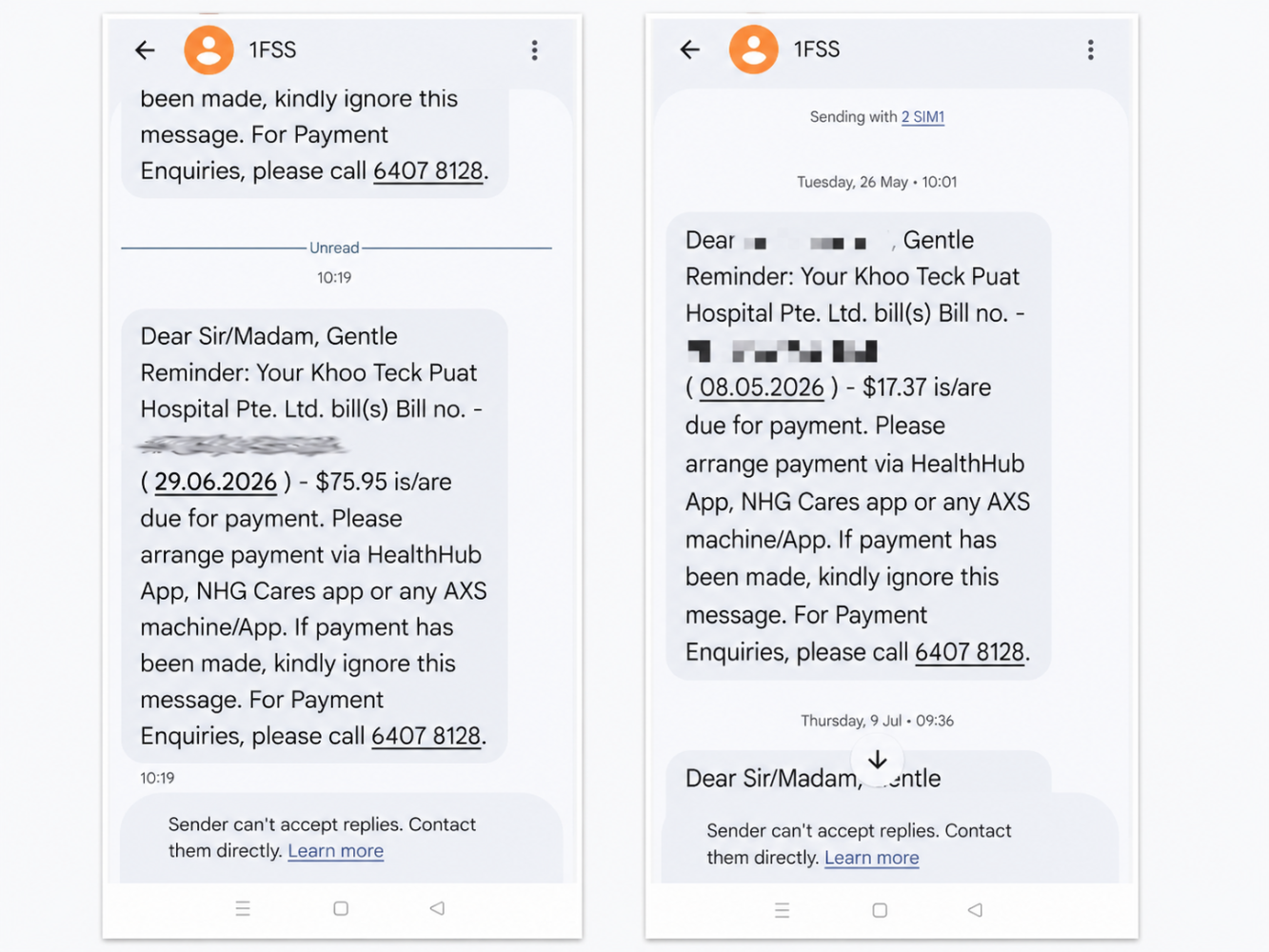
The latest development makes the situation even more disturbing.
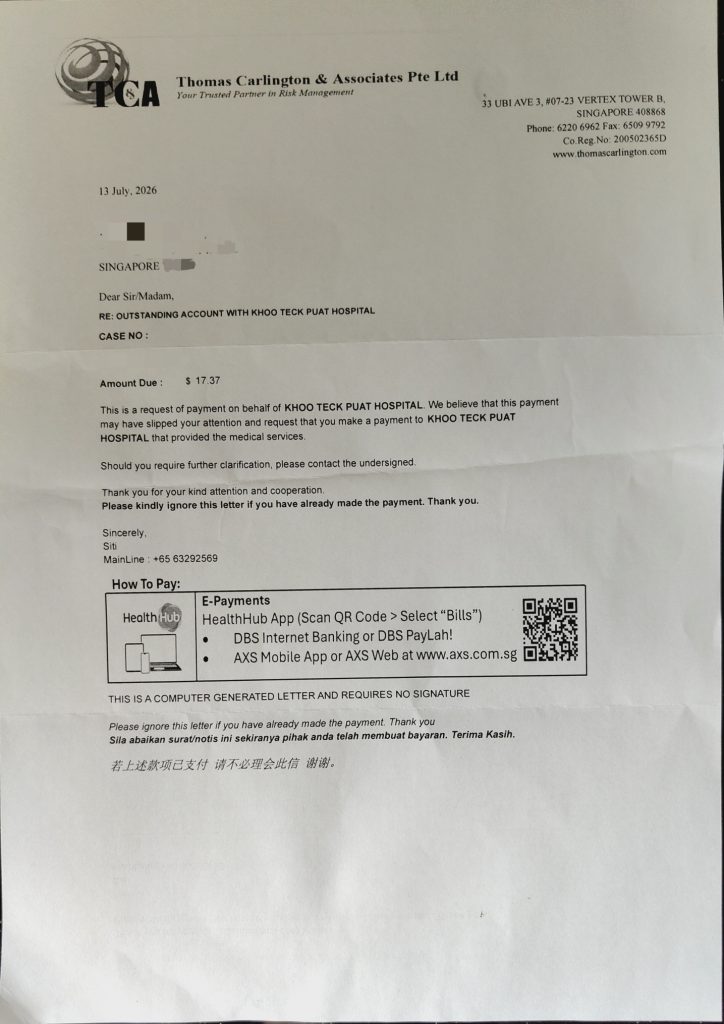
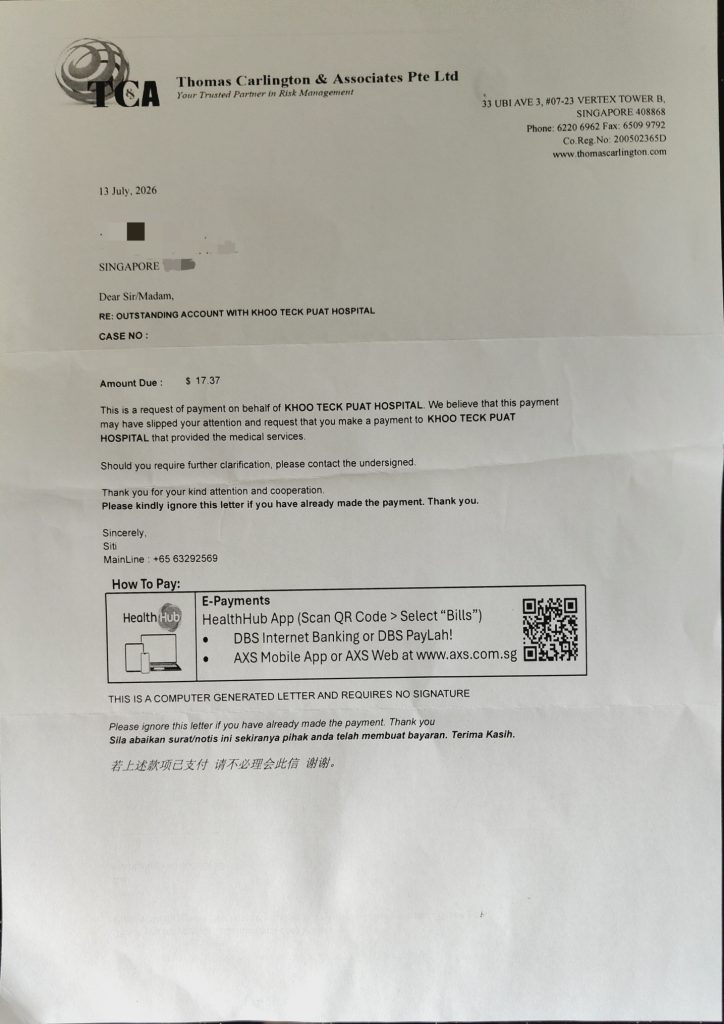
The reader has now received a debt-recovery advice note dated 13 July 2026 from Thomas Carlington & Associates Pte Ltd, regarding an alleged outstanding account with Khoo Teck Puat Hospital.
The amount pursued is:
S$17.37
The letter states that the request for payment is made on behalf of Khoo Teck Puat Hospital and suggests that the payment may have “slipped” the patient’s attention.
But according to the reader, the payment had not simply been forgotten.
The bill had already been actively disputed.
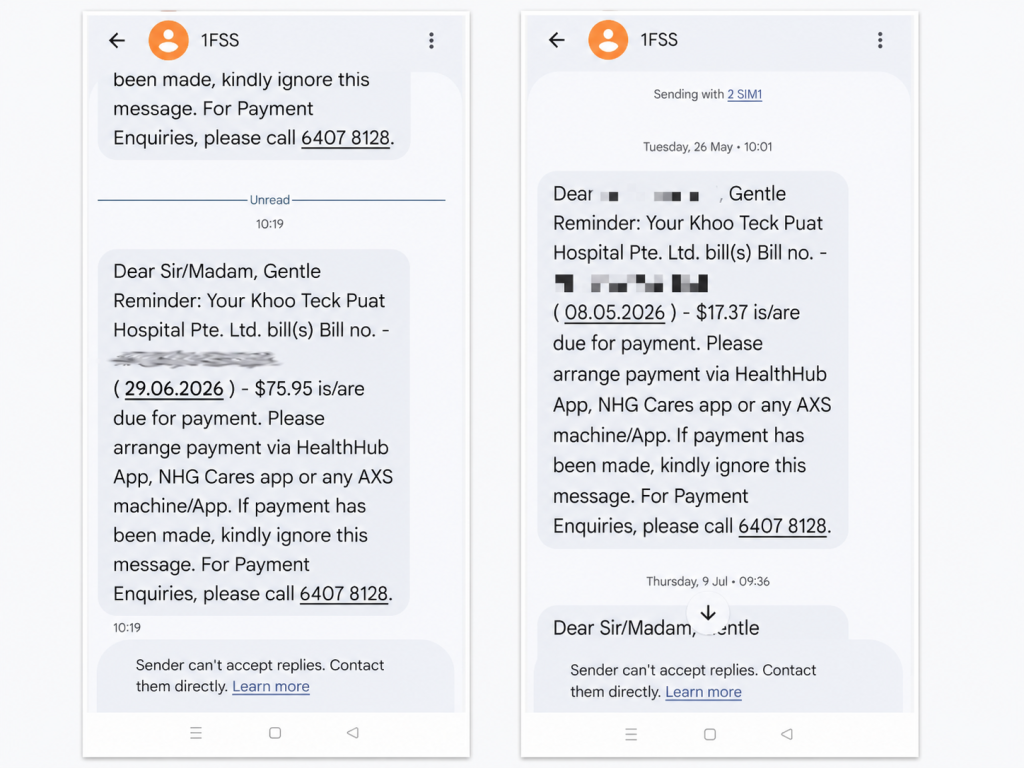
The family had submitted its financial-assistance documents, followed instructions given by hospital personnel, sent reminders and repeatedly sought clarification over whether the consultation should have been subsidised or whether the patient had been wrongly channelled into a private pathway.
That distinction is important.
There is a major difference between:
- a patient who ignores an undisputed bill; and
- a financially assisted patient who has repeatedly sought resolution of a disputed charge arising from an allegedly inappropriate referral pathway.
When a disputed healthcare charge is transferred to a debt-recovery company before the underlying financial-assistance and referral questions have been properly reconciled, the issue is no longer merely an unanswered email or a slow billing adjustment.
It becomes a question of institutional governance.
The debt-recovery letter appears to treat the matter as an ordinary overdue payment. Yet the reader’s account suggests that the central issue is whether the charge should have arisen in the first place.
This raises several serious questions:
Did Khoo Teck Puat Hospital’s billing department know that the invoice was disputed?
Were the patient’s ComCare documents and previous correspondence visible to the department that initiated debt recovery?
Was the matter reviewed by Medical Social Services or the relevant financial-assistance team before it was escalated externally?
Was the patient warned that the disputed amount would be sent for debt recovery while clarification was still outstanding?
Does Khoo Teck Puat Hospital have a formal hold process that prevents disputed financial-assistance cases from progressing automatically into collection activity?
The concern is not simply the amount.
S$17.37 may appear minor to an institution.
For a financially distressed family, receiving a formal debt-recovery letter can cause disproportionate anxiety. It can create fears about credit consequences, legal escalation and further costs, even where the patient had already tried repeatedly to resolve the issue.
It is also troubling that the collection process appears more integrated than the assistance process.
The hospital’s systems were able to:
- retain the outstanding invoice;
- generate repeated reminders;
- escalate the account;
- appoint an external debt-recovery company;
- and issue payment instructions.
Yet the same ecosystem apparently could not ensure that:
- the ComCare letter reached the correct decision-maker;
- the disputed referral pathway was reviewed;
- the earlier promise that the amount would be “taken care of” was honoured;
- or the patient received a clear written explanation.
In other words:
The system appears highly efficient at pursuing S$17.37, but far less effective at determining whether the financially assisted patient should have been charged S$17.37 at all.
That imbalance deserves attention.
The reader also says hospital personnel subsequently acknowledged that financially constrained patients should not be referred into private practices without clear disclosure and consideration of subsidised alternatives.
If that is accurate, the next step should not have been debt recovery.
It should have been reconciliation.
A proper review should establish:
- what referral was issued;
- whether the service was subsidised or non-subsidised;
- what the family was told before treatment;
- whether the referring team knew about the family’s assistance status;
- whether a suitable subsidised alternative was available;
- why earlier staff assurances did not result in the invoice being adjusted;
- and why a disputed bill was referred to an external debt-recovery company before those issues were resolved.
The public-interest question is therefore not whether Khoo Teck Puat Hospital is legally entitled to recover valid debts.
Of course it is.
The question is whether a public healthcare institution should first establish that a charge is valid, properly disclosed and consistent with the patient’s financial-assistance circumstances before escalating that charge against a vulnerable family.
That is not merely compassionate administration.
It is basic procedural fairness.
Case Two: A subsidy may exist—but can vulnerable families realistically navigate it?
A second reader shared an experience involving her elderly father’s motorised mobility scooter.
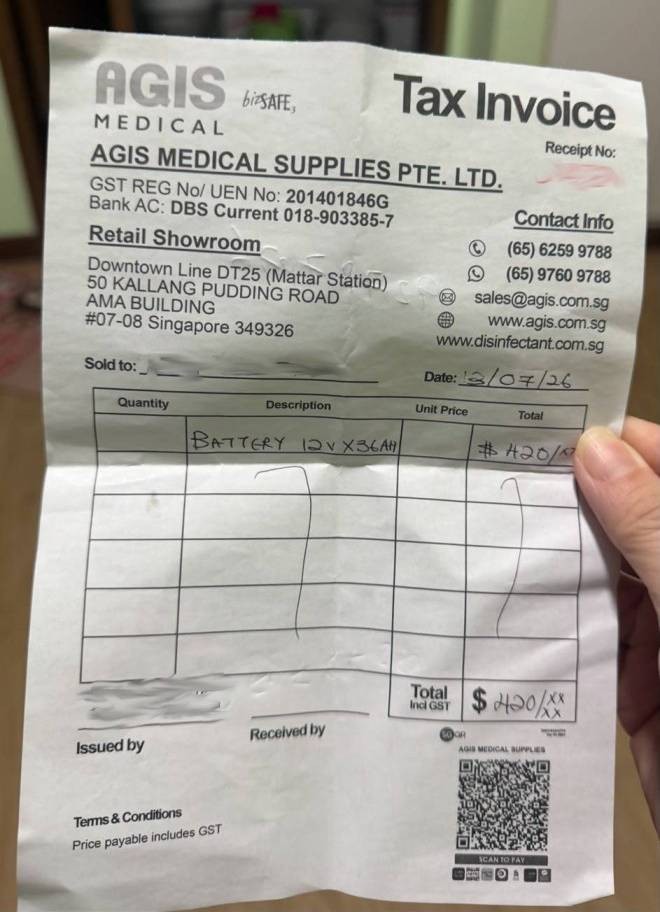
The family says the scooter had originally been obtained through a retail pharmacy at Khoo Teck Puat Hospital. When its battery failed, the father called the telephone number displayed on a sticker attached to the device.
A representative attended and replaced the battery.
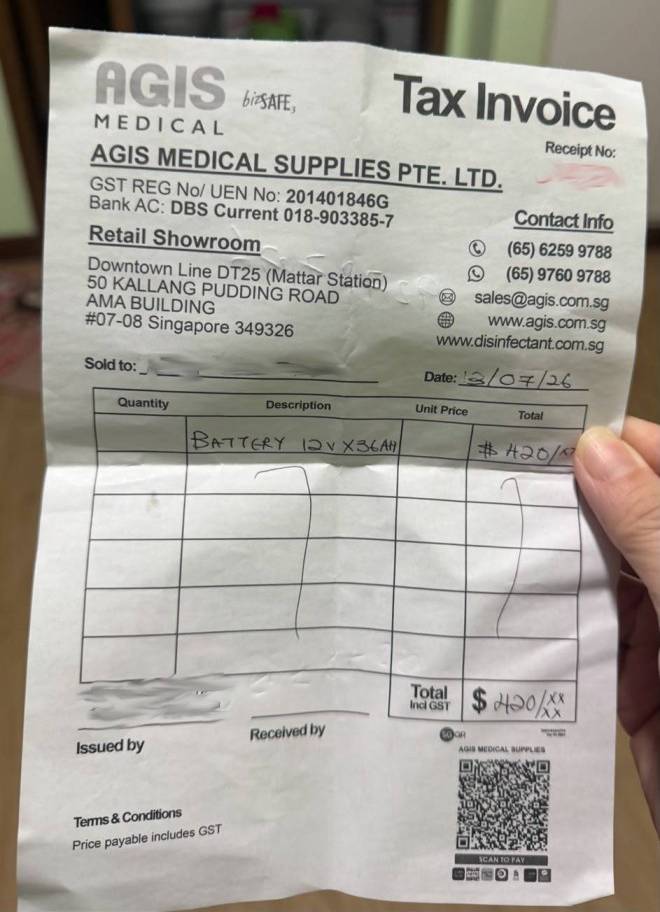
The invoice supplied by the family records a charge of S$420 for a 12V 36Ah battery.
The daughter later discovered that a subsidy pathway may have been available through the Agency for Integrated Care’s Seniors’ Mobility and Enabling Fund, or SMF. The scheme can cover replacement batteries for eligible motorised mobility devices, subject to conditions such as means testing, prior approval and the applicable replacement period.
On paper, the policy may appear clear.
For an elderly person and his caregiver dealing with a broken mobility device, however, the pathway is far from simple.
The family may be expected to determine:
- whether the scooter was originally funded under SMF or another scheme;
- whether the replacement period had elapsed;
- whether a new assessment was required;
- which healthcare professional should submit the application;
- whether approval must be obtained before purchase;
- which supplier is acting under the subsidised scheme;
- and whether a commercial purchase would prevent later reimbursement.
These distinctions may be familiar to AIC, hospital staff, therapists, medical social workers and appointed suppliers.
They are unlikely to be obvious to an elderly patient experiencing cognitive decline or to a caregiver urgently trying to restore his mobility.
That is the central issue.
The existence of a subsidy does not automatically mean that the intended beneficiary can access it.
The family should not be expected to interpret the system alone
According to the reader, her father simply wanted the scooter repaired.
He called the number displayed directly on the device because that appeared to be the official and most immediate route for assistance.
He was not in a position to distinguish confidently between:
- a commercial vendor;
- an AIC-appointed supplier;
- a hospital-linked service provider;
- and a subsidised application channel requiring prior approval.
When families raise questions about such transactions, the appropriate response from institutions familiar with the policy should not be to redirect them repeatedly or state that the matter belongs elsewhere.
The authorities, hospital departments and appointed suppliers already understand how the scheme operates.
The family does not.
Those with institutional knowledge should therefore help reconstruct the pathway:
- identify how the original device was funded;
- check whether the patient was eligible for a replacement subsidy;
- determine whether prior approval was required;
- explain what information the vendor gave before proceeding;
- establish whether a lower-cost official route was reasonably available;
- and coordinate a fair resolution where the family was inadequately informed.
That is what an integrated care system should do.
A potentially tenfold difference deserves active assistance
The family was charged S$420.
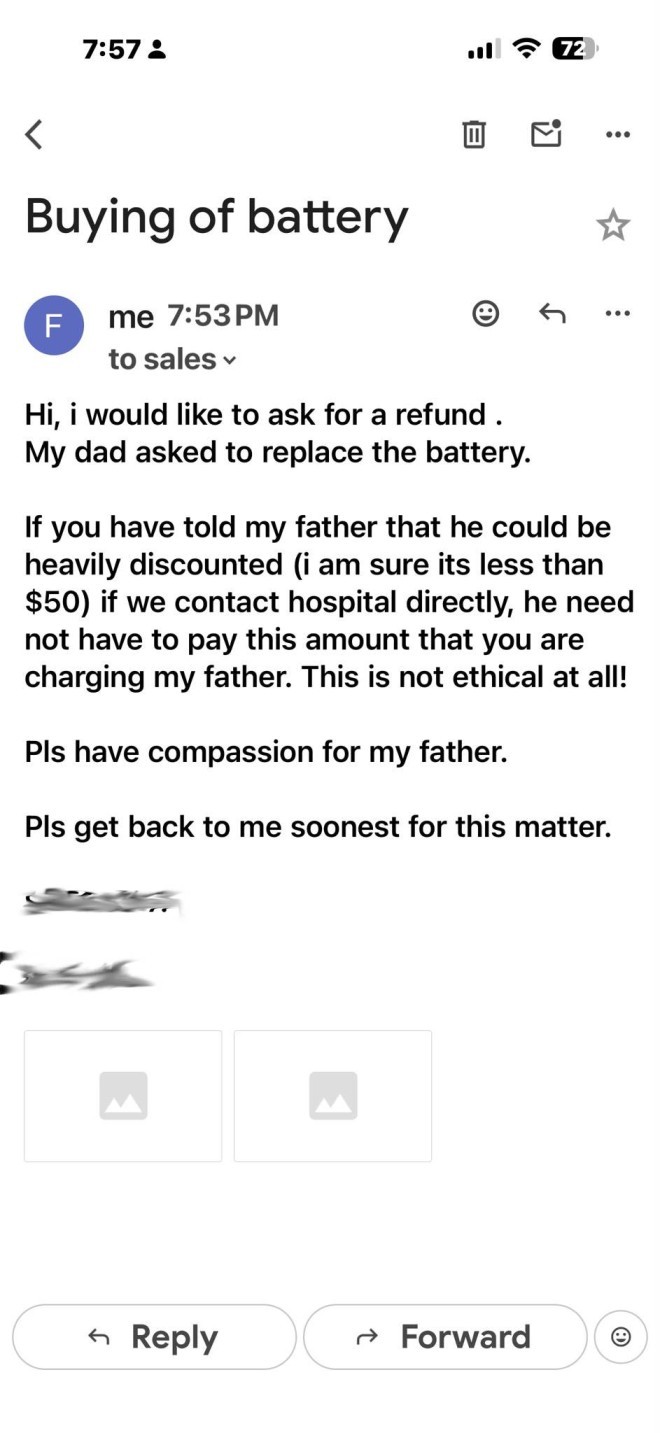
The daughter says she later learned that the patient’s share might have been approximately S$42 if a 90% subsidy had applied.
That comparison is mathematically plausible, although the patient’s actual entitlement still needs to be confirmed.
The difference is significant enough that the institutions involved should not treat the complaint as an ordinary commercial disagreement.
For a vulnerable senior, the distinction between S$42 and S$420 may determine whether he can afford medication, food, transport or other daily necessities.
When such a discrepancy is raised, the response should be:
“Let us check the patient’s records, eligibility and the transaction pathway.”
It should not be:
“Please contact another department.”
Nor should it be:
“The purchase has already been made, so nothing can be done.”
The requirement for prior approval may be administratively necessary. But where an elderly patient may have entered the wrong pathway because the system failed to provide clear information, the institutions involved should examine whether an adjustment, refund or ex gratia resolution is appropriate.
Policy should protect vulnerable people.
It should not become a technical reason for refusing to help after the protection has failed.
The sticker effectively determined the pathway
The telephone number pasted onto the scooter is not a minor detail.
For the elderly user, it became the service system.
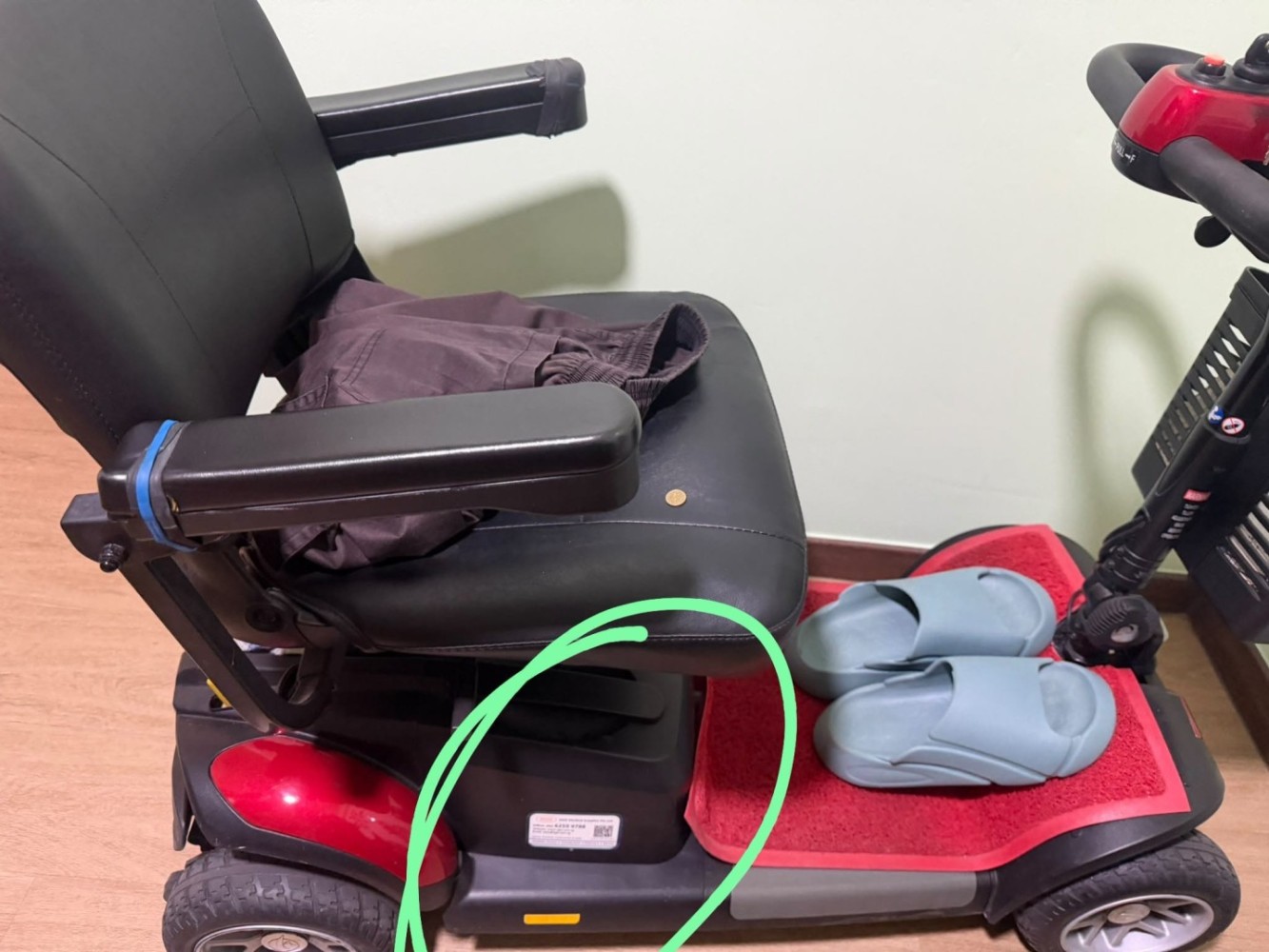
When the device failed, he did what most people would reasonably do: he called the number placed directly in front of him.
If that number routed him immediately to a full-price commercial transaction, without also explaining the subsidised pathway, then the service design placed the burden on the least equipped person to make the most consequential decision.
A more responsible system would ensure that the sticker clearly distinguishes between:
- urgent technical support;
- full-price commercial servicing;
- and the hospital or AIC route for subsidy assessment.
An appointed supplier receiving such a call should also be required to ask basic questions before proceeding:
- Was the device originally subsidised?
- Is the caller an elderly or vulnerable user?
- Has a caregiver been informed?
- Has the caller been told that prior approval may be necessary?
- Does the caller wish to check subsidy eligibility before authorising the work?
This need not be complicated.
A short disclosure script and a visible official hotline could prevent families from unknowingly losing access to substantial assistance.
The role of AIC and the hospital is to help reconcile the case
AIC’s published framework shows that a formal subsidy route exists and that a hospital therapist or medical social worker may assist with an application.
The family’s complaint therefore deserves more than referral from one organisation to another.
AIC, Khoo Teck Puat Hospital and the supplier should jointly establish:
- the device’s funding history;
- the patient’s eligibility;
- the applicable replacement period;
- what the patient and caregiver were told;
- why the full commercial route was used;
- and whether the transaction can now be fairly resolved.
The family should not be expected to act as an investigator between institutions that already possess the relevant records, policy knowledge and contractual relationships.
A vulnerable patient sees one care ecosystem.
He does not see separate organisational charts.
The larger lesson
Government assistance schemes are often designed with detailed eligibility rules, approval processes and safeguards.
Those controls are necessary.
But complexity has a human cost.
The more difficult a policy is to understand, the greater the responsibility on those administering it to guide people through it.
When a patient or caregiver raises a credible concern, public-service organisations should not focus first on identifying why another party is responsible.
They should focus on identifying who can solve the problem.
The citizen should not need to understand the entire system before the system agrees to help.
A subsidy is not successful merely because it exists in policy documents.
It succeeds when the intended beneficiary is clearly informed, properly guided and able to receive the support before an avoidable financial burden is imposed.
And when that guidance fails, the duty of the institutions involved should be to assist and reconcile—not to deflect.
What has not been established
The reader expressed concern that a vendor might charge the patient the commercial amount and then separately claim a government subsidy.
No evidence supplied to me establishes that this happened.
There is also no evidence presently establishing that hospital employees received money, shared proceeds with a contractor or deliberately directed patients into a more expensive pathway.
Those are serious allegations and should not be presented as facts without records.
But the absence of proven wrongdoing does not eliminate the need for scrutiny.
The price difference, unclear referral channel and vulnerability of the customer are sufficient reasons to examine whether safeguards are working.
An audit is not a declaration of guilt.
It is how responsible institutions determine whether systems, money and incentives are operating as intended.
Why AGO should consider a thematic audit
Healthcare represents one of Singapore’s largest areas of public expenditure. MOH’s initial FY2025 operating expenditure estimate was S$18.8 billion.
Where substantial public money intersects with:
- subsidies;
- vulnerable beneficiaries;
- hospital procurement;
- private contractors;
- subcontractors;
- repair and maintenance services;
- financial assistance;
- billing;
- and debt recovery,
the control environment should be exceptionally clear.
AGO is empowered to examine public bodies and the administration of public funds, including whether there have been financial irregularities, excess, extravagance, gross inefficiency or inadequate preventive controls. It also accepts information concerning potential loss of public funds, suspected fraud and procurement non-compliance.
A thematic audit could examine the complete patient-and-vendor journey across more than one public healthcare institution.
It should ask:
- Are patients informed clearly and in advance whether they are entering subsidised or non-subsidised care?
- Are referring institutions required to check financial-assistance status before directing patients to higher-cost services?
- Do contractors disclose subsidised alternatives before selling commercial services to eligible seniors?
- Are patient payments reconciled against any subsidy claims made for the same equipment or service?
- Can vendor systems technically prevent duplicate recovery from both patients and public schemes?
- Are hospital retail outlets, vendors and maintenance contractors operating under consistent scripts and rules?
- Who approves service stickers and hotline information placed on subsidised equipment?
- How many complaints involving incorrect pathways, unexpected private charges or vulnerable seniors have been received?
- How often are refunds or adjustments made after complaints?
- Why are unresolved cases transferred to debt recovery before disputed financial-assistance issues are reconciled?
The review should sample actual transactions, not merely ask institutions whether written policies exist.
Policies almost always look satisfactory on paper.
The failures occur in telephone calls, referrals, invoices, stickers, database classifications and handovers between departments.
AGO, AGC and CPIB have different roles
Precision matters.
AGO is the appropriate body for auditing the handling of public funds and controls.
AGC advises and represents the Government and exercises prosecutorial functions through the Attorney-General’s role as Public Prosecutor.
Where credible information suggests bribery, kickbacks or corrupt benefits, CPIB is the only agency authorised to investigate corruption offences in Singapore. It can also examine procedural loopholes uncovered during investigations.
Public commentary should not collapse poor service, weak controls, aggressive sales practices and corruption into one accusation.
They are different problems requiring different evidence and different institutions.
But neither should uncertainty become an excuse to do nothing.
Outsourcing work does not outsource public duty
A hospital may outsource equipment maintenance.
It may use external vendors.
It may appoint debt collectors.
It may operate commercial services alongside subsidised care.
None of these arrangements is inherently improper.
But the public institution cannot outsource its obligation to protect vulnerable patients from avoidable confusion and foreseeable harm.
When a contractor interacts with a senior because of a product purchased through a public hospital, the public-facing experience remains connected to that hospital.
When a debt collector pursues a disputed healthcare bill, the patient does not experience an abstract corporate arrangement.
The patient experiences the public healthcare system.
Outsourcing may change who performs the work.
It must not change who remains accountable.
Trust leaks through the gaps
Environmental waste leakage occurs when no one takes responsibility for what happens between production, collection, transport, processing and final disposal.
Institutional trust leaks in much the same way.
The referral team says billing is not its responsibility.
Billing says the service was private.
The private service says it followed the referral.
The contractor says the customer agreed to the price.
The agency says the complaint belongs elsewhere.
Every participant may have followed a narrow process.
Yet the citizen is still harmed by the overall outcome.
That is why integration cannot be measured by whether each department complied with its own checklist.
It must be measured by whether the entire system produced a fair result.
Restore the work ethic behind the policy
Readers often tell me that Singapore has lost some of its kampung spirit.
Perhaps the greater concern is that we are also losing the spirit of ownership at work.
The instinct to say:
“This may not technically sit under my department, but I will help ensure it reaches the right person and is resolved.”
Rejecting or redirecting a complaint is administratively easy.
Reconciling it requires effort.
It requires someone to retrieve the records, call the hospital, contact the contractor, compare the charges, examine subsidy eligibility and return with a reasoned answer.
That is not an inconvenience standing in the way of public service.
That is public service.
The outcome we should seek
This article is not asking AGO, MOH, KTPH, AIC or any other institution to assume guilt.
It is asking them to establish the facts.
The family should receive:
- a clear explanation of the subsidy pathway;
- confirmation of whether the S$420 charge was properly disclosed;
- clarification of whether a lower subsidised option was available;
- a review of whether the customer’s cognitive vulnerability was considered;
- and, where appropriate, a refund or price adjustment.
The public should receive:
- transparent vendor rules;
- safeguards against duplicate claims;
- clear stickers and hotline information;
- proper referral controls;
- and independent assurance that subsidies are reaching the people Parliament intended to benefit.
A well-designed subsidy that fails at the final metre is still a failed subsidy.
Singapore does not strengthen regional trust by insisting that its systems are already excellent.
It strengthens trust by examining credible weaknesses openly, correcting them quickly and protecting those least able to protect themselves.
That is leadership.
And that is how trust is earned.
P.S. — Who sits behind the collection letter?
After receiving the debt-recovery notice, the reader asked me to look into the company behind it, suggesting that there might be more to understand about how public-sector and private-sector relationships intersect.
Publicly available information identifies Thomas Choo as Chairman and Chief Executive Officer of Thomas Carlington & Associates. His professional profile also records a past directorship involving SESAMi and Abecha from 2001 to 2011, while another portion describes him as a director and shareholder of SESAMi. The present status of that latter relationship should be independently confirmed rather than assumed.
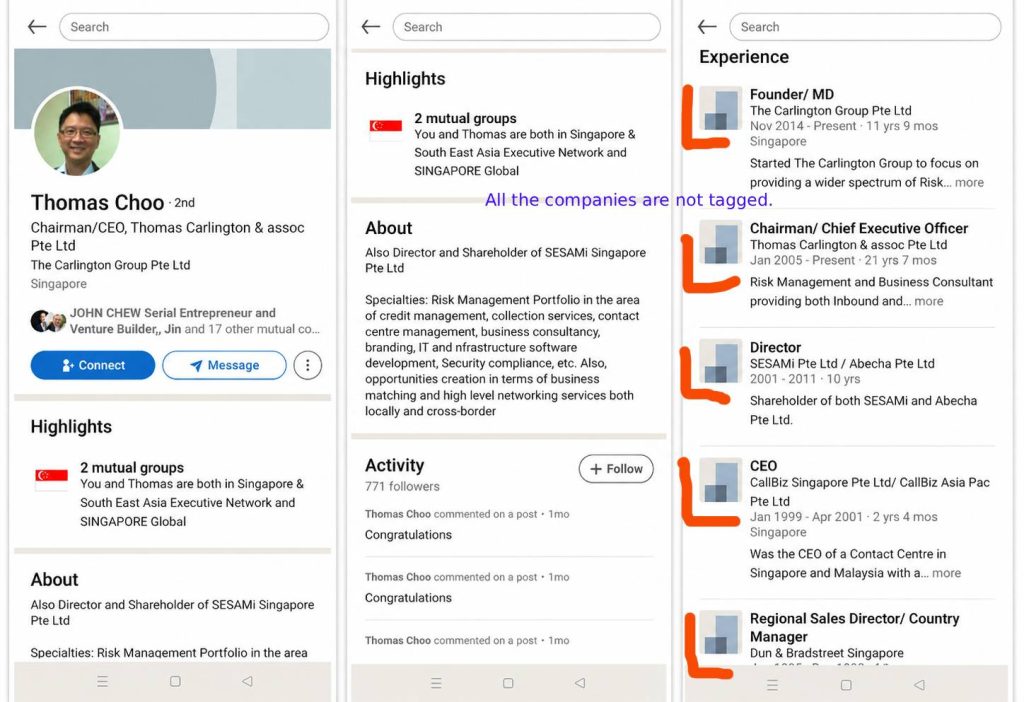
SESAMi is an established private e-procurement and e-marketplace provider used by large Singapore organisations. Public records also indicate that it has previously secured public-sector procurement work, including contracts involving the Accountant-General’s Department and the Defence Science and Technology Agency. Abecha’s own corporate history describes links with SESAMi, Microsoft, Intraco and, historically, JTC Corporation.
This does not establish nepotism, related-party dealing or an improper award.
Nor does it prove that these earlier business relationships had anything to do with the decision to appoint Thomas Carlington & Associates to pursue this particular S$17.37 account.
But it does reinforce the need for transparency.
The relevant questions are:
How was the debt-recovery firm selected?
Was the appointment made through an open tender, quotation exercise, panel arrangement or direct appointment?
What conflicts-of-interest declarations were required?
What due diligence was undertaken regarding common directors, shareholders, former business relationships and public-sector connections?
What instructions were given about disputed medical bills involving ComCare or other financial-assistance cases?
Does the contractor receive a fixed fee, a percentage of recovery, or another form of incentive?
Was the debt collector informed that the underlying charge was already disputed?
These questions do not presume misconduct.
They are ordinary governance questions whenever public institutions outsource sensitive work affecting vulnerable citizens.
The troubling point is not that an experienced businessperson has held several directorships or worked with prominent organisations. That is common in Singapore’s closely connected commercial environment.
The concern arises when citizens cannot see how those connections are governed.
A procurement system should be able to demonstrate—not merely assert—that appointments are based on merit, value, appropriate controls and the absence of undisclosed conflicts.
Until the relevant institutions explain the appointment and escalation process, the responsible interpretation is neither “nothing to see here” nor “nepotism proven.”
It is:
There is enough public-interest concern to justify disclosure, reconciliation and independent scrutiny—but not enough evidence to accuse individuals of corruption or favouritism.
That distinction matters.
Trust is protected not by speculation, but by transparent records that make speculation unnecessary.
#166 当补贴无法惠及弱势群体:为何公共医疗机构与供应商的关系值得接受独立审计
外包可以转移工作,但绝不能转移责任
外包经常被宣传为一种解决方案。
它据说能够降低成本、引入专业能力,并让公共机构专注于自身的核心职责。
然而,外包也可能成为一种方便的方式,把责任从视线中移走。
承包商把问题推给医院。
医院让病人去找承包商。
政府机构表示,这件事属于另一个组织负责。
投诉获得确认后,又被转介、退回或拒绝。
最终,承担代价的,往往是最缺乏金钱、影响力,也最没有能力理解和穿梭于复杂制度之间的人。
这就像富裕经济体把废弃物出口到其他国家,再宣称自己的环境十分整洁。问题并没有消失,只是被转移给了权力更小、反抗能力更弱的人。
新加坡是东盟创始成员国之一,也经常以区域治理、可持续发展和制度能力的领导者自居。
但区域领导力必须从国内开始。
如果一个国家一方面要求东南亚防止塑料和废弃物流入跨境水域、海洋和生态系统,另一方面却允许责任在本国医院、承包商、分包商和政府机构之间不断“渗漏”,那么这种领导力便难以令人信服。
两名读者的经历提出了一些值得认真回答的问题。
我们需要的不是假设、指控,或又一次只有同理心、却没有解决方案的回应。
案例一:受补贴病人被引导至非补贴路径,随后还被交给追债公司
在上一篇文章中,我讲述了一户正在接受 ComCare 援助、经济困难家庭的经历。
这户家庭表示,政府牙科诊所把孩子转介到设于邱德拔医院内的牙科专科服务。
他们曾多次清楚说明,除非治疗获得政府补贴或费用豁免,否则家庭没有能力承担私人医疗费用。
然而,费用仍然产生了。
据这户家庭所述,不同工作人员后来给出了不同解释:
- 这是私人服务;
- 按照政策,费用必须支付;
- 有关部门会调查;
- 他们无需再采取行动;
- 之前的账单会获得处理。
然而,父亲和孩子的账单依然没有解决。
当补贴无法惠及弱势群体:为何公共医疗机构与供应商的关系值得接受独立审计
外包可以转移工作,但绝不能转移责任
外包经常被宣传为一种解决方案。
它据说能够降低成本、引入专业能力,并让公共机构专注于自身的核心职责。
然而,外包也可能成为一种方便的方式,把责任从视线中移走。
承包商把问题推给医院。
医院让病人去找承包商。
政府机构表示,这件事属于另一个组织负责。
投诉获得确认后,又被转介、退回或拒绝。
最终,承担代价的,往往是最缺乏金钱、影响力,也最没有能力理解和穿梭于复杂制度之间的人。
这就像富裕经济体把废弃物出口到其他国家,再宣称自己的环境十分整洁。问题并没有消失,只是被转移给了权力更小、反抗能力更弱的人。
新加坡是东盟创始成员国之一,也经常以区域治理、可持续发展和制度能力的领导者自居。
但区域领导力必须从国内开始。
如果一个国家一方面要求东南亚防止塑料和废弃物流入跨境水域、海洋和生态系统,另一方面却允许责任在本国医院、承包商、分包商和政府机构之间不断“渗漏”,那么这种领导力便难以令人信服。
两名读者的经历提出了一些值得认真回答的问题。
我们需要的不是假设、指控,或又一次只有同理心、却没有解决方案的回应。
案例一:受补贴病人被引导至非补贴路径,随后还被交给追债公司
在上一篇文章中,我讲述了一户正在接受 ComCare 援助、经济困难家庭的经历。
这户家庭表示,政府牙科诊所把孩子转介到设于邱德拔医院内的牙科专科服务。
他们曾多次清楚说明,除非治疗获得政府补贴或费用豁免,否则家庭没有能力承担私人医疗费用。
然而,费用仍然产生了。
据这户家庭所述,不同工作人员后来给出了不同解释:
- 这是私人服务;
- 按照政策,费用必须支付;
- 有关部门会调查;
- 他们无需再采取行动;
- 之前的账单会获得处理。
然而,父亲和孩子的账单依然没有解决。
他们正是政府政策声称要帮助的弱势群体。
最新发展更加令人不安
这名读者后来收到一封日期为 2026年7月13日 的追债通知。
信函来自 Thomas Carlington & Associates Pte Ltd,内容涉及一笔据称拖欠邱德拔医院的款项。
被追讨的金额是:
S$17.37
信函表示,有关付款要求是代表邱德拔医院提出,并称付款可能只是“未受到病人注意”。
但根据读者的说法,这笔账单并不是简单地被遗忘。
它早已受到正式质疑。
这户家庭已经:
- 提交经济援助文件;
- 按照医院工作人员的指示办事;
- 发出多次提醒;
- 反复要求确认有关诊疗是否应获得补贴;
- 询问病人是否从一开始便被错误引导至私人收费路径。
这项区别十分重要。
一个忽略无争议账单的病人,与一个已经多次寻求解决、并质疑自己被错误转介的受助病人,两者性质完全不同。
当一笔仍有争议的医疗费用,在经济援助资格和转介问题尚未妥善核实之前,便被移交给外部追债公司,问题便不再只是无人回复的电邮或缓慢的账单调整。
这已经成为一个机构治理问题。
追债信似乎把这件事当作普通逾期付款处理。
但根据读者提供的情况,真正的问题是:
这笔费用从一开始是否就应该产生?
因此,必须回答以下严肃问题:
- 邱德拔医院的账单部门是否知道这张账单正在受到质疑?
- 病人的 ComCare 文件和过去的通信记录,是否能够被启动追债程序的部门看到?
- 在向外部追债公司升级之前,医疗社会服务部门或相关经济援助团队是否审核过这宗个案?
- 在问题仍未厘清时,病人是否被告知有关费用会被转交追讨?
- 邱德拔医院是否设有正式的暂停程序,防止涉及经济援助争议的账单自动进入追债流程?
问题并不仅仅是金额。
对一家大型机构而言,S$17.37 或许微不足道。
但对一个经济困难家庭而言,一封正式追债信可能造成与金额极不相称的压力。
它可能令人担心:
- 是否会影响信用记录;
- 是否会出现法律升级;
- 是否会产生更多费用;
- 自己此前所作的解释和申诉是否完全没有被记录。
最令人不安的是,追债流程似乎比援助流程整合得更好。
医院系统能够:
- 保留未付款账单;
- 发出重复提醒;
- 升级账户;
- 委任外部追债公司;
- 发出付款指示。
但同一个系统却似乎无法确保:
- ComCare 援助信送到正确的决策者手中;
- 有争议的转介路径获得审核;
- 工作人员早前所说的“会处理好”真正兑现;
- 病人获得一份明确的书面解释。
换句话说:
系统在追讨 S$17.37 时极有效率,却在判断这名经济援助病人是否根本不应被收取 S$17.37 时,显得远没有那么有效率。
这种失衡值得关注。
读者还表示,医院人员后来承认,在没有清楚解释收费性质,也没有考虑补贴替代方案的情况下,不应把经济困难病人转介到私人诊疗路径。
如果这项说法属实,下一步本不应该是追债。
下一步应该是核对、协调与解决。
一次适当的审查应确认:
- 当时究竟发出了什么转介;
- 有关服务属于补贴还是非补贴性质;
- 家庭在治疗前获得了什么说明;
- 转介团队是否知道家庭的经济援助身份;
- 当时是否存在合适的补贴替代方案;
- 为什么工作人员早前的保证没有导致账单被调整;
- 为什么在这些问题解决之前,一笔有争议的账单已经被交给外部追债公司。
公共利益所关心的,并不是邱德拔医院是否有权追讨有效债务。
医院当然拥有这项权利。
真正的问题是:
公共医疗机构在对弱势家庭采取追债行动之前,是否应先确认收费有效、收费性质已被妥善披露,并且与病人的经济援助情况相符?
这不只是富有同情心的行政管理。
这是最基本的程序公平。
案例二:补贴或许存在,但弱势家庭真的有能力找到正确路径吗?
另一名读者分享了她年长父亲的电动代步车经历。
这户家庭表示,代步车原本是通过邱德拔医院内的一家零售药房取得。
当电池故障时,父亲拨打了贴在设备上的电话号码。
一名代表随后上门并更换了电池。
家属提供的发票显示,一枚 12V 36Ah 电池收费 S$420。
女儿后来发现,父亲可能能够通过护联中心(Agency for Integrated Care,简称 AIC)管理的乐龄行动与辅助器材基金(Seniors’ Mobility and Enabling Fund,简称 SMF)申请补贴。
有关计划可涵盖符合条件的电动代步设备更换电池,但必须符合一系列条件,包括:
- 家庭经济状况评估;
- 事前批准;
- 适用的更换周期;
- 医疗专业人员评估;
- 指定申请路径。
从政策文件来看,规则可能显得相当清楚。
但对一名代步车突然故障的老人及其照顾者而言,实际路径远没有那么简单。
家庭可能需要自行判断:
- 代步车原本是通过 SMF 还是其他计划资助;
- 更换期限是否已经届满;
- 是否需要重新评估;
- 应由哪一名医疗专业人员提交申请;
- 是否必须在购买之前取得批准;
- 哪一家供应商正以补贴计划身份提供服务;
- 一旦先按商业价格购买,是否会失去之后申请补贴的资格。
这些区别也许对 AIC、医院人员、治疗师、医疗社会工作者和获委任供应商而言十分熟悉。
但对一名认知能力正在下降的老人,或一名急于恢复父亲行动能力的照顾者而言,这些规则绝不显而易见。
这正是问题的核心。
补贴存在,并不等于目标受益人能够真正取得补贴。
家属不应被迫独自解释整套制度
根据读者的说法,她的父亲只想把代步车修好。
他拨打设备上清楚贴出的电话号码,因为在他看来,那就是最直接、最正式的求助方式。
他没有能力清楚区分:
- 一般商业供应商;
- AIC 委任供应商;
- 与医院有关联的服务商;
- 需要事前审批的补贴申请渠道。
当家属对这类交易提出疑问时,熟悉政策的机构不应反复把他们转介到别处,也不应只说事情属于另一个组织负责。
政府机构、医院部门和委任供应商都明白计划如何运作。
家庭并不明白。
因此,掌握制度知识的一方应主动协助重新梳理整个过程:
- 查明原有设备通过什么计划获得资助;
- 检查病人是否符合更换电池补贴资格;
- 确认是否需要事前批准;
- 解释供应商在进行更换前提供了什么信息;
- 确认当时是否存在合理可得的低成本官方路径;
- 如果家属没有获得充分信息,应协调一个公平的解决方案。
这才是一个整合医疗体系应当做的事情。
可能相差十倍的费用,值得机构主动协助
家庭支付了 S$420。
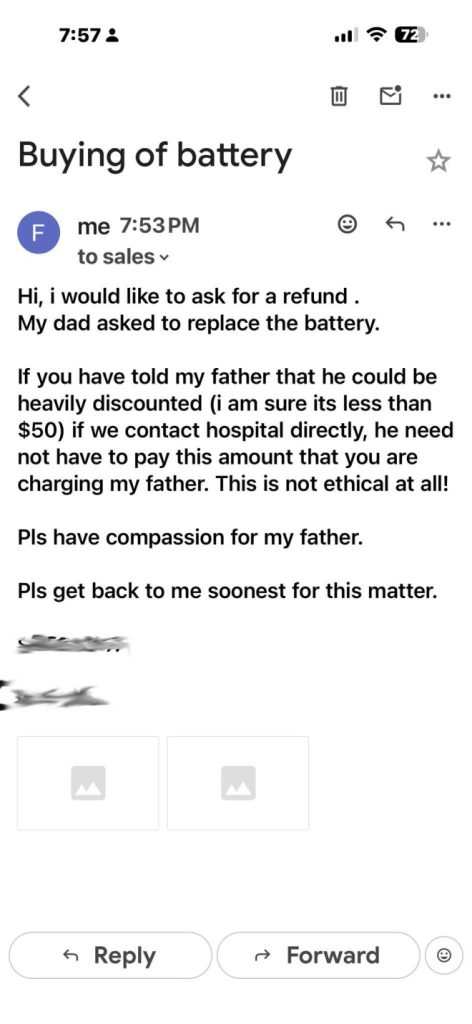
女儿表示,她后来得知,如果适用90%的补贴,病人的自付金额可能约为 S$42。
从数学上看,这项比较是合理的,但病人是否实际符合资格,仍需正式确认。
然而,金额差距如此巨大,相关机构不应把投诉简单视为普通商业纠纷。
对一名弱势老人而言,S$42 与 S$420 之间的差额,可能影响他是否有能力支付:
- 药物;
- 食品;
- 交通;
- 其他基本日常开支。
当家属提出这种差异时,机构的回应应该是:
“让我们检查病人的记录、资格和整个交易路径。”
而不应该是:
“请联系另一个部门。”
也不应该是:
“东西已经购买,所以我们无能为力。”
事前批准的要求或许具有行政必要性。
但如果老人因为制度没有提供清楚信息而走错路径,相关机构就应该研究是否可以作出:
- 费用调整;
- 退款;
- 善意补偿;
- 特别酌情处理。
政策的目的应该是保护弱势人士。
当保护机制失效后,政策不应反过来成为拒绝帮助的技术理由。
一张贴纸,实际上决定了老人走进哪条路径
贴在代步车上的电话号码,并非微不足道的细节。
对这名老人而言,那张贴纸就是整个服务系统。
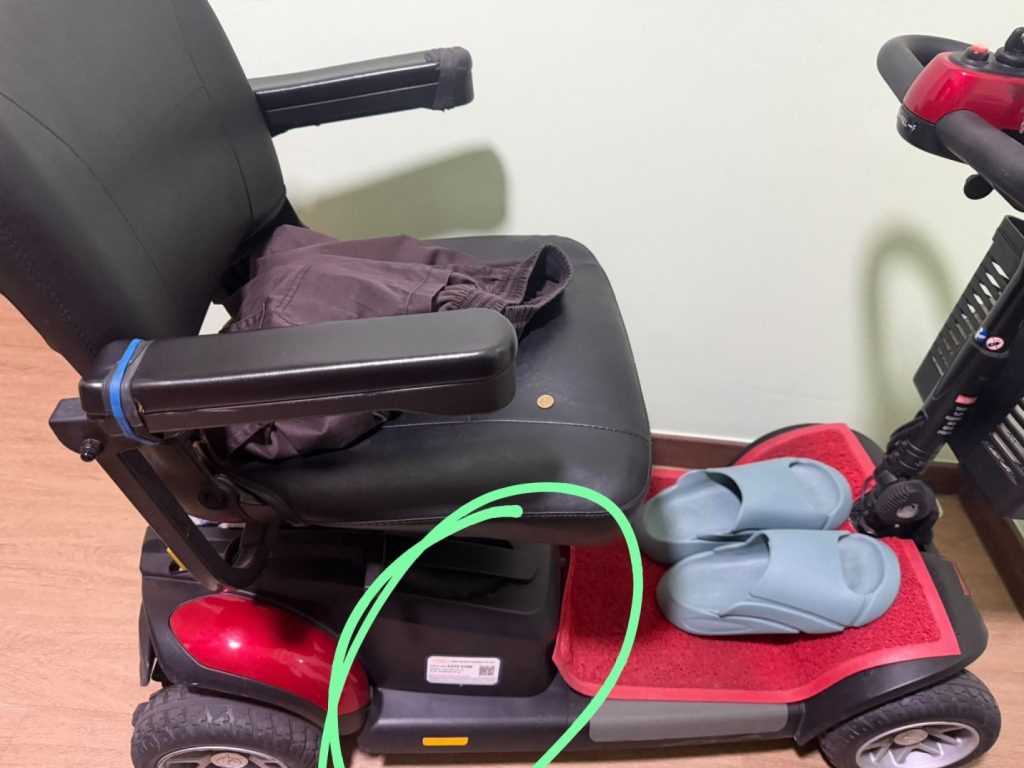
设备发生故障时,他做了大多数人都会做的事:
他拨打眼前的电话号码。
如果这个电话号码直接把他带入全价商业交易,却没有同时说明补贴路径,那么整个服务设计实际上把最重要的决定,交给了最缺乏能力判断的人。
一个更负责任的系统,应该确保贴纸清楚区分:
- 紧急技术支援;
- 全价商业维修;
- 医院或 AIC 的补贴评估渠道。
接到这类电话的委任供应商,也应在进行服务前提出几项基本问题:
- 设备原本是否获得补贴?
- 来电者是否为年长或弱势使用者?
- 照顾者是否知情?
- 使用者是否被告知可能需要事前批准?
- 使用者是否希望在授权维修前先检查补贴资格?
这些措施并不复杂。
一句简短的标准说明,以及一个清楚展示的官方热线,就可能防止家庭在毫不知情的情况下失去大额补贴。
AIC 和医院的责任应该是协助协调,而不是把问题推开
AIC 的公开政策显示,正式补贴渠道确实存在,而医院治疗师或医疗社会工作者也可以协助提出申请。
因此,这户家庭的投诉理应获得比“请联系另一家机构”更多的回应。
AIC、邱德拔医院和供应商应共同确认:
- 设备过去的资助记录;
- 病人的资格;
- 适用的更换周期;
- 病人和照顾者当时获得了什么说明;
- 为什么最终采用全价商业路径;
- 这笔交易现在是否可以获得公平解决。
家庭不应被迫在掌握相关记录、政策知识和合同关系的机构之间充当调查员。
一名弱势病人看到的是一个完整的照护生态系统。
他看不到,也不应该被迫理解每一家机构的组织图。
更大的教训
政府援助计划通常设有详细的资格条件、审批程序和保障措施。
这些控制当然必要。
但复杂性也会带来人性成本。
政策越难理解,负责管理政策的机构就越有责任主动引导公众。
当病人或照顾者提出可信的疑问时,公共服务机构首先考虑的,不应是解释为什么另一方才应该负责。
它们首先应考虑的是:
谁能够把问题解决?
市民不应该先理解整套制度,制度才愿意帮助他。
补贴的成功,并不只是因为它存在于政策文件中。
真正的成功,是目标受益人获得清楚告知、适当指引,并且在承受可避免的经济负担之前,真正获得援助。
而当指引失效时,相关机构的责任应该是:
协助与协调,而不是推卸与转介。
目前尚未获得证实的事项
读者担心,供应商可能一方面向病人收取商业价格,另一方面再向政府申请补贴。
目前提供给我的资料,并不能证明这种情况确实发生。
也没有证据显示医院员工:
- 收取了个人利益;
- 与承包商分享收益;
- 故意把病人引导到更昂贵的路径。
这些都是严重指控。
在没有交易记录、补贴申报和采购文件之前,不应把它们当成事实发表。
但没有证实违法行为,并不表示无需审查。
价格差异、含糊不清的服务路径,以及客户本身的脆弱性,已经足以让有关方面检查现有保障是否真正有效。
审计并不等于宣告有罪。
审计是负责任机构确认制度、资金和经济激励是否按照原意运作的方法。
为什么审计署应考虑进行专题审计
医疗保健是新加坡最大的公共支出领域之一。
卫生部2025财政年度最初的营运支出预算约为 S$188亿。
当大量公共资金同时涉及:
- 补贴;
- 弱势受益人;
- 医院采购;
- 私人承包商;
- 分包商;
- 维修和保养服务;
- 经济援助;
- 账单;
- 追债服务,
相关控制环境就必须格外清晰。
新加坡审计署(Auditor-General’s Office,AGO)有权审查公共机构和公共资金的管理情况,包括是否存在:
- 财务不当;
- 浪费;
- 过度支出;
- 严重低效率;
- 预防控制不足;
- 公共资金可能流失;
- 疑似欺诈;
- 采购不合规。
一次专题审计可以跨越多家公共医疗机构,审查从病人到供应商的完整流程。
审计应询问:
- 病人在进入补贴或非补贴治疗路径之前,是否获得清楚说明?
- 转介机构在把病人引导至较昂贵服务前,是否必须核实其经济援助身份?
- 承包商在向符合资格的老人销售商业服务前,是否必须披露补贴替代方案?
- 病人付款是否会与同一设备或服务的任何政府补贴申请进行核对?
- 供应商系统是否能够技术性防止同时向病人和公共计划重复收款?
- 医院零售点、供应商和维修承包商是否使用一致的说明和规则?
- 谁批准在补贴设备上放置服务贴纸和热线资料?
- 有多少投诉涉及错误路径、意外私人收费或弱势老人?
- 投诉后作出退款或价格调整的比例是多少?
- 为什么仍未解决的经济援助争议,会在核对前进入追债程序?
审查不应只是询问机构是否拥有书面政策。
政策在纸面上几乎总是看起来完整。
真正的问题通常发生在:
- 电话交谈;
- 转介过程;
- 发票;
- 设备贴纸;
- 数据库分类;
- 部门之间的交接。
AGO、AGC 与 CPIB 扮演不同角色
用词必须准确。
审计署(AGO)负责审查公共资金的使用和相关控制。
总检察署(AGC)负责向政府提供法律意见、代表政府,并通过总检察长作为公共检察官行使检控职能。
如果存在可信资料显示贿赂、回扣或腐败利益,则应由**贪污调查局(CPIB)**调查。CPIB 是新加坡唯一获授权调查贪污罪行的机构,也可以审查调查过程中发现的程序漏洞。
公共评论不应把以下问题混为一谈:
- 服务不佳;
- 控制薄弱;
- 过度积极的商业销售;
- 腐败行为。
这些是不同问题,需要不同证据和不同机构处理。
但不确定性同样不应该成为无所作为的借口。
外包工作,并不等于外包公共责任
医院可以把设备维修外包。
它可以使用外部供应商。
它可以委任追债公司。
它也可以同时经营补贴和商业性质的服务。
这些安排本身并不一定不当。
但公共机构不能把保护弱势病人免受可避免混乱和可预见伤害的责任一并外包。
当承包商因为一件通过公共医院取得的产品而与老人接触时,公众仍然会把这段体验与医院联系起来。
当追债公司追讨一张仍有争议的医疗账单时,病人感受到的并不是抽象的企业合同安排。
病人感受到的是整个公共医疗体系。
外包可以改变由谁执行工作,却不能改变最终由谁承担责任。
信任会从制度缝隙中流失
环境中的废弃物渗漏,往往发生在没有人愿意对生产、收集、运输、处理和最终处置之间的环节负责时。
机构信任也会以类似方式渗漏。
转介团队说,账单不属于自己的责任。
账单部门说,这是私人服务。
私人服务机构说,它只是按照转介办事。
承包商说,顾客已经同意价格。
政府机构说,投诉属于其他单位处理。
每一个参与者或许都遵守了自己狭义范围内的流程。
但市民仍然因为整体结果而受到伤害。
因此,制度整合不能只以各部门是否完成自己的检查清单来衡量。
它必须以整个制度是否产生公平结果来衡量。
恢复政策背后的工作责任感
读者经常告诉我,新加坡已经失去了一部分甘榜精神。
更大的忧虑也许是,我们正在失去工作中的责任感与主人翁精神。
也就是愿意说出这句话的本能:
“这件事在技术上也许不属于我的部门,但我会确保它转交给正确的人,并得到解决。”
拒绝或转介一宗投诉,在行政上十分容易。
真正协调解决,需要付出努力。
需要有人:
- 调取记录;
- 致电医院;
- 联系承包商;
- 比较费用;
- 检查补贴资格;
- 最后给家庭一个有依据的答案。
这并不是妨碍公共服务的不便。
这本身就是公共服务。
我们应该争取的结果
这篇文章并不是要求 AGO、卫生部、邱德拔医院、AIC 或任何其他机构预先假设有人有罪。
它要求这些机构确认事实。
有关家庭应该获得:
- 对补贴路径的清楚解释;
- 确认 S$420 的费用是否获得妥善披露;
- 说明当时是否存在更低成本的补贴方案;
- 审查交易时是否考虑到客户的认知脆弱性;
- 在适当情况下作出退款或价格调整。
公众则应该获得:
- 透明的供应商规则;
- 防止重复申领的保障;
- 清晰的设备贴纸和热线资料;
- 适当的转介控制;
- 独立确认补贴确实到达国会原本希望帮助的人。
一个设计完善、却在最后一米失效的补贴,仍然是失败的补贴。
新加坡不能靠坚持自己的制度已经十分优秀,来加强区域信任。
真正能够建立信任的,是公开检查可信的弱点、迅速纠正问题,并保护最没有能力保护自己的人。
这才是领导力。
这也是信任如何被赢得。
附言(P.S.):追债信背后是谁?
在收到追债通知后,读者要求我调查有关公司,暗示公共部门和私人企业之间的关系,可能还有更多值得了解之处。
公开资料显示,Thomas Choo 是 Thomas Carlington & Associates 的主席兼首席执行官。
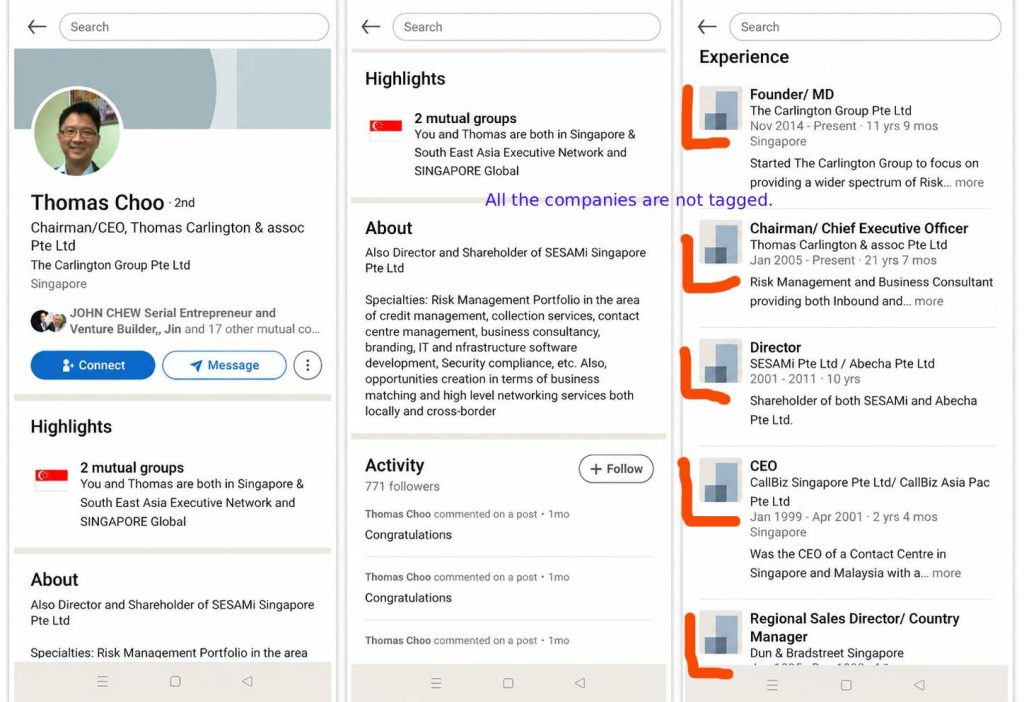
他的职业资料也显示,他曾于 2001年至2011年担任 SESAMi 和 Abecha 的董事;资料中的另一部分则称他是 SESAMi 的董事及股东。
后者目前是否仍属实,应独立核实,而不应直接假设。
SESAMi 是一家成熟的私人电子采购和电子市场平台供应商,为新加坡多家大型机构提供服务。
公开记录也显示,它过去曾取得公共部门采购项目,包括与会计总署及国防科技局有关的合同。
Abecha 的公司历史则提到其与 SESAMi、微软、Intraco,以及历史上的裕廊集团之间的联系。
这些资料不能证明存在裙带关系、关联方不当交易或不适当授标。
它们也不能证明这些早期商业关系,与 Thomas Carlington & Associates 获委任追讨这笔 S$17.37 账单有关。
但这些资料确实进一步说明了透明度的重要性。
公众有理由询问:
- 这家追债公司是如何获选的?
- 委任是通过公开招标、报价程序、供应商名单,还是直接委任?
- 有关人员需要作出哪些利益冲突申报?
- 针对共同董事、股东、过去商业关系和公共部门联系,进行了什么尽职调查?
- 承包商收到什么指示,以处理涉及 ComCare 或其他经济援助的争议账单?
- 承包商按固定费用、追款比例,还是其他奖励方式收费?
- 追债公司是否知道这笔医疗费用本来已经受到质疑?
这些问题并不预设存在不当行为。
每当公共机构外包一项影响弱势公众的敏感工作时,这些都是普通而必要的治理问题。
令人担忧的并不是一名经验丰富的商人曾担任多家公司董事,或曾与大型机构合作。
在新加坡紧密相连的商业环境中,这并不罕见。
真正的问题是,公众看不见这些关系如何受到治理。
一个完善的采购制度,应该能够通过记录证明,而不只是口头声称:
- 委任基于能力和价值;
- 适当控制已经落实;
- 不存在未披露利益冲突。
在相关机构解释委任和升级程序之前,负责任的解读既不是:
“这里没有任何问题。”
也不是:
“裙带关系已经获得证明。”
更准确的结论是:
目前已有足够的公共利益疑问,值得披露、协调与独立审查;但现有证据仍不足以指控任何个人涉及腐败或偏袒。
这项区别十分重要。
信任不是靠猜测获得保护,而是靠透明记录,让公众不再需要猜测。