
#163 Charity Deserves Reliable Technology Too — And So Do Public Services 慈善机构也值得拥有可靠的科技——公共服务亦然
What a food bank’s single point of failure and a library’s “haunted seat” reveal about digital resilience, dignity and trust
Technology does not have to be sophisticated to be important.
Sometimes, it is a barcode scanner recording groceries collected by a family in need.
Sometimes, it is a booking portal helping a student find a quiet place to study.
When these systems work, few people notice them.

When they fail, queues form, volunteers become frustrated, beneficiaries are made to wait, and members begin wondering whether Singapore’s digital transformation is genuinely improving daily life—or merely transferring old administrative problems onto new screens.
When one POS machine becomes the entire operation
Food from the Heart is an IPC-status food charity dedicated to alleviating hunger and food insecurity in Singapore. Its work is supported by donors, sponsors, staff and volunteers.
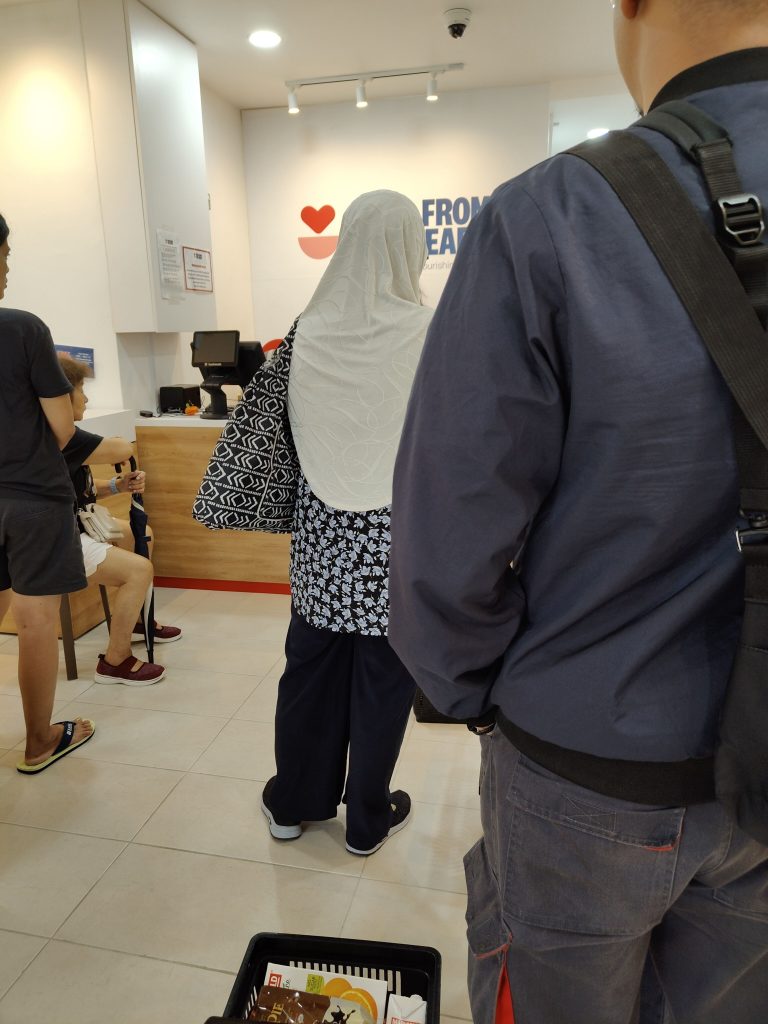
A reader recently shared an experience at one of its food-distribution points.
According to the reader, the operation appeared to depend on:
- one point-of-sale machine;
- one barcode scanner; and
- one receipt printer.
There was no apparent operational backup.
The equipment had reportedly experienced recurring disruptions over several weeks. Whenever an error occurred, the machine required a reset lasting about five minutes.
On one occasion, the interruption and troubleshooting process resulted in a wait of approximately 40 minutes before transactions could resume.
Forty minutes may not sound catastrophic in a corporate technology environment.
At a food-distribution point serving people who may already be experiencing financial stress, health problems, mobility difficulties or caregiving responsibilities, it matters.
It also affects volunteers who are trying to serve beneficiaries efficiently but have little control over the technology placed in front of them.
A person who appeared to be responding to the technical problem eventually arrived at the location. How that person looked or dressed is ultimately beside the point.
The more important question is:
Why did a routine equipment fault require physical intervention while the entire distribution process waited on one machine?
That is not redundancy.
That is a single point of failure.
Charity operations still require business continuity
Technology resilience should not be reserved for banks, airlines and multinational corporations.
Charities also manage important operations:
- beneficiary records;
- food allocations;
- inventory movements;
- transaction histories;
- receipts; and
- donor-funded resources.
When their systems stop working, the consequences extend beyond inconvenience.
Queues grow.
Volunteers lose productive time.
Beneficiaries may feel embarrassed or anxious.
Records may be delayed or entered incorrectly.
Donors may begin wondering whether sufficient operational controls exist over the resources they contributed.
Reliable technology is therefore not an administrative luxury.
It protects dignity, accountability and trust.
The solution does not need to be expensive
A practical fallback could be implemented using relatively modest technology.
A managed smartphone or low-cost tablet can scan barcodes through its camera. A secure browser-based or mobile application can record transactions. A portable Bluetooth or wireless printer can produce receipts.
The fallback system could include:
Offline processing
Transactions should continue when the internet connection or central server becomes temporarily unavailable.
Records can be placed in an encrypted local queue and synchronised once connectivity returns.
Cloud synchronisation
Authorised devices should access the same beneficiary, inventory and allocation records instead of depending on information stored inside one physical terminal.
Automatic recovery
When one device fails, an approved backup device should be able to resume the operation without requiring the entire queue to wait for technical support.
Clear audit trails
Every transaction should record the authorised user, time, items distributed and synchronisation status.
Simple recovery instructions
Volunteers should know when to restart the terminal, activate offline mode, switch to a backup device or escalate the problem.
They should not have to improvise while beneficiaries wait.
Allowing volunteers to use their personal phones indiscriminately would create privacy and security risks. Beneficiary information should not be stored casually on privately owned devices.
A better approach would involve organisation-managed devices, or a secure application with role-based access, no permanent personal storage and the ability to revoke access immediately.
The principle is straightforward:
The backup should be simple enough for volunteers to use, but secure enough for beneficiaries and donors to trust.
Then there is the National Library Board
A separate reader shared screenshots and photographs documenting a frustrating experience with the National Library Board’s study-seat booking system.
NLB provides an official online service for reserving seats in designated study areas. It is an agency under the Ministry of Digital Development and Information, which says that NLB’s libraries and archives aim to deliver more personalised and “omnichannel” learning experiences both in person and online.
The reader’s experience, however, appeared anything but seamless.
The “haunted seat”: available, unavailable—and apparently already booked
The problem was not merely that a preferred seat became unavailable.
That can happen when several people attempt to reserve the same place at approximately the same time.
The difficulty was that the system appeared to present contradictory information during the same booking journey.
In one sequence, the portal informed the reader that the original preferred seat was unavailable and invited the reader to choose another seat.
The system then displayed several alternatives—including S17, S24, S27, S28 and S30—as selectable options.
The reader selected S27.
The booking still could not be completed.
Instead, the system returned this message:
“Booking unsuccessful. Please cancel your existing booking before making another booking.”
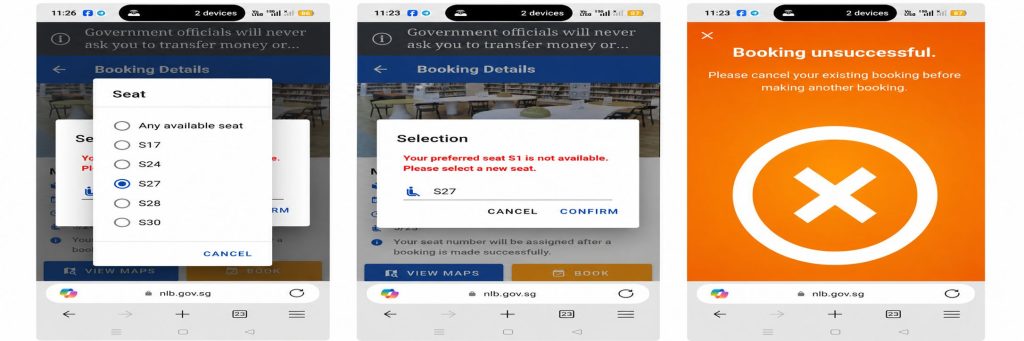
The reader did not recall creating an existing reservation.
That immediately generated a new set of questions.
Was there a booking the reader had forgotten?
Had a previously cancelled booking remained active?
Was an expired reservation still being retained?
Was another login session open?
Had someone else accessed the account?
Or was the system producing an inaccurate message because its records had not synchronised correctly?
The failure screen did not identify the alleged existing reservation.
It did not display:
- the library;
- seat number;
- reservation date and time;
- check-in status; or
- the time the booking was created.
Nor did it provide a direct way to view, cancel or report the supposedly existing booking.
The reader was simply told that one existed.
A trustworthy digital service should not leave the user to investigate its own allegation.
Available—until you try to book it
Another sequence involving Seat S17 was even more confusing.
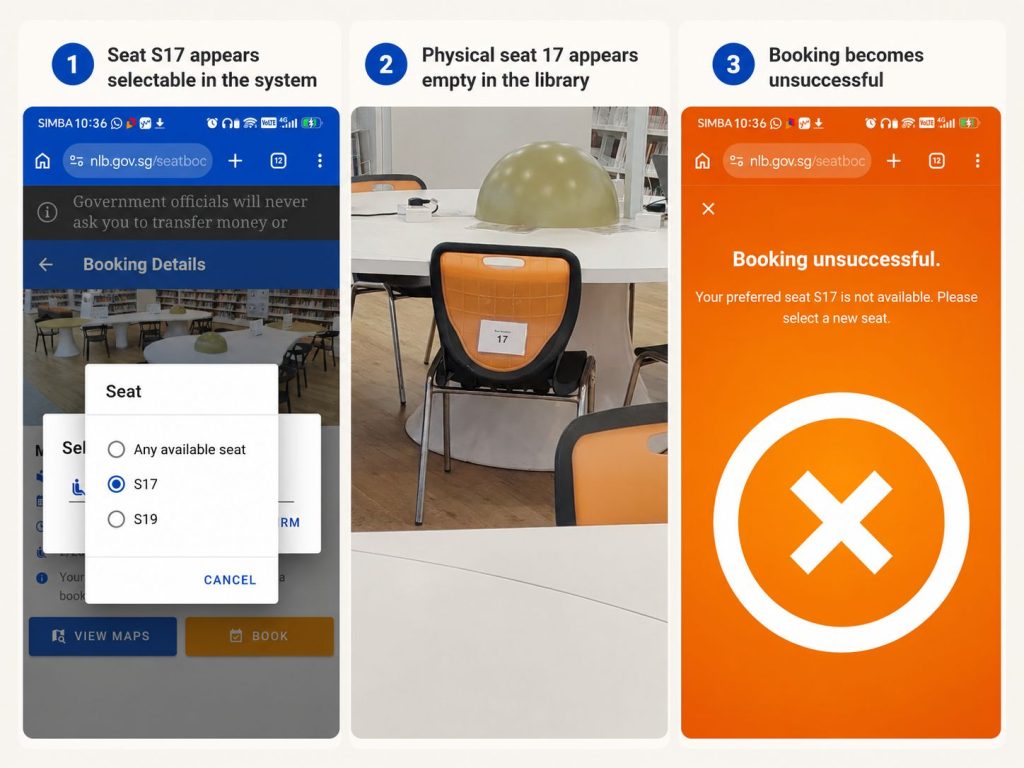
The problem was not merely that a preferred seat became unavailable.
The booking interface displayed S17 as an available option.
The reader selected it.
The next screen then stated:
“Booking unsuccessful. Your preferred seat S17 is not available. Please select a new seat.”
At the physical library, the chair marked 17 appeared empty.
An empty chair does not necessarily prove that the seat was unreserved.
The person who booked it may have been temporarily away.
The reservation may not yet have started.
The user may have failed to check in.
Or the seat may have been blocked for another operational reason.
But when the physical chair appears unused while the digital system alternately presents it as selectable and unavailable, the experience reasonably raises questions:
- Are physical occupancy and digital reservations synchronised?
- Are expired bookings released promptly?
- Is check-in required?
- Are no-shows removed automatically?
- Is availability refreshed before confirmation?
- Are different screens drawing from the same source of truth?
From the member’s perspective, S17 became something of a “haunted seat”:
Visible in the library.
Visible in the booking system.
Available on one screen.
Unavailable on the next.
Suggested caption for the S17 photographs and screenshots
Seat 17 appeared physically empty and digitally selectable, but the booking was subsequently rejected as unavailable. The photographs do not prove that it was unreserved—but they show why clearer real-time status and check-in rules are needed.
Error messages should resolve uncertainty—not create it
The supplied screenshots illustrate two distinct failure messages:
“Your preferred seat is not available.”
and
“Please cancel your existing booking before making another booking.”
These do not describe the same problem.
The first suggests that the chosen seat has become unavailable.
The second asserts that the reader already holds another reservation.
Each requires a different response.
Yet neither message gave the reader sufficient information to understand what had happened or what to do next.
A better “existing booking” message should immediately display:
- the library and seat involved;
- booking date and time;
- when the reservation was created;
- check-in status;
- a View booking button;
- a Cancel booking button; and
- a Report unrecognised booking option.
Similarly, when a seat displayed as available becomes unavailable after selection, the system should indicate whether:
- another member reserved it moments earlier;
- the availability data had not refreshed;
- the seat was temporarily blocked;
- the booking session expired; or
- a technical error occurred.
The purpose of an error message is to help a person recover from an error.
It should not merely announce failure.
Why ambiguous messages matter in a scam-conscious society
Singaporeans are frequently reminded to look out for compromised accounts, impersonation attempts, unauthorised transactions and scams.
Against that backdrop, being told that one has an “existing booking” that one does not recognise can naturally create anxiety.
The reader began wondering:
“Did I book something and forget?”
“Is the system showing old information?”
“Did someone gain access to my account?”
“Is this a technical error or an actual security concern?”
There is no evidence from the screenshots alone that the account was compromised.
A stale reservation, synchronisation delay or session problem may be a far more likely explanation.
But sound digital design should not force users to choose between assuming the system is defective and fearing that their account has been misused.
A visible booking history would resolve much of that uncertainty immediately.
Separate backend systems are not the real problem
NLB may use separate technical components for:
- membership authentication;
- catalogue access;
- digital borrowing;
- seat inventory;
- reservations;
- check-in;
- cancellations; and
- physical occupancy management.
That is normal.
Modern digital platforms often rely on multiple services and databases behind one interface.
The problem begins when users can see the gaps between those services.
A member should experience one coherent NLB service, even where numerous systems operate underneath it.
The member should not have to understand whether the booking page, account profile, branch inventory and check-in database are communicating properly.
That is the institution’s responsibility.
Backend complexity should remain invisible to the citizen.
NLB sits under MDDI, currently led by Minister Josephine Teo, whose portfolio includes digital development and Singapore’s Smart Nation strategy. Small frontline failures are therefore not too minor for leadership attention: they are where national digital ambitions become real—or frustrating—for ordinary users.
The practical improvements are straightforward
NLB could strengthen the booking experience through several practical measures.
Real-time availability checks
Seat status should be refreshed immediately before the final confirmation.
Visible booking history
When the system claims that an existing reservation is present, it should display that reservation rather than merely asserting its existence.
Automatic no-show release
Seats should return to the available pool when a member fails to check in within a reasonable period.
Simple check-in and check-out
QR codes or another lightweight check-in method could improve the relationship between physical occupancy and digital availability.
Clear seat states
The interface should distinguish between:
- available;
- reserved;
- occupied;
- temporarily away;
- blocked; and
- out of service.
Actionable failure messages
Every error should offer a clear next step.
One member-facing experience
Borrowing, reservations and study-seat management should be accessible through one coherent front end, even if separate services remain behind it.
None of this requires revolutionary artificial intelligence.
It requires dependable service design, operational ownership and testing of the complete member journey.
More people and more qualifications are not enough
Although Food from the Heart is a charity rather than a government agency, its operations sit within Singapore’s wider social-support landscape.
The broader social and family development portfolio is currently led by MSF Minister Masagos Zulkifli.
As the social-service sector grows, workforce numbers, degrees and professional certifications will remain important.
But qualifications establish only a baseline.
They cannot, by themselves, guarantee:
- empathy;
- emotional intelligence;
- respectful communication;
- practical judgement;
- ownership; or
- determination to bring a case to closure.
A person seeking food assistance, financial support or help navigating a public service may already be frightened, embarrassed, angry or exhausted.
The quality of the experience depends not only on whether the worker knows the correct policy.
It also depends on whether the person feels heard, respected and helped.
Technology cannot replace human empathy.
But weak technology should not consume the time and energy of volunteers and professionals who ought to be helping people.
Good service requires both:
Competent systems and compassionate humans.
What a food-bank terminal and library seat have in common
A malfunctioning food-bank POS terminal and an inconsistent library-seat portal may initially appear unrelated.
They are not.
Both demonstrate what happens when an organisation digitises a transaction without adequately designing for continuity, recovery and failure.
At the food bank, one malfunctioning device can stop an entire queue.
At the library, inconsistent system states can prevent a member from using an apparently vacant seat.
In both cases, frontline staff, volunteers and users absorb the consequences of systems they did not design and cannot repair.
That is why reliability is not merely a technical concern.
It is a form of respect.
Reliability is a form of respect
A food-bank beneficiary should not have to stand in a long queue because one terminal is restarting.
A volunteer should not have to apologise repeatedly for a system they cannot repair.
A student should not see rows of empty seats while the booking portal says none can be reserved.
A member should not be left wondering whether a confusing message indicates a minor technical fault or an account-security problem.
Digital transformation is not measured by the number of applications, websites, dashboards or portals an organisation launches.
It is measured by whether services remain usable when something goes wrong.
It is measured by whether systems communicate.
It is measured by whether users understand the next step.
And it is measured by whether an organisation has designed not only for the ideal transaction—but also for failure.
Charity deserves reliable technology too.
So do volunteers.
So do donors.
So do library members.
Most importantly, so do the people these technologies were created to serve.
Digitalisation without resilience creates fragile services.
Digitalisation without integration creates electronic silos.
Digitalisation without empathy merely makes frustration faster.
This article is also published on LinkedIn.
慈善机构也值得拥有可靠的科技——公共服务亦然
一台食物银行的单点故障设备,以及图书馆里一张“幽灵座位”,揭示了什么是数码韧性、尊严与信任
科技不一定要非常复杂,才会显得重要。
有时候,它只是一台条码扫描器,用来记录一个有需要家庭领取的食品。
有时候,它只是一个座位预约系统,帮助学生找到一个安静温习的地方。
当这些系统正常运作时,很少有人会特别留意。
但一旦系统出现故障,队伍便开始变长,义工感到无助,受助者被迫等待,公众也会开始怀疑:
新加坡的数码转型,究竟真的改善了我们的日常生活,还是只是把过去的行政问题搬到新的屏幕上?
当一台收银系统成为整个服务的命脉
Food from the Heart 是一家具有公益机构资格的本地食物慈善组织,致力于缓解新加坡的饥饿与粮食不安全问题。它的运作依赖捐助者、赞助商、员工与义工的共同支持。
最近,一名读者向我分享了他在其中一个食品发放点的经历。
据他观察,现场的整个流程似乎依赖于:
- 一台销售终端机;
- 一台条码扫描器;
- 一台收据打印机。
现场似乎没有可立即启用的备用系统。
据说,这套设备在过去数周反复出现故障。每当系统出错,就必须重新启动,而每次重启大约需要五分钟。
其中一次,故障和排查过程令整个办理流程停滞,读者最终等待了约四十分钟,交易才得以继续。
在大型企业的信息科技环境中,四十分钟或许听起来并不算灾难。
但对于一个服务经济困难人士的食品发放点而言,四十分钟绝非小事。
部分受助者可能同时面对:
- 经济压力;
- 健康问题;
- 行动不便;
- 照顾家人的责任。
这也让义工陷入尴尬。
他们希望有效率地帮助受助者,却无法控制摆在面前的设备,更无权修复它。
后来,一名看起来负责技术支援的人抵达现场。
她的外表或穿着,其实并不是重点。
真正值得追问的是:
为什么一项看似日常的设备故障,必须等待人员亲自到场处理,而整个食品发放流程却只能停下来,继续依赖同一台机器?
这不是备援。
这是一个典型的单点故障。
慈善服务同样需要业务连续性
科技韧性不应只属于银行、航空公司和跨国企业。
慈善机构同样管理着重要的业务与资料,包括:
- 受助者记录;
- 食品分配;
- 库存流动;
- 交易记录;
- 收据;
- 由捐款支持的资源。
一旦系统停止运作,后果不只是“不方便”。
队伍会越来越长。
义工的时间被浪费。
受助者可能感到尴尬、焦虑,甚至被羞辱。
记录可能延迟,甚至被错误输入。
捐助者也可能开始担心:
自己所捐出的资源,是否受到足够完善的管理和监督?
因此,可靠的科技绝不是一种行政奢侈品。
它保护的是:
尊严、问责与信任。
解决方案未必昂贵
一个实际可行的备用方案,并不一定需要昂贵或复杂的系统。
一台由机构管理的智能手机或低成本平板电脑,就可以通过摄像镜头扫描条码。
一套安全的浏览器应用或手机应用,可以记录交易。
一台便携式蓝牙或无线打印机,则可以打印收据。
备用系统可以包括以下功能。
离线处理
即使网络连接或中央服务器暂时中断,交易也应该能够继续进行。
有关记录可以先储存在加密的本地队列中,待网络恢复后再同步到中央系统。
云端同步
获授权的设备应能够访问同一套受助者资料、库存记录与分配记录,而不是把所有信息锁死在一台实体终端机内。
自动恢复
当一台设备故障时,获批准的备用设备应该能够迅速接手,而不是让整条队伍等待技术人员到场。
清楚的审计记录
每一笔交易都应记录:
- 经手的获授权人员;
- 时间;
- 所发放的物品;
- 同步状态。
简单明确的恢复指引
义工应该清楚知道:
- 何时重新启动设备;
- 何时切换到离线模式;
- 何时启用备用设备;
- 何时升级问题寻求技术支援。
他们不应在受助者面前一边道歉,一边临场猜测应该怎样处理。
当然,随意让义工使用私人手机,也可能产生隐私与网络安全风险。
受助者资料不应轻率地储存在私人设备上。
更合理的做法,是提供由机构管理的设备,或开发具备以下条件的安全应用:
- 角色权限控制;
- 不在私人设备永久储存资料;
- 可即时撤销访问权限;
- 完整审计记录。
原则其实很简单:
备用系统必须简单到让义工能够轻松使用,也必须安全到足以获得受助者与捐助者的信任。
再看看国家图书馆管理局
另一名读者则提供了截图与照片,记录她在使用国家图书馆管理局自习座位预约系统时遇到的困扰。
NLB 提供官方线上服务,让会员预约指定学习区域内的座位。
但这名读者的体验,却一点也不顺畅。
“幽灵座位”:可以选择、无法预约,还声称已经被预订
问题并不只是某个座位突然无法预约。
如果多人在相近时间选择同一个座位,这种情况当然有可能发生。
真正令人困惑的是:
系统在同一段预约流程中,似乎给出了互相矛盾的信息。
在其中一次操作中,平台通知读者,原先选择的座位已经无法使用,并要求她选择另一个座位。
系统随后列出了多个可供选择的座位,包括:
S17、S24、S27、S28 和 S30。
读者选择了 S27。
然而,预约依然无法完成。
系统显示:
“预约不成功。请先取消现有预约,再进行新的预约。”
问题是,读者并不记得自己曾经作出过其他预约。
这立即引发了一连串问题。
她是否曾经预约过,但忘记了?
先前已经取消的预约,是否仍然被系统保留?
一个已经过期的预约,是否仍被视为有效?
是否还有另一个登入中的会话?
是否有人使用了她的账户?
还是系统因为资料没有正确同步,错误地告诉她已有预约?
失败页面并没有说明所谓“现有预约”的具体内容。
它没有显示:
- 哪一家图书馆;
- 哪一个座位;
- 日期与时间;
- 是否已经登记入座;
- 预约是在什么时候建立的。
页面也没有提供直接查看、取消或举报该预约的按钮。
系统只是告诉读者:
你已经有一个预约。
一个值得信赖的数码服务,不应该要求用户自行调查系统对自己的“指控”。
S27 截图建议说明
系统显示 S27 可以选择,但预约后来被拒绝,理由是读者已有一个没有被识别或显示出来的“现有预约”。
显示可选——但一按就不能预约
另一次围绕 S17 座位 的经历,更加令人费解。
预约界面显示 S17 是可选择的座位。
读者选择了它。
然而下一页却显示:
“预约不成功。您首选的 S17 座位无法使用。请选择另一个座位。”
与此同时,在实体图书馆内,编号 17 的椅子看起来是空着的。
当然,仅凭一张空椅子的照片,不能证明该座位没有被预约。
有可能预约者暂时离开。
也可能预约时段尚未开始。
也可能预约者没有办理入座。
座位也可能因为其他营运原因被暂时封锁。
但当一个实体座位看起来无人使用,而数码系统却先显示它可以选择,随后又显示它无法使用,公众自然会提出以下问题:
- 实体占用情况是否与网上预约系统同步?
- 已经过期的预约是否及时释放?
- 是否设有登记入座机制?
- 预约者没有出现时,系统是否自动释放座位?
- 用户确认预约前,座位状态是否会重新刷新?
- 不同页面是否读取同一套即时资料?
从读者的角度来看,S17 仿佛成了一张**“幽灵座位”**:
实体看得见。
系统也看得见。
一个页面说可以选。
下一个页面却说不能用。
S17 照片与截图建议说明
17号座位在现场看起来空着,在系统内也一度可供选择,但最终预约却被拒绝。照片并不能证明座位当时没有被预订,却清楚说明为何系统需要更透明的即时状态与入座规则。
错误信息应该消除疑问,而不是制造更多疑问
读者提供的截图显示两种不同的失败信息:
“您首选的座位无法使用。”
以及:
“请先取消现有预约,再进行另一个预约。”
这两种信息所代表的情况完全不同。
第一种表示座位已无法使用。
第二种则表示读者已经持有另一个预约。
用户需要采取的行动也完全不同。
可是,这两种提示都没有提供足够资料,让读者知道发生了什么,也不知道下一步应该如何处理。
一个更完善的“现有预约”提示,应该即时显示:
- 图书馆与座位号码;
- 预约日期和时间;
- 预约建立时间;
- 入座状态;
- “查看预约”按钮;
- “取消预约”按钮;
- “举报未识别预约”选项。
同样地,当一个原本显示可用的座位,在选择后突然变成不可用,系统也应该说明原因,例如:
- 刚刚被另一名会员预约;
- 页面资料尚未刷新;
- 座位暂时被封锁;
- 预约会话已经过期;
- 系统出现技术错误。
错误信息的目的,是帮助用户从错误中恢复。
它不应该只是宣布失败。
在全民防诈骗的环境中,含糊的信息更容易造成恐慌
新加坡人经常被提醒防范:
- 账户被盗用;
- 冒充骗局;
- 未经授权的交易;
- 网络诈骗。
在这样的环境下,当系统突然告诉一个人,她拥有一个自己不认识的“现有预约”,她自然会感到不安。
读者开始思考:
“我是不是预约过,只是忘记了?”
“系统是否仍显示旧资料?”
“是否有人进入了我的账户?”
“这只是技术故障,还是账户安全问题?”
单凭这些截图,没有证据显示账户真的被入侵。
一个过期但未清除的预约、资料同步延迟或会话问题,都可能是更普通、更合理的解释。
但良好的数码设计,不应该迫使用户在两个选择之间猜测:
到底是系统坏了,还是账户被人盗用了?
只要提供一个清楚、可查阅的预约记录页面,大部分疑虑都可以立即消除。
后端使用不同系统,并不是问题本身
NLB 可能使用不同的技术组件,分别管理:
- 会员身份验证;
- 馆藏目录;
- 电子书借阅;
- 座位库存;
- 预约;
- 入座登记;
- 取消预约;
- 实体座位使用情况。
这本身很正常。
现代数码平台通常依赖多个服务与数据库共同运作。
真正的问题,是当用户开始清楚看见这些系统之间的裂缝。
即使后端由许多独立系统组成,会员仍应体验到一个完整、一致的 NLB 服务。
会员不应该需要了解:
预约页面、账户资料、分馆座位系统和入座数据库,是否正在互相沟通。
那是机构本身的责任。
后端的复杂性,应该对公众保持隐形。
NLB 隶属于数码发展及新闻部,而有关部门也负责国家的数码发展与智慧国方向。
因此,这些看似微小的一线问题,并不应该被视为无关紧要。
因为国家级的数码愿景,最终正是通过这些日常服务,被公众真正感受到——或者真正感到挫折。
改善方法其实很直接
NLB 可以通过以下实际措施,改善预约体验。
即时检查座位状态
在用户最终确认预约前,系统应再次刷新并确认座位状态。
显示完整预约记录
当系统声称用户已有预约时,应直接把该预约显示出来,而不是只作出一个无法验证的陈述。
自动释放无人入座的座位
如果会员在合理时间内没有办理入座,座位应自动重新开放给其他人。
简单的登记入座与离座
可以通过二维码或其他简易方式,提升实体占用状态与数码预约资料之间的准确度。
清楚区分座位状态
系统应明确区分:
- 可预约;
- 已预订;
- 正在使用;
- 暂时离开;
- 暂时封锁;
- 停止使用。
可执行的错误提示
每一个失败信息,都应提供一个明确的下一步。
统一的会员前端体验
借阅、预约和自习座位管理,应尽可能通过一个一致的前端平台完成,即使背后仍由不同系统支撑。
这些改善完全不需要革命性的人工智能。
需要的只是:
可靠的服务设计、明确的营运责任,以及对完整用户流程的认真测试。
人数增加、资格提升,并不自动等于服务改善
Food from the Heart 虽然是一家慈善机构,而不是政府部门,但它的工作属于新加坡整体社会支援生态的一部分。
随着社会服务行业不断扩张,增加人手、学历和专业认证当然重要。
但资格证书只能建立最基本的专业门槛。
它们无法自动确保一个人具备:
- 同理心;
- 情绪智商;
- 尊重他人的沟通方式;
- 实际判断力;
- 对个案的责任感;
- 把事情真正处理到有结果的决心。
一个前来寻求食物援助、经济援助或公共服务协助的人,可能早已感到:
- 害怕;
- 尴尬;
- 愤怒;
- 困惑;
- 精疲力尽。
服务质量不仅取决于工作人员是否熟悉政策。
也取决于当事人是否真正感到自己被聆听、被尊重,并获得实际帮助。
科技不能取代人的同理心。
但薄弱的科技,也不应该消耗义工和专业人员原本应该用来帮助他人的时间与精力。
优质服务需要同时具备:
有能力的系统,以及有同理心的人。
一台食品银行终端机与一张图书馆座位,有什么共同之处?
一台故障的食品银行销售终端机,与一个前后不一致的图书馆座位预约系统,表面上看似毫无关系。
其实,它们反映的是同一个问题。
两者都说明:
当机构只是把交易数码化,却没有认真设计系统故障、恢复流程和服务连续性时,会发生什么。
在食品发放点,一台设备出现故障,就可能令整个队伍停下来。
在图书馆,互相矛盾的系统状态,可能令会员无法使用一张看起来空着的座位。
在这两种情况下,最终承受后果的,都是:
- 一线员工;
- 义工;
- 用户;
- 受助者。
他们没有设计这些系统,也没有能力修复它们。
因此,可靠性从来不只是技术问题。
它也是一种尊重。
可靠性,就是一种尊重
食物援助的受助者,不应该因为一台终端机正在重启,而被迫长时间排队。
义工不应该为了自己无法修理的系统,反复向公众道歉。
学生不应该看着一排空座位,却被预约系统告知没有座位可订。
会员也不应该因为一个含糊的错误提示,而怀疑到底是系统故障,还是账户安全出了问题。
数码转型,不是以一个机构推出多少应用程序、网站、仪表板或门户来衡量。
真正的衡量标准是:
系统出错时,服务是否仍然可以继续?
不同系统之间是否会互相沟通?
用户是否清楚知道下一步?
机构是否只为理想情况下的交易流程进行设计,还是也认真为失败做好准备?
慈善机构值得拥有可靠的科技。
义工值得。
捐助者值得。
图书馆会员也值得。
最重要的是:
这些科技原本就是为了服务的人,更值得。
没有韧性的数码化,只会创造脆弱的服务。
没有整合的数码化,只会创造电子孤岛。
没有同理心的数码化,只会让挫折来得更快。