#87 🛤️ David vs Goliath on the MRT, and Why Leadership Matters More Than Titles 大卫对战歌利亚:新加坡地铁的故事与领导力的真谛
中文版在英文刊文下方
“Dad, why did Minister Ong Ye Kung walk over to greet us?” My eldest asked this as we were walking through Canberra.
I grinned. “Because Daddy is notorious. Daddy does things most men fear to do.”
Even with a mask on, Ong Ye Kung, Singapore’s Health Minister recognised me as we walked past each other. We last met at a Singapore Federation of Chinese Clans (SFCCA) event; today we exchanged banter. He asked about my health, I told him I’m under ENT review at Khoo Teck Puat Hospital. The mother of our children quipped for him to sanitise his hands after shaking mine, “He’s the Health Minister.” I teased. “So.” she shot back.
We laughed. Different personalities, but united in wanting to ignite change in Singapore.
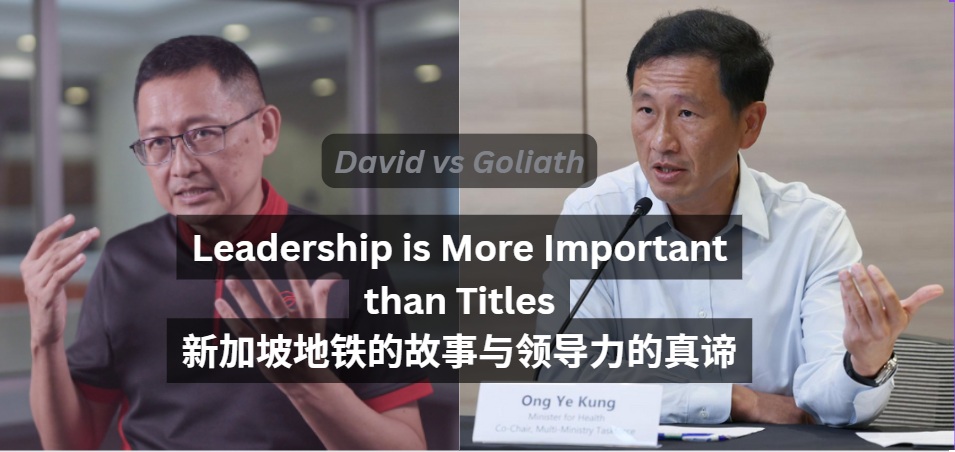
His entourage paused for photos (which I only learned about later when my eldest shared over dinner). Beside him stood SMRT Corporation Ltd President Lam Sheau Kai, heading towards a Cinewav screening at Canberra MRT; a clever way to make train stations more human-centred spaces.
That short encounter sparked a long dinner conversation about SMRT, leadership, and culture.

🚇 SMRT: When Focus Shifted, Culture Cracked
For those unfamiliar: SMRT’s journey hasn’t been easy. Under Saw Phaik Hwa, the company focused heavily on retail, but engineering talent bled out as the core rail system aged. When breakdowns became frequent, Desmond Kuek, an ex-army general (now Temasek Trust CEO) — was parachuted in and famously cited deep cultural issues in Parliament.
Over the years, retired military personnel; army, air force, and even some navy, found second careers inside SMRT. But instead of cohesion, politics and factionalism took root. National security narratives justified the influx, but trains still broke down. Commuters suffered.
I’ve written before about how this military-to-civilian transition can go wrong when not managed with humility and respect for ground engineering expertise: 👉 Leadership Matters More Than Tracks — When a 15-Minute MRT Ride Becomes an Hour of Confusion
From procurement lapses (grey-market equipment, ignored handbooks) to 官官相护 (“officials protecting officials”), the result was a system too slow to own mistakes and fix them. Some who erred upstream later found sanctuary in the very company meant to learn from those errors.
🧭 What This Teaches My Children
At dinner, my youngest asked: “Daddy, is OYK a good guy?”
We talk politics often at home. “There’s no absolute right or wrong,” I said. “But there is clear right and clear wrong in some situations.”
I told them: “OYK was Daddy’s senior at Maris Stella High, a Chinese missionary school that breeds a different kind of boy. His father once stood with the opposition, but OYK had the courage to join the People’s Action Party (PAP) and try to ignite change; imagine a lion stepping into a den of tigers. That takes guts.”
“Would you do it?” they asked.
“Why not? Our family already takes on the machinery of government when it gets things wrong.”
We laughed, slurped pasta and Yong Tau Foo at a food court, aware an Indian gentleman nearby was quietly listening. Surveillance? Maybe. But some prominence is thrust upon you when you refuse to stay silent.
既然藏不了,就锋芒。 (If you cannot hide, then stand brilliant.)
✍️ My Take
Singapore’s success was built on courageous, pragmatic leadership, but courage is not rank. It’s character. When agencies fill senior roles with people who haven’t walked the ground or who let internal politics trump public service, systems decay.
The military-to-civilian pipeline can work; if those who transition respect domain expertise and serve rather than dominate. Otherwise, we risk factional turf wars over real public infrastructure that ordinary families depend on.
I’ve endured poor processes, unnecessary surveillance, and leadership that refuses to admit mistakes. But I teach my children to keep faith: to speak truth to power, to demand better, and to serve when called, even if it means stepping into a den of tigers.
If my family’s voice can provoke reform and solidarity among the Home Team and SAF to truly protect; not politicise the people, then that will be our small gift to Singapore.
🔹 Leadership isn’t about the stars on your shoulder — it’s about the spine in your heart. 🔹 True protection starts with humility and accountability.
What do you think? How can Singapore better integrate ex-military leadership without sacrificing engineering excellence and public trust?
Ministry of Health (Singapore)
This article is also published on LinkedIn.
🛤️ David vs Goliath on the MRT — and Why Leadership Matters More Than Titles
🛤️ 大卫对战歌利亚:新加坡地铁的故事与领导力的真谛
“Dad, why did Minister Ong Ye Kung walk over to greet us?” “为什么王乙康部长走向我们道好?” 我家老大在堪培拉地铁站好奇地问。
我笑了笑: “因为爸爸很‘臭名昭著’啊。爸爸常做别人不敢做的事。”
戴着口罩的我,仍被新加坡卫生部长王乙康一眼认出。我们上一次见面是在新加坡宗乡会馆联合总会(SFCCA)的活动。这一次擦肩而过,他停下来和我寒暄,问我最近身体如何。我说在邱德拔医院看耳鼻喉。孩子的母亲打趣地对他说:“要消毒一下手哦。”我顺势调侃:“他可是卫生部长。”她立刻回怼:“那又怎样!”
我们笑成一团。性格不同,但我们同心希望推动新加坡的改变。
后来才知道,他的随行人员还为我们停下脚步拍了照片(是老大在晚餐时才告诉我的)。在他身旁的,是地铁公司 SMRT 总裁林少凯。他们正赶去 Canberra MRT Cinewav 电影活动——一个用电影让地铁空间更有人情味的尝试。
这短暂的相遇,引发了我们家一顿长长的晚餐对话:关于SMRT、领导力与企业文化。
🚇 SMRT:当焦点偏离,文化开始裂解
很多人也许不熟悉 SMRT 的曲折历程: 早年在苏派华(Saw Phaik Hwa)的领导下,公司重零售、轻工程,结果 工程人才大量流失,而轨道系统逐渐老化。当地铁频频故障时,前陆军将领郭木财(Desmond Kuek,现任淡马锡信托 CEO)被空降进来,他在国会公开指出公司内部存在深层文化问题。
这些年,大量退役军人——陆军、空军,甚至可能包括海军——被安置进 SMRT。 本意是为国家安全与转型安置,但结果却是政治化、派系林立。国安叙事被滥用,乘客却仍要忍受故障与混乱。
我之前写过: 👉 领导力比轨道更重要:当 15 分钟的地铁旅程变成一小时的迷茫
从灰市采购、忽视手册规范到官官相护,一些在陆路交通管理局(LTA)犯过错的人,后来反而在 SMRT 里找到庇护。令人失望。
🧭 给孩子的政治与领导课
晚餐时,老二问: “爸爸,王乙康是好人吗?”
我们家常常谈政治。 “没有绝对的对或错,”我说,“但在某些情况下,是非非常清楚。”
我告诉他们: “王乙康是爸爸的学长,我们都出自 Maris Stella High School 海星中学,一所华校传教学校,培养出的男孩与众不同。他父亲曾是反对党,但他有勇气加入执政党去推动改变——就像狮子走进虎穴,需要胆识。”
“那你会吗?”孩子们问。
“为什么不会?我们全家已经在和庞大的体制对话了。”
我们一边笑,一边在熟食中心吃意大利面和酿豆腐。身边有一位印度朋友安静地坐着听。也许被监视,但当你选择不沉默时,某种意义上的‘显眼’是注定的。
既然藏不了,就锋芒。
✍️ 我的观点
新加坡的成功建立在勇敢而务实的领导力上—— 但勇气不是军衔,而是人格与担当。
如果机构高层由缺乏一线经验、又陷于政治权谋的人占据,系统就会腐坏。 军转民并非不能成功,但前提是——尊重专业,放下官威,真正服务大众,否则只会让公共基础设施变成派系角力的战场。
我经历过糟糕的流程、不必要的监控,也看过许多不愿承认错误的领导。但我依然教孩子保持信念:敢言、追求改进、在需要时挺身而出——哪怕要走进“虎穴”。
如果我们一家的声音能促使国安体系与三军(陆、海、空)真正团结、保护人民,而不是把内部政治带到地铁和民生设施,那将是我们送给新加坡的一份礼物。
🔹 Leadership isn’t about the stars on your shoulder — it’s about the spine in your heart. 🔹 真正的保护,从谦逊与问责开始。
💬 你怎么看——新加坡如何才能在引入退役军人领导的同时,不牺牲工程专业与公众信任?
![#54 🚀 Lithan AI Masterclass: Future-Ready Skills in Action [💡 Upskill with Impact | #SkillsFuture | #AITransformation | #WorkforceDevelopment]](https://marvinfoo.com/wp-content/uploads/2025/07/IMG20250723161346-768x577.jpg)