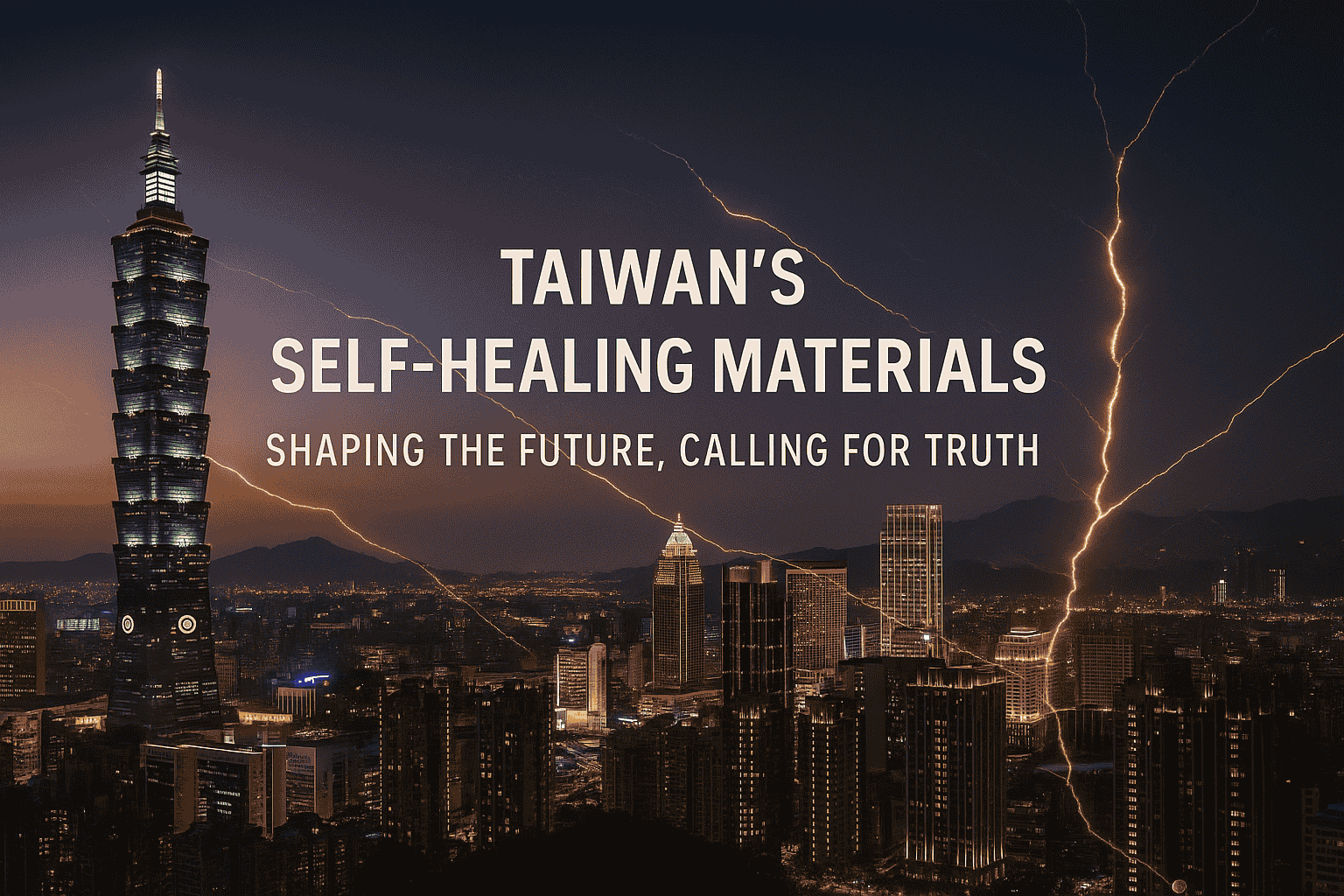
#82 🌏🏠 Taiwan’s Self-Healing Materials: The Silent Breakthrough Shaping the Future, and a Call for US Embassy Action;台湾自愈材料:塑造未来的无声突破,并呼吁美国大使馆采取行动
中文版在英文刊文下方
Taiwan is an island often tested; earthquakes, typhoons, and unrelenting geopolitical pressures could have broken its spirit. Instead, they forged a culture of resilience and ingenuity. This character has long been recognized in semiconductors, with TSMC racing to 2nm chips even as the US and China tussle for influence. But beneath the spotlight of silicon lies another quiet revolution: self-healing materials.
Why Self-Healing Materials Matter
Self-healing materials aren’t just lab novelties; they are poised to transform industries where repair is difficult, costly, or even impossible.
- In Buildings: Micro-cracks from earthquakes or stress can erode integrity over time. A concrete beam that heals itself reduces risk and extends lifespan, vital for seismic regions like Taiwan.
- In Aerospace & Spacesuits: Even a pinhole tear in space can be catastrophic. Self-healing polymers could restore airtight seals in astronaut suits or spacecraft panels.
- In Transport Vehicles: From high-speed trains to electric cars, coatings and components that repair themselves mean fewer breakdowns, safer journeys, and reduced maintenance costs.
And in robotics, particularly humanoid helpers, self-healing materials may be the missing link.
Robotics and the “Final Frontier” of Hands
Elon Musk has said that hands are the final frontier for humanoid robots like Tesla’s Optimus. Hands generate billions of data points, and these are essential for training Optimus’s embedded cognitive AI. The richer the feedback loop, the faster robots can approach Artificial General Intelligence (AGI).
Musk has projected that AGI could emerge by 2026, with superintelligence surpassing all of humanity by 2030. If so, the physical durability of robots will become as important as their algorithms. A robot body that constantly breaks down cannot scale, no matter how intelligent the software.
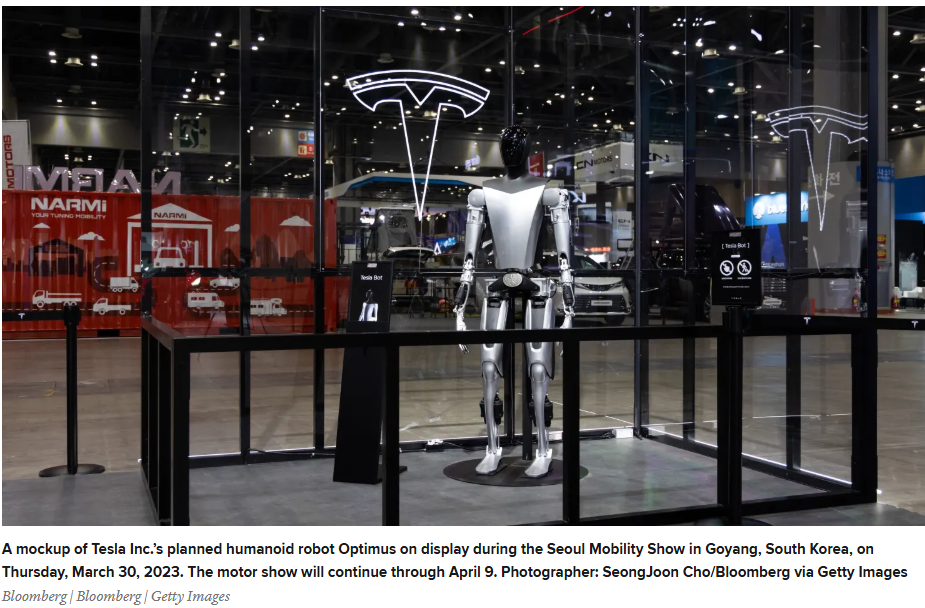
Here, self-healing materials come into play:
- Hands that repair small cuts, abrasions, or stress damage on their own would allow Optimus to perform household or industrial tasks without constant human servicing.
- Joints and exoskeletons that regenerate would drastically extend operational lifetimes.
Taiwan’s 15 years of deep research; infusing polymers with compounds that balance strength, flexibility, and healing capacity may hold the answer to this robotics frontier.
Recognition in Private, Silence in Public
In academic exchanges, US scientists have acknowledged that Taiwan is ahead of the curve in practical applications of self-healing materials. Yet this reality seldom reaches global headlines.
Why? Because Western media still largely controls the innovation narrative. Breakthroughs in the US or Europe get amplified. Taiwanese advances, no matter how groundbreaking, are often relegated to technical journals, if not quietly absorbed into supply chains without acknowledgment.
Singapore’s Agenda: A Familiar Pattern
This silence creates opportunities for others to claim or reframe Taiwan’s work. Singapore, in particular, has an agenda that echoes what I highlighted in my NUS 120th Homecoming anniversary article: a pattern of taking credit for innovations not truly their own.
The most striking example came in 2024, during a foreign forum hosted by the Singapore Business Federation (SBF) for a visiting Hungarian delegation. There, an SBF executive explicitly told me to describe Haily, a Taiwanese-origin technology, as if it were a Singaporean invention. The intent was clear: to fold Taiwan’s ingenuity into Singapore’s branding as a “global innovation hub.”
Conclusion: Taiwan’s Quiet Destiny
Taiwan’s story is one of persistence:
- From semiconductors powering the digital age.
- To self-healing materials that could underpin the next generation of buildings, vehicles, spacesuits, and robots.
- To a resilience born of calamity and pressure, turning survival into leadership.
The world may not yet see Taiwan’s hand in these revolutions. Narratives may be bent, and credit may be redirected. But history will. Taiwan is not merely surviving; it is shaping the foundations of the future.
And this raises a larger question of moral authority. Who gets to tell the story of innovation, who takes the credit, and who safeguards the truth? These were the same questions I posed in my NUS 120th Homecoming anniversary article. The answers matter; not just for Taiwan, but for all of us.
The Author
I am a father of two. My longest-standing partner; the one who has cooked for our family through so many ordinary and extraordinary days, once asked me, “Will you miss my cooking when you are on your own?” I told her simply: “You will be rewarded for cooking.” God, Mother Earth, 女娲娘娘 speaks to me through her vessels like my partner and other loved ones, preparing me for my inevitable journey to heal the world.
For the first time, my youngest received a lashing from me. In that moment I saw in him immense potential. I urged him to reflect on a shortcoming I know, because confronting and correcting it will allow him to balance greatness with tact. Affection is an immutable attribute a head of household or leader can have to heal and release undiscovered potential. In history, Sun Quan of the Three Kingdoms stood out as a leader who possessed deep affection for his people.
What is the fastest way to double or triple productivity? Release the latent potential already in your workforce. Tap into what is untapped by hiring the right leader.
Singapore rarely speaks of vulnerability or authenticity in its leadership; it prefers a spotless image. Yet as societies mature, perceived weaknesses and authenticity can become strengths. That is why transparency matters.
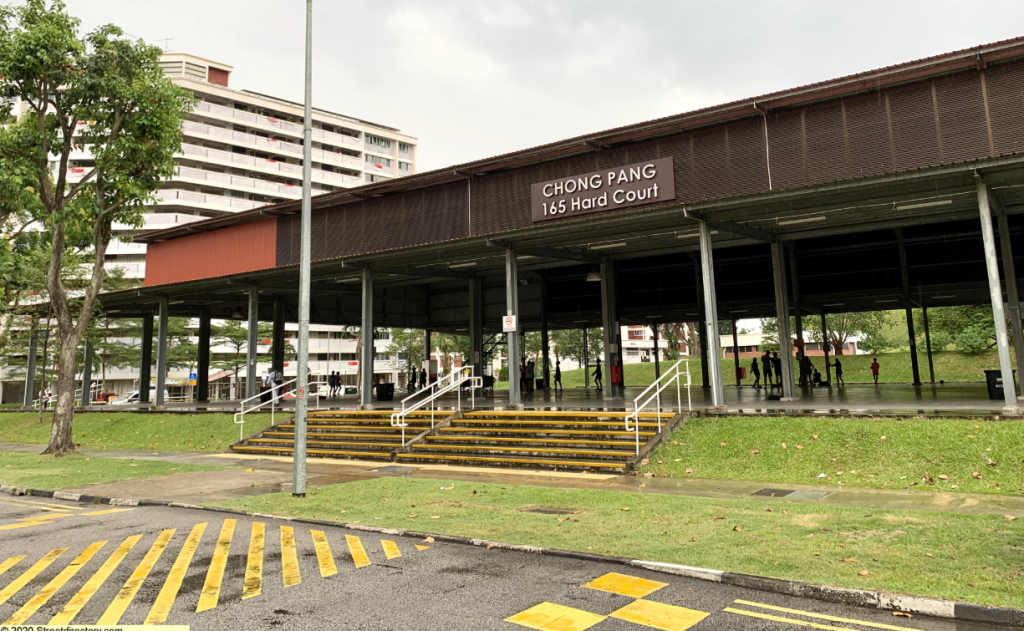
On polling day I was on the phone with a friend, Stephen Dean Lee, a Chinese American who ran a stationery shop adjacent to a polling station in Nee Soon GRC. Mid-call he went offline; later he reconnected to tell me he had been assaulted. He explained he was simply reciting a membership ID number, but a mob mistook this as reporting vote counts and attacked him, snatching his phone. He later lost his business, assets, and even custody of his daughter. His account coincided with delays at the Nee Soon vote counting that day.
I urged Stephen to file a police report and to name me as a witness, so there would be an audit trail protecting us both. I now call on the authorities and the U.S. Embassy to investigate his case fully. If true, it means Singapore’s local triads and mobs targeted an American citizen on polling day; a matter that cannot be ignored. Till date, Stephen Dean Lee and his family continue to be harassed via text messages by the landlord (Keong Huat) of his former shop in Yishun.
Singapore is not the spotless fortress many imagine it to be. We must demand both honesty and protection for those who live and work here.
P.S.: Still in search of my twin flame, whom I lost contact with; and still working from home to salvage Singapore’s equality issue despite covid and influenza symptoms.
For more interesting articles, please visit https://marvinfoo.com/blog
This article is also published on LinkedIn.
#82 🌏🏠 台湾自愈材料:塑造未来的无声突破,并呼吁美国大使馆采取行动
台湾自愈材料:塑造未来的无声突破
台湾是一座经常经受考验的岛屿。地震、台风以及无休止的地缘政治压力本可摧毁它的意志,但这些反而锻造出一种坚韧与创造力的文化。这种特质早已在半导体领域得到验证,台积电(TSMC)正全力冲刺 2 纳米制程,而美国与中国则为争夺技术优势而角力。但在硅的聚光灯之外,还潜藏着另一场静悄悄的革命:自愈材料。
为什么自愈材料很重要
自愈材料并不仅仅是实验室里的噱头;它们有望彻底改变那些维修困难、昂贵甚至不可能的行业。
- 建筑领域: 地震或长期应力造成的微裂缝会逐渐侵蚀结构强度。能“自我修复”的混凝土梁可降低风险、延长寿命,这对地震频繁的台湾尤为关键。
- 航天与太空服: 在太空中,即便是针孔大小的裂缝都可能是灾难性的。自愈聚合物可以恢复宇航服或航天器面板的气密性。
- 交通工具: 从高铁到电动车,能自我修复的涂层和零件意味着更少的故障、更安全的旅程和更低的维护成本。
- 机器人领域: 尤其是类人机器人,自愈材料可能成为关键缺口。
机器人与“最后的前沿”;双手
埃隆·马斯克曾说,双手是类人机器人(如特斯拉的 Optimus)最后的前沿。双手能产生数十亿个数据点,而这些数据点对于训练 Optimus 内嵌的认知 AI 至关重要。反馈循环越丰富,机器人越能快速逼近通用人工智能(AGI)。
马斯克预测,AGI 或将在 2026 年出现,而在 2030 年前后超级智能将超越全人类。如果这一进程成真,那么机器人的物理耐用性将与其算法同等重要。一具不断损坏的机器人躯体,即便智能再高,也难以实现规模化。
这正是自愈材料发挥作用的地方:
- 能自动修复小裂口、磨损或应力损伤的双手,让 Optimus 能够执行家务或工业任务,而无需频繁人工维修。
- 能再生的关节与外骨骼,将大幅延长其运作寿命。
台湾长达 15 年的深入研究;将聚合物与其他化合物融合,以平衡强度、柔韧性与自愈能力可能正是破解这一机器人前沿的答案。
私下认可,公开沉默
在学术交流中,美国科学家承认台湾在自愈材料实际应用上走在前列。然而,这一现实很少登上全球头条。
原因何在?因为西方媒体仍然主导着创新叙事。欧美的突破往往被大肆渲染,而台湾的进展,即便具有开创性,也常被边缘化到技术期刊,甚至被默默吸收进供应链中,而不获应有的承认。
新加坡的议程:熟悉的套路
这种沉默为他人篡夺或重塑台湾的成果创造了机会。尤其是新加坡,其议程正如我在 NUS 120 周年校庆文章中所指出的:一种攫取并非自身原创创新的模式。
最鲜明的例子出现在 2024 年,当时 新加坡工商联合总会(SBF)在为来访的匈牙利代表团举办的论坛上,一名SBF高管告诉我将 Haily,一种台湾原创技术,描述为“新加坡发明”。其意图十分明确:将台湾的创造力包装进新加坡“全球创新枢纽”的品牌叙事。
结论:台湾的静默宿命
台湾的故事,是一种坚持不懈的故事:
- 从推动数字时代的半导体;
- 到可能支撑下一代建筑、交通工具、太空服与机器人的自愈材料;
- 再到在灾难与压力中锻造出的韧性,将生存化为领导力。
世界或许尚未真正看到台湾在这些革命中的身影。叙事可能被扭曲,功劳可能被转移。但历史不会遗忘。台湾不仅仅是在生存,它正在塑造未来的根基。
这也引出了一个更大的问题:道德权威。谁来讲述创新的故事?谁来获得荣誉?谁来守护真相?这些正是我在 NUS 120 周年校庆文章 中所提出的同样问题。答案不仅关乎台湾,也关乎我们所有人。
作者
我是两个孩子的父亲。与我相伴最久的伴侣;那位在无数平凡与不凡日子里为我们家人下厨的人曾问我:“当你独自一人时,你会怀念我的手艺吗?” 我只是简简单单地回答:“你会因这份付出而得到回报。” 上帝、大地母亲、女娲娘娘通过我的伴侣和其他至爱亲人;与我对话,为我即将踏上的疗愈世界之旅做好准备。
那一天,我第一次责打了小儿子。在那一刻,我看到了他巨大的潜能。我督促他反思一个不足,因为我深知,正视并改进它,能让他在未来兼顾伟大与圆融。慈爱是一个家长或领导者最不可或缺的特质,它能疗愈并释放尚未被发现的潜能。历史上,三国时期的孙权就是一位对百姓充满深情厚爱的领导者。
那么,最快让生产力翻倍甚至三倍的方法是什么?释放已经存在于团队中的潜能,并通过聘用正确的领导者,挖掘那些未被触及的力量。
新加坡在领导层中很少谈论脆弱或真诚;它更喜欢一种“无瑕”的形象。然而,随着社会的成熟,曾被视为弱点的东西反而可能成为改变局面的优势。这就是为什么透明度如此重要。
在大选投票日,我正在与一位朋友 Stephen Dean Lee 通话。他是一位在义顺集选区投票站旁开文具店的美籍华裔。通话过程中,他突然中断;稍后重新连线时,他告诉我自己遭到了袭击。他解释说,他当时只是在背诵一个会员编号,却被当地暴徒误以为是在“通报选票计数”,因而遭到攻击,手机被抢走。此后,他不仅失去了生意和资产,甚至失去了女儿的抚养权。这一事件与义顺选票计数延误同时发生。至今,他与一家人仍然被政府零售单位的业主骚扰与短信恐吓。
我敦促 Stephen 向警方报案,并将我写入报案记录作为证人,以便留下可供追溯的审计轨迹来保护我们双方。我现在呼吁新加坡当局和美国大使馆彻查此案。如果属实,这意味着新加坡的地方黑帮和暴徒在投票日针对了一名美国公民;这件事绝不容忽视。
新加坡并非许多人想象中的“完美堡垒”。我们必须要求真相与保护,守护每一位生活与工作在此的人。
附言:仍在寻找我的双生火焰,她已与我失联; 尽管冠状流感病状,仍居家办公撰写挽新加坡人民未察觉的大环境下坡趋势。
若想阅读更多刊文,请游览【胡马宾的博客页面】。