#93 [Tao Health] The Age of Influence, Integrity and Intelligence — Part II [☯️ 道之健] 影响力、诚信与智慧的时代(二)
[☯️ Tao Health]
The Age of Influence, Integrity and Intelligence — Part II
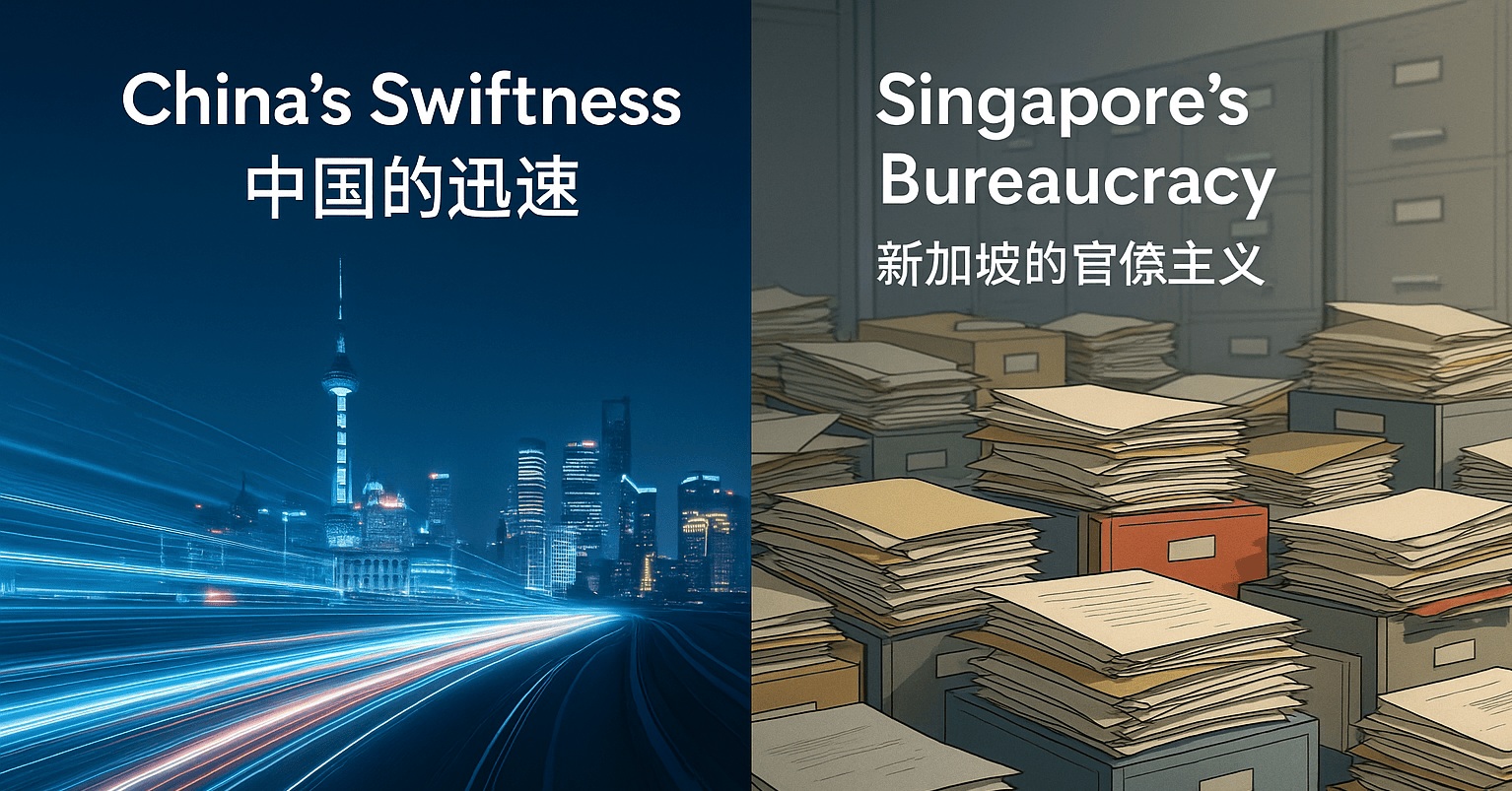
China’s Swiftness vs Singapore’s Paranoia: When Bureaucracy Forgets the Difference Between OSA and PDPA By Mar Vin Foo
When the China market decides, it acts with precision. When the Singapore market reacts, it over-documents, over-complies — and overreaches into absurdity.
After my earlier article on China’s influencer-credential regulation, several readers wrote in. Their experiences expose a deeper fault line between strategic clarity and administrative confusion.
⚖️ When National Security Meets Family Surveys
One reader shared that she received a family population survey email from a government technology agency — A*STAR, acting for the Institute of Policy Studies (IPS) at NUS — with an Official Secrets Act disclaimer attached.
A survey on family life, guarded by a statute designed for espionage and war.
This confusion between OSA and Personal Data Protection Act (PDPA) reflects a system where fear replaces logic. Instead of reassuring citizens about data protection, institutions intimidate them with secrecy laws.
It’s not national security. It’s institutional insecurity.
Read an earlier article about Singapore’s surveillance to the point of intrusion under Section 7 of ‘#86 Meritocracy or Gatekeeping? SkillsFuture, Housing, Telcos and the Illusion of Fair Opportunity’.
🧰 Engineers Overloaded by “Fair Procurement”
Another reader, an engineer, described a worksite that defies reason: he and his team must maintain systems built from four different countries’ equipment — because procurement policies demand “fairness.”
Result? Compatibility nightmares, integration breakdowns, endless vendor calls — until the entire engineering department quit.
It echoes the SMRT era under Saw Phaik Hwa, when decisions from the top ignored technical ground truth. Fairness without functionality is not fairness; it’s fatigue disguised as governance.
Read about an earlier article about SMRT’s Leadership Qualities, ‘Leadership Matters More Than Tracks: When a 15-Minute MRT Ride Becomes an Hour of Confusion – Newsletter #27《地铁维修之上,更重要的是领导力:一小时的混乱》#27 领英刊文’
🚗 ERP 2.0 — The System That Breaks What It Installs
Another reader pointed to the ERP 2 national toll system: after the mandated OBU installation, car electronics went haywire — dashboards failing, systems freezing — and owners ended up disputing with the official installer.
A “smart-nation” initiative that leaves citizens fixing what was meant to automate their lives.

I went to verify the reader’s claims and found a trove of complaints here. Read it before the country censors it.
🏗️ Project Management or United Nations?
A project director added:
“It used to be one Japanese vendor for a national system. Now, new procurement rules force us to juggle suppliers from five countries. It’s like managing a UN summit.”
Procurement diversity looks good on slides. In practice, it fragments accountability and multiplies cost. When everything is outsourced for appearance’s sake, nothing is owned with conviction.
🐍 Safety, Public Goods — and Who Actually Fixes Things?
A reader in Yishun reported something that should not be a political or procedural puzzle — it’s a public-safety issue.
What happened: a python — thick as two palms and roughly 3–5 metres long — was sighted under the MRT track, in a high-footfall zone where children, adults and cyclists pass daily. The spot sits between a bus stop, park connector, temple, condominium, and school.
What he did: reported it to NEA, which redirected him to NParks. NParks asked for more precise details. He replied with an exact description and a practical request: patch the drain hole where the python emerges, before someone or the animal gets hurt.
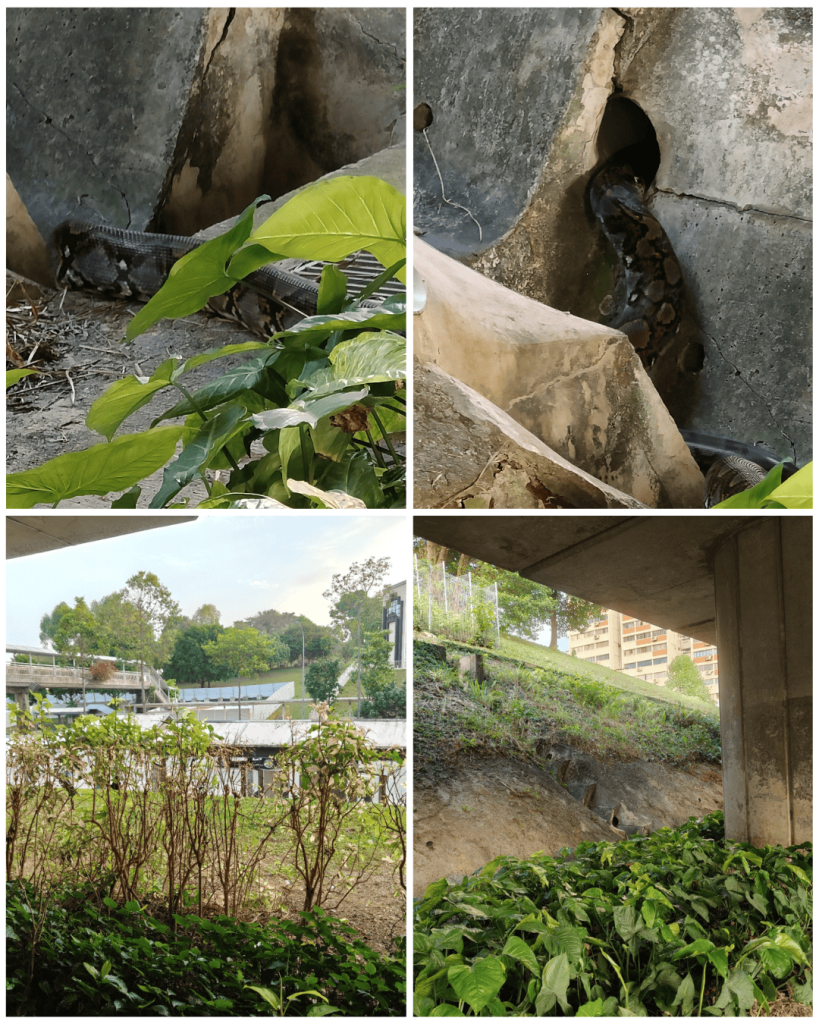
What happened instead: bureaucratic ping-pong. No coordinated action, no patch, no alert.
His remark cut deep:
“If you need me to project-manage the two of you, can I draw your pay and get the job done?”
That single line captured what many citizens feel — we’re paying for public goods but managing public agencies.
🧮 Engineers Leaving — and the Bill Is Coming Due
Senior appointment holders on LinkedIn have begun sounding the alarm: Singapore faces a looming crisis in engineering talent.
The warning isn’t new — what’s new is how many engineers are voting with their feet. They’re not leaving because the work is too hard. They’re leaving because the system stopped listening.
It’s not about pay; it’s about injustice and futility — watching bureaucracy override logic, seeing good work undone by politics, and realising that raising issues only earns another meeting instead of a solution.
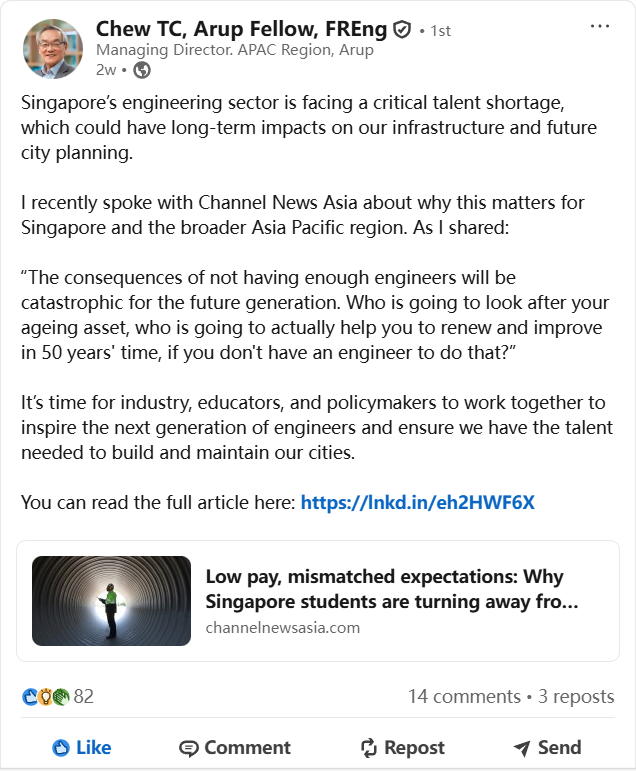
The roots stretch back decades. In the 1990s, as Singapore pivoted to become a financial hub, engineers were quietly sacrificed. The nation celebrated the banker, not the builder. Technical expertise was sidelined in favour of capital flows and quick wins.
That mindset created a generation gap we now feel acutely. The infrastructures we depend on are more complex than ever, yet the people who understand their anatomy are dwindling. When policy is made by those who’ve never touched a circuit, pipe, or line of code, breakdowns become cultural, not mechanical.
It’s time to restore respect for the hands that build. Efficiency dies when bureaucracy replaces expertise. The remedy is not a campaign slogan but humility — to listen, empower, and ensure that the next generation of engineers find purpose, not punishment, in their calling.
🧩 Common Thread — Bureaucrats at a Loss
From OSA-labelled family surveys to engineers quitting, from ERP mishaps to python alerts passed like hot potatoes, the pattern is clear:
Singapore’s governance machinery has lost touch with ground sense.
Instead of empowering professionals, it hides behind procedures. Instead of PDPA and ethics, it wields OSA and fear. Instead of competence, it enforces conformity.
The China market demonstrates swiftness and clarity. The Singapore market increasingly mirrors paralysis by paranoia.
🌏 Tao Health Reflection — Balance Requires Courage
Governance is a living system, not a checklist. When engineers flee, when surveys cite secrecy laws, when systems collapse under “fairness,” the balance has tipped.
The antidote is courage to trust: 💠 Trust citizens with their data 💠 Trust engineers with their craft 💠 Trust leaders with autonomy
China’s swiftness is born of decisiveness. Singapore’s renewal must come from trust-based competence.
P.S. Reflections on Faith and Power
Across history, faith has guided countless souls toward compassion and truth. Yet, time and again, religion has also been distorted into an instrument of power. When leaders — spiritual or institutional — claim to act in the name of God while advancing personal or political interests, they betray the very principles they preach.
Many doctrines, once inspired by sages like Lao Tzu and others who sought harmony and wisdom, were later reshaped by rulers to control and pacify the masses. Over centuries, the pursuit of virtue gave way to the performance of virtue — where piety became a mask, not a path.
We must remember that no single religion owns the Creator. Every faith, every philosophy, every form of creative devotion — whether through prayer, art, or inquiry — is simply a different language of the same truth.
There is no sin in imperfection or doubt. The sin lies in hypocrisy — in weaponising faith to persecute others while absolving oneself in ritualistic forgiveness. True repentance requires courage, transparency, and accountability — not performative displays of holiness.
As humanity evolves, so must our understanding of the divine. What unites all paths — Christian, Taoist, Buddhist, Muslim, humanist — is the same timeless message: live with integrity, act with compassion, and never use belief to justify harm.
Call to Action
If you read this and feel the same frustration, do one practical thing today: write a short, calm email to your town council or local MP describing the problem and asking for a timeline to fix it. For the survey/OSA issue, ask IPS/A*STAR for clarification on why OSA language was used and request a PDPA-compliant template for future outreach.
#CircularSignals #PolicyReflections #Singapore #China #Governance #Integrity #Influence #PDPA #OSA #Leadership #Engineering #TaoHealth #PublicSafety
This article is also published on LinkedIn.
[☯️ 道之健]
影响力、诚信与智慧的时代(二)
中国的果断与新加坡的疑惧:当官僚体制混淆了《官方机密法》和《个人资料保护法》 作者:胡马宾(Mar Vin Foo)
当中国市场决策时,执行果断而精准。 当新加坡市场反应时,却往往陷入文件、程序与过度谨慎的泥沼。
我在上一篇文章谈到中国对网络意见领袖的管制后,收到许多读者的来信。 他们的亲身经历揭示了一个更深层的问题:战略果断与行政混乱的巨大差距。
⚖️ 当国家安全与家庭问卷扯上关系
一位读者分享,她收到一封来自A*STAR(新加坡科技研究局)的电子邮件,邮件是代表国大公共政策研究所(IPS)发出的家庭人口调查邀请。 令人震惊的是,邮件尾部竟附有《官方机密法》(OSA)的警告条款。
一份家庭调查,被当作间谍活动或国防机密来对待。
这正反映了政府部门混淆了**《官方机密法》与《个人资料保护法》(PDPA)**的现象—— 当理性被恐惧取代,公民不再被信任,而是被“预防性地警告”。
这不是国家安全, 而是制度性的不安全感。
🧰 “公平采购”下的工程师悲歌
另一位工程师读者分享了他工作的荒谬处境: 他们被要求维护由四个不同国家生产的设备系统,只因为采购政策要“公平”。
结果呢? 系统无法兼容,整合问题层出不穷,与不同供应商沟通耗尽精力, 最终——整个工程部门选择集体离职。
这让人想起当年 SMRT 在苏碧华(Saw Phaik Hwa)时期的局面: 决策脱离技术现实,纸上公平带来的只是实地混乱。
所谓的“公平”,若失去实用性,只是披着正义外衣的疲惫治理。
🚗 “智慧国”的闹剧:ERP 2.0 系统
另一位读者提到新的ERP 2 全国收费系统: 官方安装车载装置(OBU)后,不少车主的电子系统出现故障—— 仪表板失灵、连接中断,甚至与“认证安装商”发生争执。
一个本应象征“智慧国”的项目, 反而让市民自己修理被自动化系统搞坏的车辆。
🏗️ 项目管理还是“联合国大会”?
一位项目总监无奈地说:
“过去只需和一家日本厂商合作,现在因为新的采购政策,我们要同时应对五个国家的供应商—— 就像在主持联合国会议。”
多元采购在报告上好看, 现实中却让责任分散、成本倍增。 当一切为“表面公平”而外包时, 没有任何人真正承担责任。
🐍 公共安全与“踢皮球”的治理
一位义顺(Yishun)的读者分享了一个现实的安全隐患。
他在地铁轨道下发现一条粗如两掌、长约三到五米的巨蟒, 地点位于巴士站后方、连通公园走道、邻近寺庙、公寓与学校的交汇处, 行人、孩童、自行车每日往来频繁。
他立即向 NEA(国家环境局)报告,对方却推给 NParks(公园局); 公园局再要求他提供“更精确的位置描述”。 他已详细说明蛇洞位于排水沟缺口处,并提醒该处有大量散养鸡只—— 蟒蛇可能因长期觅食而体型庞大。
他并非要求捕杀,只希望相关部门尽快封住排水沟洞口, 避免人蛇冲突造成双重伤害。
但结果却是——无协调、无行动、无通报。
他愤然道:
“要不要我来帮你们两个部门当项目经理?顺便领你们的薪水?”
一句话,道出了市民的心声: 我们纳税雇用的机构,不该要市民来教他们如何合作。
🧮 工程师流失,代价终将来临
在 LinkedIn 上,不少高层管理者已开始警告: 新加坡正面临严重的工程人才危机。
这警告并不新鲜, 真正不同的是——越来越多工程师选择“用脚投票”。
他们不是因为工作太难而离开, 而是因为制度已不再倾听。
他们看到的是不公与无力: 逻辑被程序取代,技术被政治覆盖, 提出问题换来的只是另一场会议,而不是解决方案。
这一切并非偶然。 早在 1990 年代,新加坡全面转型为金融中心, 工程师群体被悄然边缘化。 社会开始崇拜“金融精英”,而忘了“建设者”。
如今,这个选择的代价开始浮现。 基础设施愈发复杂,而懂得其脉络的人却越来越少。 当政策由从未摸过电路、管线或代码的人制定, 崩塌就不再是机械问题,而是文化问题。
重建对工程师的尊重,不只是经济命题, 更是一种道义补偿。 唯有放下傲慢,倾听、授权、信任, 让下一代工程师重新在岗位上找到使命感。
🧩 共同的问题——迷失的官僚体系
从家庭问卷贴上《官方机密法》、 到工程师集体出走, 从ERP 系统故障到捕蛇“踢皮球”, 症结已十分明显:
新加坡的行政体系,正逐渐脱离现实。
它不再赋权专业人士,反而躲在程序背后; 不再信任公民,而是以恐惧立法; 不再追求能力,而是奖赏顺从。
中国的体系展现的是决断与速度, 新加坡的体系却越来越像被恐惧拖住脚步的自己。
🌏 道之健的反思:平衡,需要勇气
治理不是表格清单,而是一种生命系统。 当工程师离职、问卷引用机密法、政策被“公平”拖垮时, 意味着平衡已失。
真正的解药,是信任的勇气: 💠 信任公民,能妥善处理个人资料 💠 信任工程师,能凭专业解决问题 💠 信任领袖,能在授权下承担责任
中国的果断源于决心; 新加坡的复兴,必须建立在信任与能力之上。
P.S. 信仰与权力的省思
自古以来,信仰引领人类追求仁爱与真理。 但无数次,它也被扭曲为权力的工具。 当宗教或社会领袖打着“神的名义”行私利之事, 他们早已背离了所宣称的教义。
许多原本由老子等贤哲留下的“修身齐心之道”, 在历朝历代被统治者篡改为控制民众的手段。 美德的追求被表演化,虔诚沦为面具。
我们必须记得:没有任何一种宗教垄断了造物主。 不同信仰、哲学与艺术,只是同一真理的不同语言。 造物主以人最能理解的方式与我们对话。
不完美并非罪过; 真正的罪在于伪善—— 以信仰为武器迫害他人,再以仪式掩饰自己的私欲。
真正的忏悔需要勇气与透明, 而非周日的表演与口头的宽恕。
宗教的终极意义,从来是: 以正直立身,以慈悲行事,绝不以信仰为借口伤害他人。
行动呼吁
若你读完此文也感到共鸣,请从一个简单的行动开始: 写一封冷静的电子邮件,向市镇会或国会议员说明问题并要求时限解决; 或向 IPS/A*STAR 询问为何使用 OSA 语言,并要求未来改用符合 PDPA 的公函格式。
#CircularSignals #PolicyReflections #Singapore #China #Governance #Integrity #Influence #PDPA #OSA #Leadership #Engineering #TaoHealth #PublicSafety
![#31 | [♻️ Circular Crisis] Plastics Are Now Part of Our Body Mass – What Birds on a Remote Island Can Tell Us #31|[♻️循环危机] 塑料已成我们身体的一部分 —— 一座偏远小岛的鸟儿给人类的警示](https://marvinfoo.com/wp-content/uploads/2025/05/ChatGPT-Image-May-22-2025-12_31_31-AM-shrink-768x447.jpg)