

#78❌ 3 Months, 10 Emails, No Answers: Why Grant Transparency Matters for SMEs ❌ 3个月、10封邮件、零回复:为什么透明的补助审批对中小企业至关重要
16 September 2025
中文版在英文刊文下方。
After three months of correspondence, multiple calls, and countless hours preparing documents, our SME’s grant application was rejected.
No explanation. No written reason. Just silence.
And this isn’t just our story — it highlights a larger problem in Singapore’s SME support ecosystem.
The Case Study: Our Experience
In June 2025, we applied for a Career Conversion Programme (CCP) grant with the hope of supporting our HR Manager, who had joined in June.
Over the next three months:
- We submitted job descriptions, resumes, and supporting documents.
- We were asked to align job descriptions to business strategy and KPIs — an unusual demand, since KPIs are not typically inserted into job descriptions and may even deter candidates.
- Concerned about confidentiality, we offered to sign a mutual NDA before sharing sensitive business plans.
Despite our cooperation, the grant lapsed in September 2025 without approval. What’s more troubling is that no written explanation was ever provided, despite repeated requests for clarity.
We documented the entire process: 10+ emails across three months, unanswered. For those who want to see how opaque this became, I’ve published the full correspondence separately: [External PDF Share – Correspondence with SNEF]
What the Numbers Say
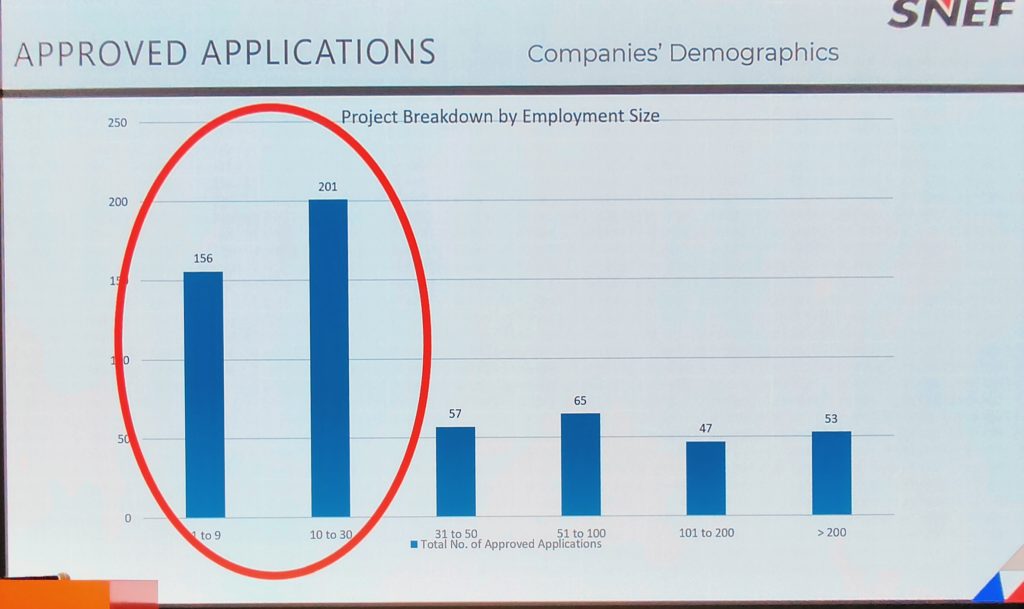
According to Singapore National Employers Federation (SNEF)’s own data, most approved applications go to very small companies:
- 1–9 employees → 156 approvals
- 10–30 employees → 201 approvals
That’s 357 approvals out of 579 total — more than 60% of all approvals.
📌 Which makes the lack of transparency even more alarming: the very SMEs these programmes are supposed to empower are also the most vulnerable to opaque rejections.
Why This Matters
For SMEs, government grants are not “nice-to-haves.” They are lifelines — especially when hiring, retraining, or scaling in a challenging economy.
But when processes become opaque, with shifting requirements and no accountability, the impact is real:
- Wasted resources: man-days lost on correspondence and document preparation.
- Erosion of trust: SMEs begin to doubt whether grant schemes are genuinely accessible.
- Deterrence: Entrepreneurs may stop applying altogether, which defeats the purpose of public support schemes.
How Other Countries Handle It
Other advanced economies have built transparency into their SME grant systems:
- United Kingdom (Innovate UK): Every rejection comes with a feedback report, outlining why the proposal didn’t qualify and how to improve.
- European Union (Horizon Europe): Applicants receive Evaluation Summary Reports scoring applications across impact, excellence, and implementation.
- Australia (Business.gov.au): Rejections are accompanied by clear reasons, and applicants are encouraged to reapply with improvements.
📌 If the UK, EU, and Australia can make transparency a baseline, surely Singapore — a global hub for business — can too.
The Bigger Picture
This isn’t an isolated case. At public events, agencies like Workforce Singapore (WSG) and SNEF speak often about supporting SMEs and creating inclusive growth.
But on the ground, many SMEs face delays, unclear requirements, and silent rejections. The gap between policy messaging and operational reality is widening — and that hurts the very businesses these programmes are meant to help.
For a broader perspective on how systemic discrepancies affect Singapore Pte Ltd companies, see my companion article: #77 🎭 Singapore Pte Ltd: The Hidden Cost of Grants.
A Call for Reform
What SMEs need isn’t sympathy — it’s transparency. Some practical steps:
- Written Reasons for Rejection: Every application should receive a clear explanation.
- Appeal Mechanism: SMEs should have the right to contest unclear or unfair rejections.
- Confidentiality Protections: Sensitive business strategies should be handled with NDAs, not casual email requests.
SMEs are willing to put in the work. What we ask for is simple: clarity, fairness, and respect for the time and trust we invest.

Closing Thought
Grants are meant to empower businesses, not exhaust them. Without transparency, even the most well-intentioned schemes risk becoming barriers instead of bridges. The disparity between marketing rhetoric, which I documented in my LinkedIn posts and articles, and the reality of obtaining grants by SMEs is a concern.
It’s time to bridge the gap.
For more interesting articles, please visit https://marvinfoo.com/blog
This article is also published on LinkedIn.
78❌ 3个月、10封邮件、零回复:为什么透明的补助审批对中小企业至关重要
经过三个月的往来沟通、多次电话、以及无数小时的文件准备,我们公司的补助申请最终被拒绝。
没有解释。 没有书面理由。 只有沉默。
而且,这不仅仅是我们的故事 —— 它凸显了新加坡中小企业支持体系中的更大问题。
案例研究:我们的经历
2025年6月,我们申请了“职业转换计划(CCP)”的补助,希望能支持一位于6月入职的人力资源经理。
在接下来的三个月中:
- 我们提交了职位描述、简历和相关支持文件。
- 我们被要求将职位描述与公司战略和KPI对齐 —— 这是一个不寻常的要求,因为KPI通常不会写入职位描述,甚至可能吓退候选人。
- 出于保密考虑,我们提出愿意签署双向NDA后再分享敏感的商业计划。
尽管我们全力配合,申请仍在2025年9月失效,未获批准。更令人担忧的是,尽管我们多次要求澄清,至今从未收到任何书面解释。
整个过程我们都有记录:三个月内超过10封邮件,无人回复。想了解事情究竟有多不透明,我已单独发布了完整往来记录:[PDF链接 – 完整电邮通讯记录]。
数据怎么说
根据 SNEF 自身的数据,大多数获批申请来自非常小的公司:
- 1–9名员工 → 156个批准
- 10–30名员工 → 201个批准
这意味着在579个批准中,有357个来自员工少于30人的公司 —— 超过总数的60%。
📌 这让“不透明”的问题更加严重:这些补助原本是要扶持的中小企业,反而成了最容易被模糊拒绝的群体。
为什么这很重要
对中小企业而言,政府补助并不是“锦上添花”。它们是企业的生命线 —— 尤其是在招聘、再培训或扩张的艰难经济环境下。
但当流程变得不透明、要求不断变化且无人负责时,后果是切实的:
- 资源浪费:大量人天耗费在邮件往来和文件准备上。
- 信任流失:中小企业开始怀疑这些补助计划是否真正可及。
- 申请意愿下降:创业者可能干脆不再申请,这违背了公共支持计划的初衷。
其他国家如何处理
许多先进经济体已经在中小企业补助体系中建立了透明机制:
- 英国(Innovate UK):每一次拒绝都会附上反馈报告,说明提案未通过的原因以及改进建议。
- 欧盟(Horizon Europe):申请人会收到“评估总结报告”,对项目在影响力、卓越性和执行力等方面进行评分。
- 澳大利亚(Business.gov.au):拒绝时会明确说明原因,并鼓励申请人改进后再次申请。
📌 如果英国、欧盟和澳大利亚都能把透明作为基本要求,那么作为全球商业枢纽的新加坡也应该做到。
更大的图景
这不是孤立的案例。在公开活动中,像 WSG 和 SNEF 这样的机构经常谈论如何支持中小企业、推动包容性增长。
但在实际操作中,许多中小企业面对的却是延误、不清晰的要求、和沉默的拒绝。政策宣传与执行现实之间的差距正在拉大 —— 而受伤害的正是这些计划本应帮助的企业。
关于新加坡私人有限公司(Pte Ltd)制度中的系统性矛盾,我在另一篇文章中有更详细的探讨:#77 🎭 新加坡私人有限公司:补助金背后的代价。
改革呼吁
中小企业需要的不是同情,而是透明。几个切实可行的措施:
- 书面拒绝理由:每一份申请都应收到明确的解释。
- 申诉机制:中小企业应有权利对模糊或不公的拒绝提出异议。
- 保密保障:敏感的商业计划应通过NDA处理,而不是随意的邮件请求。
中小企业愿意付出努力。我们要求的很简单:清晰、公平,以及对我们所投入的时间与信任的尊重。
结语
补助的目的在于赋能企业,而不是耗尽它们。没有透明度,即便是最有善意的计划,也可能变成障碍而不是桥梁。
我在LinkedIn的文章和帖子中记录过 —— 市场宣传与中小企业实际获取补助之间的落差,已成为令人担忧的问题。
是时候弥合这道鸿沟了。
若想读阅更多真正的新加坡,请游览【胡马宾的博客页面】。
此刊文也发布在【胡马宾的领英社交媒体账号】。



![#60 [🎓 Reconnecting with Roots: A Special Visit to NUS] 【🎓 重返母校:一场意义非凡的NUS之行】](https://marvinfoo.com/wp-content/uploads/2025/08/IMG20250806122646-768x576.jpg)
![[☯️ Strategy Unveiled] Tesla, Xiaomi, and the Stalking Horse Gambit: The Art of War in Capital Markets](https://marvinfoo.com/wp-content/uploads/2025/03/20240430_121920-min-768x359.jpg)