
#57 🚀 China’s Tianwen-3: The Next Giant Leap from Mars to Beyond 🚀 中国探火再出发,火星样本返回任务“天问三号”定于2028年发射
华文版在英文刊文下方
In the words of Britney Spears, “Oops!… I Did It Again” — but this time, it’s not pop stardom we’re talking about, it’s planetary exploration. After becoming the first nation to land on the far side of the Moon, China is now setting its sights on the Red Planet. Scheduled for launch around 2028, Tianwen-3 — China’s first Mars sample-return mission — aims to bring back no less than 500 grams of Martian material by 2031.
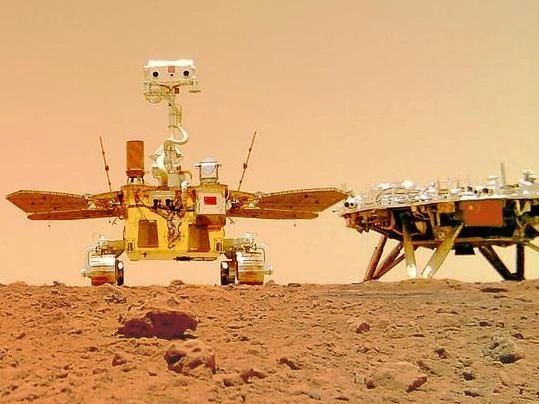
The announcement was recently made public by Hou Zengqian, academician of the Chinese Academy of Sciences and chief scientist of the Tianwen-3 mission. In a peer-reviewed article published in Nature Astronomy, Hou and his team laid out the most detailed scientific roadmap yet for the mission.
🛰️ What Makes Tianwen-3 Unique?
Unlike previous planetary missions, Tianwen-3 combines orbiting, landing, collecting, and return all in one integrated plan, demonstrating China’s growing confidence and ambition in space. It’s not just about the technological feat — it’s about unlocking secrets hidden beneath the Martian dust. These samples may offer clues to the planet’s geological history, past climate, and even potential habitability.
🌍 Why It Matters
Mars sample-return missions are considered a holy grail of planetary science. NASA and the European Space Agency (ESA) have similar plans in the works, but China could potentially be the first to successfully bring Martian samples back to Earth. This could shift the geopolitical landscape of space exploration, positioning China as a formidable leader in deep space missions.
🪐 What’s Next After Mars?
Hou teased even bolder ambitions: Venus, Jupiter, and Neptune are next on China’s interplanetary roadmap. Each of these missions would push the frontiers of human knowledge and technological capability even further.
In a world increasingly defined by innovation and exploration, China is charting a course not just across borders, but across planets. As Tianwen-3 prepares to launch, it signals not just a mission to Mars, but a message to the cosmos: China is here, and it’s reaching for the stars.
继成功登陆月球背面之后,中国再次“Oops!… I Did It Again”——这一次,目标是火星。
根据中国科学院院士、“天问三号”首席科学家侯增谦最新发表在《自然·天文学》上的文章,这项任务预计将在2028年发射,计划于2031年将不少于500克的火星样本带回地球,实现人类首次火星采样返回。
🌌 为何意义重大?
天问三号将集“轨道器 + 着陆器 + 采样器 + 返航器”于一体,全面展示中国在深空探测中的技术整合能力。火星样本或许能揭示这颗红色星球的地质演变、气候变迁,甚至生命存在的可能性。
🌍 未来更远:金星、木星、海王星
侯院士还透露,火星之后,中国将把目光投向金星、木星与海王星,开启更广阔的星际探索篇章。
✨ 点评:
这不仅是中国航天的新高度,更是全球太空探索格局的一次重塑。当其他国家还在规划,中国已经出发。中国正在把“问天”变成现实,从地月系迈向星辰大海。
#中国航天 #天问三号 #火星任务 #样本返回 #深空探索 #科技创新#SpaceExploration #Tianwen3 #ChinaMarsMission
📸 Photo and content source 照片与内容源自于: Quora post
This post is also published on LinkedIn.
![#69 第二篇【黄家揭秘】炎黄子孙的现代博弈:新加坡是否已进入“Ng 时代”? #69 Part 2 [Unveiling the Huang Clan] The Modern Rivalry of Yan and Huang: Has Singapore Entered the “Ng Era”?](https://marvinfoo.com/wp-content/uploads/2025/08/Copy-of-第一篇-Part-1-1-768x768.png)


![#50 [🌏 Business Outlook 2025] SCCCI – Maybank Mid-Year Business Outlook Forum 2025 新加坡中华总商会与马来亚银行联合主办 2025年中经济展望论坛(华语)](https://marvinfoo.com/wp-content/uploads/2025/07/IMG_20250717_183143-768x1013.jpg)