
#183 Back at NUS: Where Young Minds, AI and Real-World Innovation Meet 重返新加坡国立大学:年轻创意、人工智能与现实世界的创新交汇
Back at NUS: Where Young Minds, AI and Real-World Innovation Meet
Reflections from the 29th NUS School of Computing Term Project Showcase (STePS) | 11 November 2026
There is always something nostalgic about returning to the National University of Singapore (NUS).
The familiar surroundings bring back memories. But what keeps me coming back is the opportunity to discover what the next generation of innovators is building.
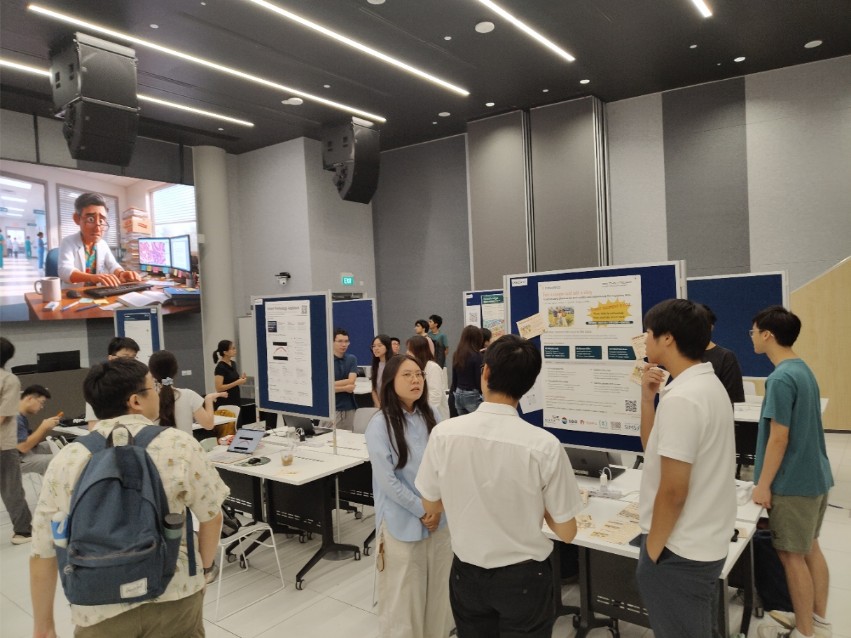
On 11 November 2026, I visited the 29th NUS School of Computing Term Project Showcase (STePS) at COM3, where students presented their work across artificial intelligence, healthcare, recommendation systems, sustainability, language learning and interactive gaming.
As an NUS alumnus, I found it especially encouraging to see how interdisciplinary thinking was being translated into practical applications.
What impressed me wasn’t simply the technology. It was the students’ ability to identify problems, challenge conventional approaches and bring their ideas to life.
When AI Meets Creativity and Consumer Behaviour
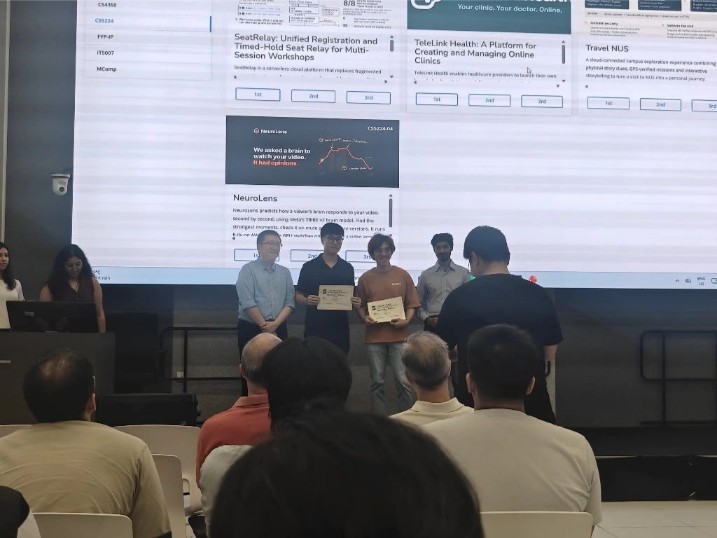
One of my most interesting conversations was with Josh from NeuroLens, whose team won the Best Project Award in its category.
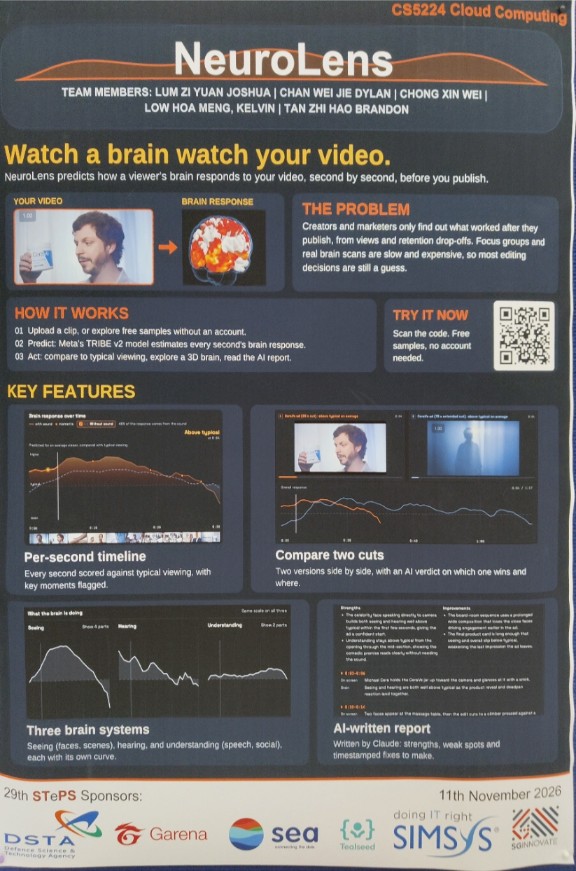
NeuroLens explores how AI can estimate viewers’ neurological responses to video content, identifying moments that may attract attention, sustain engagement or cause audiences to lose interest.
This was particularly relevant to my own exploration of digital content creation, especially educational videos.
Imagine being able to identify the moments when audiences might disengage from a video before it is even published.
Such technology could potentially transform how creative industries approach storytelling, advertising and educational content.
Of course, modelled neurological responses are not substitutes for actual audience behaviour. Nevertheless, they offer intriguing possibilities for testing creative decisions before publication.
Congratulations to Josh and the NeuroLens team on their well-deserved recognition!
I also enjoyed speaking with Ziyuan and Yifan, whose research addressed the cold-start problem in music recommendation systems.
Their work explored how content-based recommendations could help emerging music gain exposure even when it lacks an established listening history.
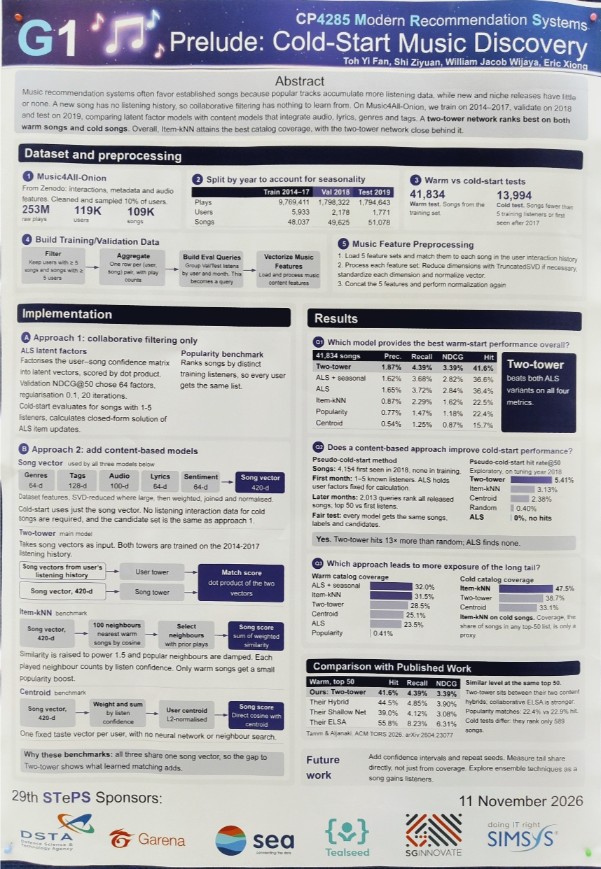
Music recommendation poster
Both projects reminded me that AI in creative industries is not solely about generating content. It can also improve how content is discovered, experienced and appreciated.
Recommendation Poisoning: When Algorithms Undermine Marketplace Trust
Another particularly thought-provoking conversation was with Yanze and Brendan Ng, representing ForgetMeNot: Poisoning and Recovery in Continually Learned Recommender Systems.
Their research examines how recommendation systems can be manipulated through malicious inputs and how those systems might recover from such attacks.
This immediately reminded me of my recent experiences with AliExpress, which I discussed in my earlier article:
Across e-commerce platforms, consumers sometimes encounter numerous sellers listing essentially the same questionable or potentially illicit products, often under different specifications, descriptions and pricing.
When such products become highly visible through marketplace search and recommendation mechanisms, the concern extends beyond individual sellers.
It raises questions about the integrity of the marketplace itself.
While the proliferation of similar listings does not necessarily establish that a recommendation-poisoning attack has occurred, the underlying challenge of maintaining trustworthy ranking and recommendation systems is highly relevant.
E-commerce platforms ought to deploy stronger detection, prevention and recovery mechanisms to protect their credibility before questionable listings undermine consumer confidence.
This includes identifying suspicious seller networks, detecting manipulated product signals, and preventing misleading or prohibited listings from gaining disproportionate visibility.
Reputation takes years to establish but can deteriorate rapidly.
Once a marketplace becomes associated with misleading sellers or illicit products, restoring consumer trust may prove considerably harder than preventing those problems in the first place.
Research such as ForgetMeNot demonstrates why cybersecurity, machine learning, consumer protection and commercial governance must increasingly work together.
AI Beyond the Screen: Healthcare, Legal Intelligence and Environmental Accountability
Several other projects demonstrated the potential for computing research to address serious industry challenges.
Smart Pathology Assistant, presented by Wang Hui, explored how AI could assist medical professionals in interpreting extremely large digital pathology slides.
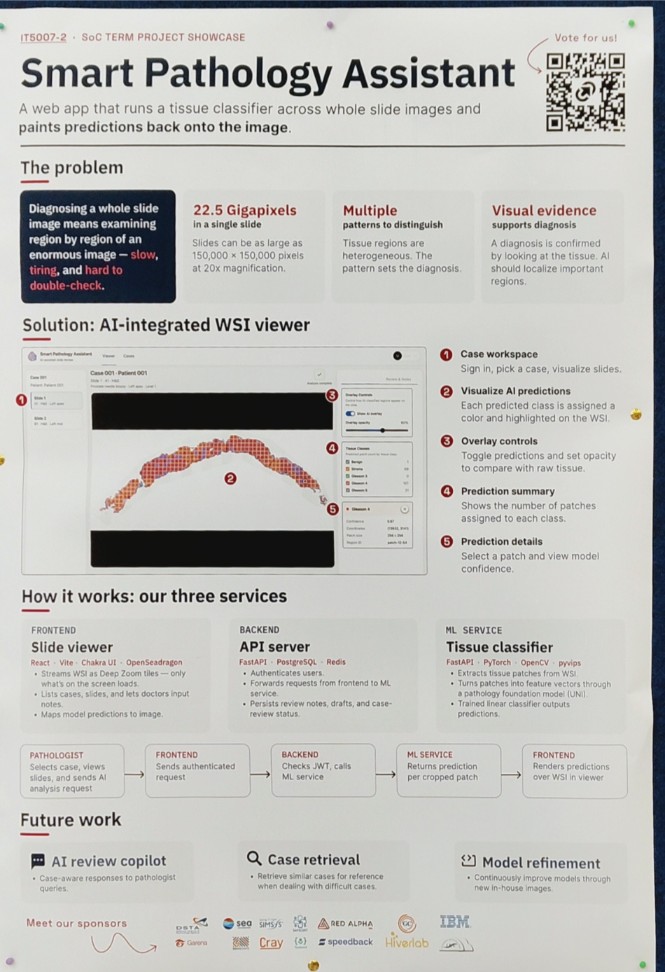
The application uses tissue classification and visual overlays to help pathologists identify relevant regions and review predictions.
Such solutions could improve clinical workflows, provided that accuracy, validation and professional oversight remain central to implementation.
I also had a fascinating exchange with Kenny, who presented an Edge-Deployed Agentic System for Patent Prosecution and Legal Intelligence.
His work demonstrated how a locally deployed AI assistant could support patent professionals in researching prior art, finding evidence and drafting technical arguments, while emphasising confidentiality, traceability and human approval.
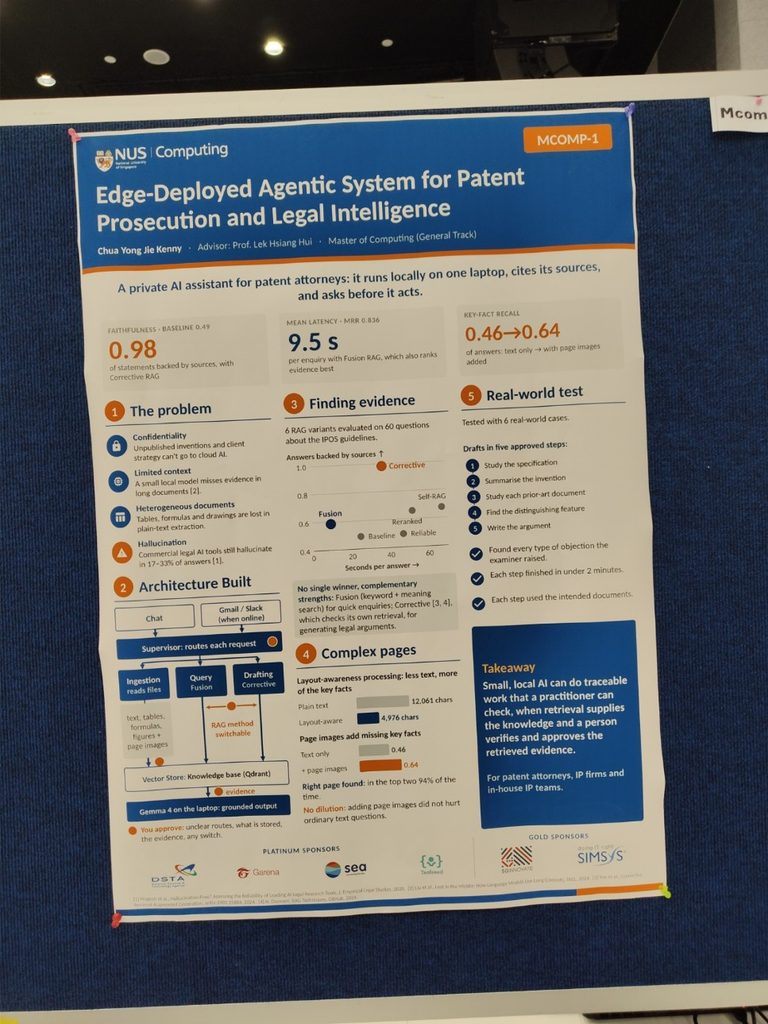
Given my own involvement in intellectual property, trademark applications and business development, I could readily appreciate the potential applications.
Meanwhile, Kunal Soni presented Assurance by Design for Blockchain-Enabled Environmental Resource Tracking.
His research examined how blockchain-based records and governance mechanisms could improve accountability, verifiability and integrity across environmental resource lifecycles.
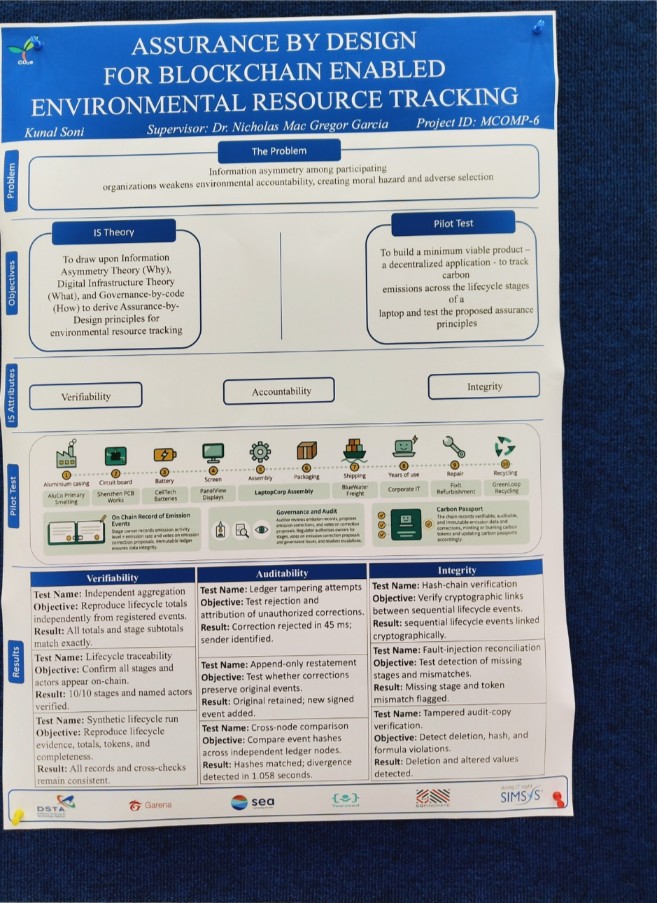
The demonstration involved tracking emissions through different stages of a laptop’s lifecycle, from manufacturing and transportation through usage and eventual recycling.
This was particularly relevant to my interests in sustainability, circular resource management and accountable supply chains.
Technology alone cannot guarantee environmental integrity, but properly designed assurance mechanisms can make environmental claims more transparent, traceable and verifiable.
These conversations reinforced something I shared with several postgraduate students:
The true value of technology emerges when it is applied to solve real problems in industries.
A good algorithm is an achievement. A good algorithm that makes a meaningful difference to how people work, learn or live is an even greater one.
Making Learning Fun: Linguini and Everyday Experiences
Not everything at STePS was about complex industrial challenges.
Some of the most engaging innovations were delightfully simple in concept.
I met Ananya Jain, whose team developed Linguini, another Best Project Award winner in its category.
The idea is refreshing: why shouldn’t your own photographs become your language-learning material?
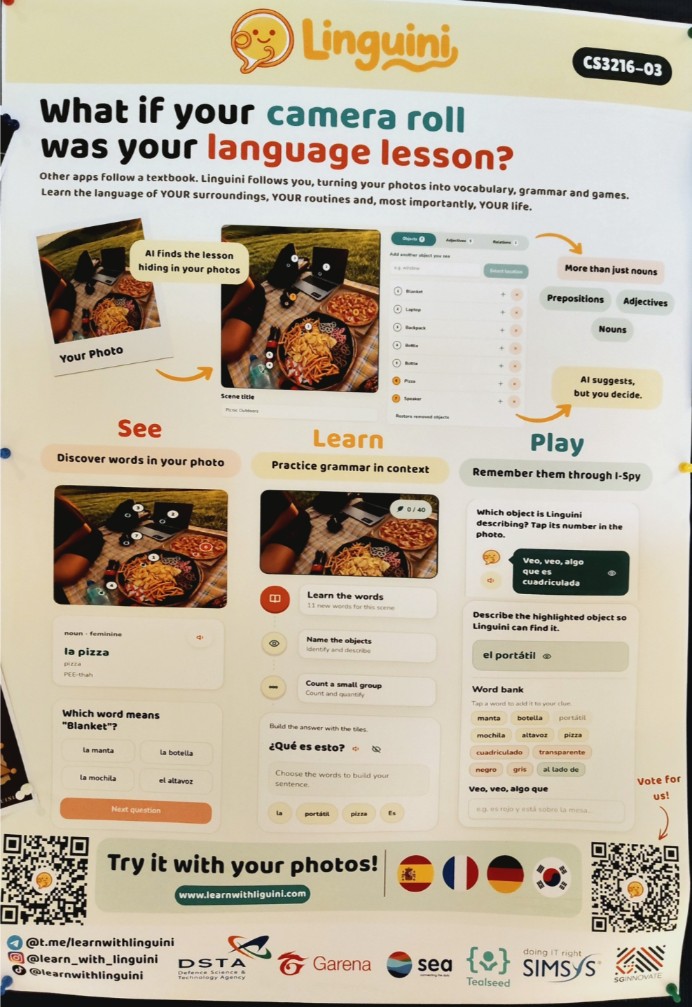
Users can upload everyday pictures, allowing AI to identify objects and relationships within the image and transform them into contextual language-learning exercises.
Instead of memorising generic vocabulary lists, learners can discover words associated with familiar places, objects and personal experiences.
It brings language learning closer to daily life, making it more intuitive and relatable.
I particularly appreciated how Linguini combines visual recognition, contextual understanding and gamification into a practical learning experience.
Congratulations to Ananya and her teammates on their well-deserved recognition!
Read more about Linguini and its achievement.
A Little Nostalgia, and Plenty of Games!
Of course, it wouldn’t be a computing showcase without games!
I couldn’t resist trying Beesness, a colourful bee-themed game that brought back fond memories of gaming in my younger days.
An associate accompanying me tried Unwound, a creative platform game developed by Ulrico, James, Celeste, Ruiyuan, Kelly and Zayd, combining dexterity, exploration and problem-solving.
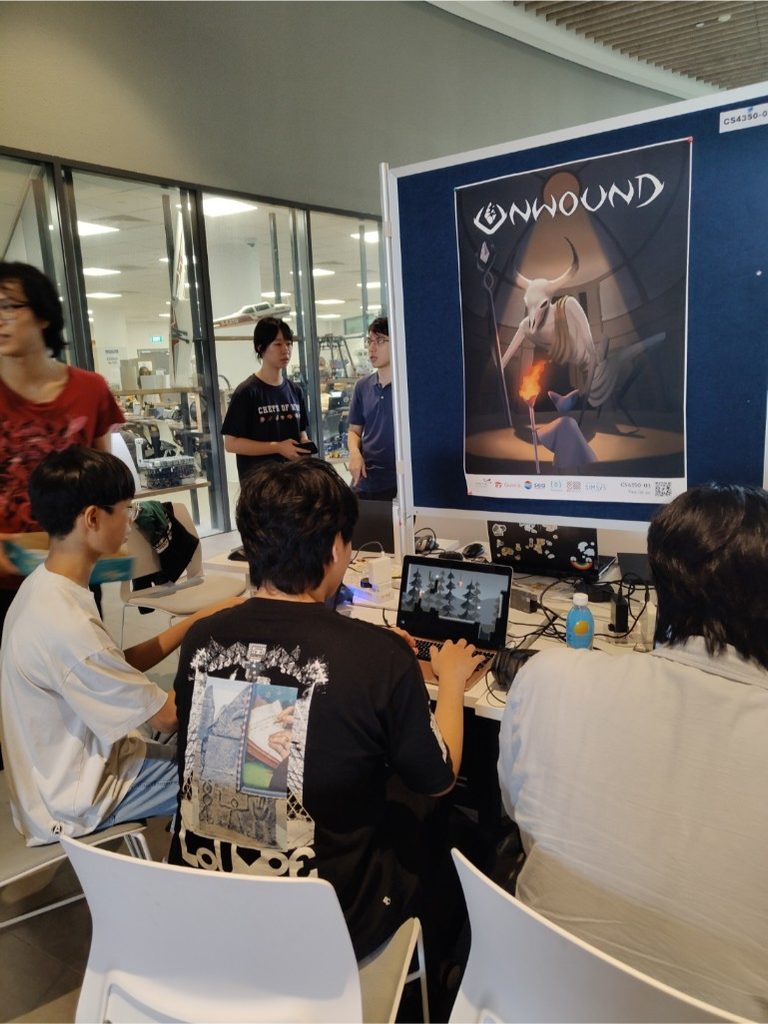
Unwound showcase
There were also first-person shooting simulations attracting enthusiastic visitors, alongside other imaginative creations.
I was equally pleased to see student projects gamifying physical activities such as running, illustrating how entertainment mechanics can encourage participation beyond conventional gaming.
It was heartening to see undergraduates applying their technical abilities with such imagination.
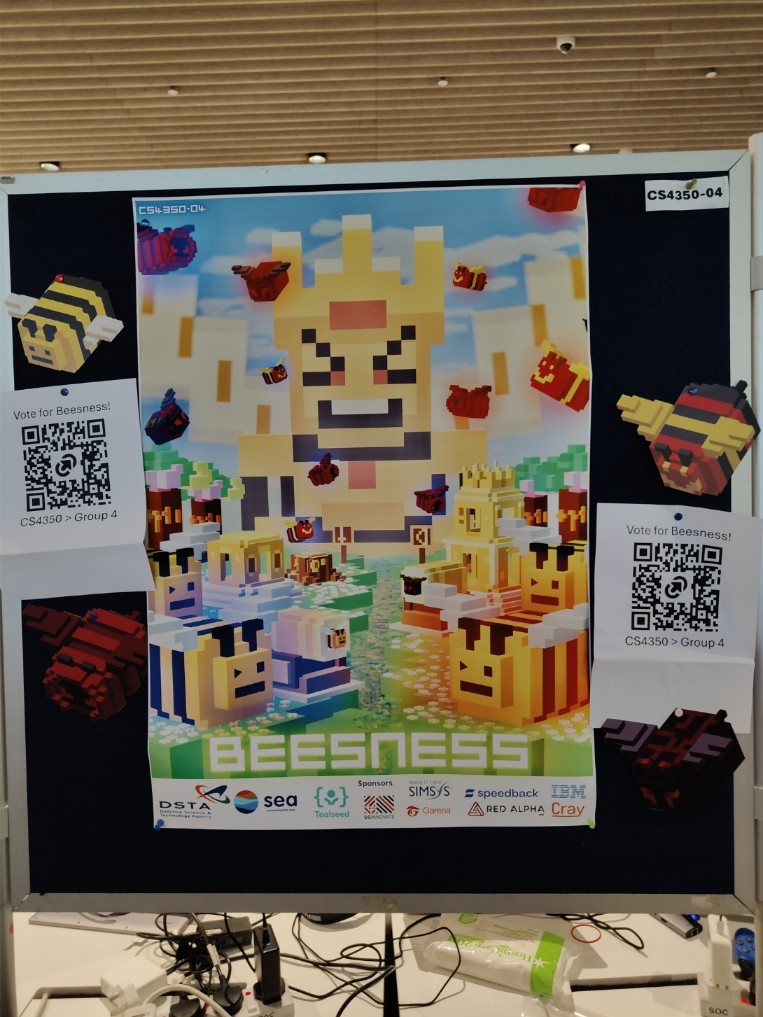
Not every project needs to solve a billion-dollar problem to be meaningful.
Sometimes, making an experience more engaging, enjoyable or accessible is already a worthwhile achievement.
Interdisciplinary Thinking Is No Longer Optional
Perhaps my biggest takeaway from the visit was how strongly the projects demonstrated the value of interdisciplinary learning.
Artificial intelligence intersected with neuroscience, digital marketing, healthcare, intellectual property, music, linguistics, environmental governance and entertainment.
These are not isolated technological disciplines.
They are areas where computing increasingly enables broader innovation.
I have long believed that interdisciplinary studies are essential to preparing the next generation for real-world challenges.
Industries do not operate neatly within academic boundaries, and neither should innovation.
During conversations with several postgraduate students, I shared my belief that their research and technical expertise have tremendous value when translated into practical industry applications.
Understanding an industry’s commercial, operational, regulatory and human challenges is just as important as developing the underlying technology.
Equally, industries should remain open to learning from academia, particularly when young researchers approach familiar problems without being constrained by conventional assumptions.
Returning to Where It All Began
Beyond the technologies and demonstrations, what made the afternoon memorable was meeting enthusiastic young people eager to explain their ideas, demonstrate their prototypes and discuss possibilities.
There is something refreshing about that curiosity and optimism.
My appreciation goes to everyone who took the time to share their work, particularly Josh, Ziyuan, Yifan, Yanze, Brendan, Wang Hui, Kenny, Kunal, Ananya, Ulrico, James, Celeste, Ruiyuan, Kelly and Zayd.
Congratulations to the award-winning teams, and equally to every student who invested the effort to bring an idea from concept to demonstration.
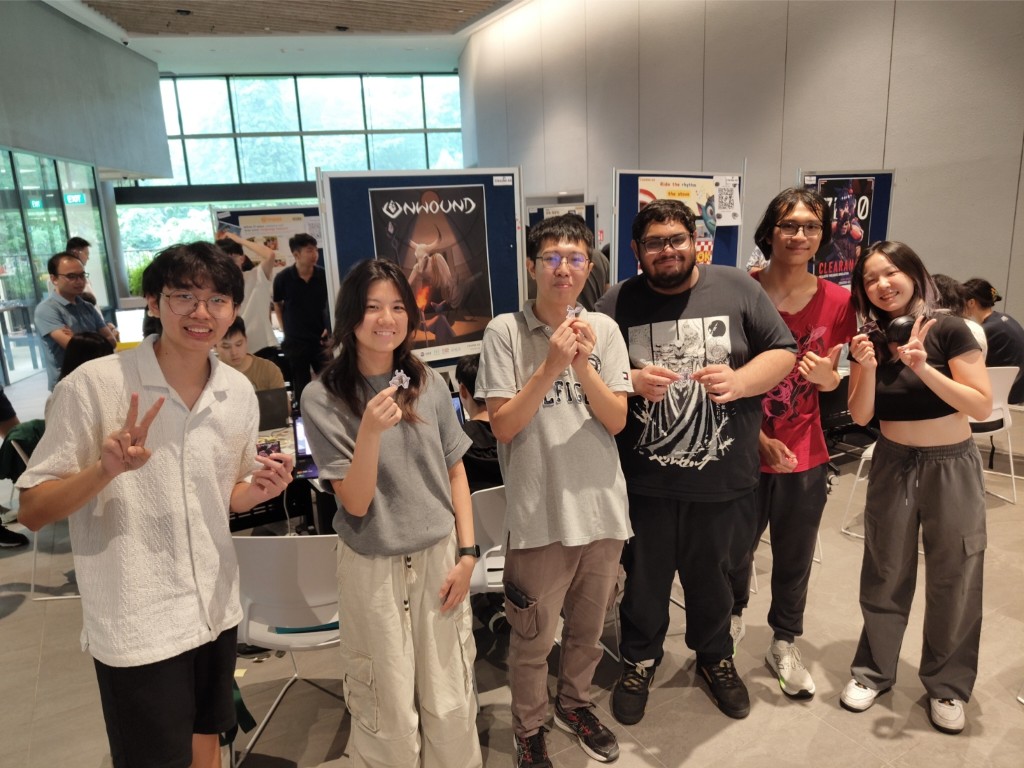
My thanks also go to NUS Computing, the organisers, faculty members and sponsors who made the 29th STePS possible.
As an alumnus, returning to NUS will always carry a sense of nostalgia.
But seeing today’s students build technologies for tomorrow gives me something even more valuable: optimism about the next generation and what they can accomplish.
Keep questioning. Keep experimenting. Keep building.
And, most importantly, keep finding ways to make technology meaningful to the world beyond the university.
Mar Vin Foo
NUS Alumnus | Founder, iMERV Digital Pte Ltd
Event: 29th NUS School of Computing Term Project Showcase
This article is also shared on LinkedIn, Facebook, Instagram, TikTok and other social media platforms.
重返新加坡国立大学:年轻创意、人工智能与现实世界的创新交汇
参加第29届新加坡国立大学计算机学院学期项目成果展(STePS)有感 | 2026年11月11日
每次重返新加坡国立大学(National University of Singapore,简称 NUS),心中总会涌起一份怀旧之情。
熟悉的校园环境,总会勾起昔日求学的回忆。然而,更吸引我重返校园的,是有机会了解新一代年轻创新者正在研发什么,以及他们如何运用科技,为未来创造更多可能。
2026年11月11日,我出席了在COM3大楼举行的第29届新加坡国立大学计算机学院学期项目成果展(School of Computing Term Project Showcase,简称 STePS)。
现场展示了学生在人工智能、医疗科技、推荐系统、可持续发展、语言学习及互动游戏等领域的研究成果与创意作品。
身为国大校友,我特别欣慰地看到,跨学科思维正逐渐被融入计算机教育,并通过实际应用展现其价值。
令我印象深刻的,不仅是学生所运用的技术,更是他们发现问题、挑战传统思维,并将创意转化为实际作品的能力。
当人工智能遇上创意产业与消费者行为
当天其中一场令我印象深刻的交流,是与 NeuroLens 项目的 Josh 进行的讨论。他所属的团队荣获了其组别的最佳项目奖(Best Project Award)。
NeuroLens 探索如何运用人工智能,预测观众观看视频时可能产生的神经反应,并辨识哪些片段能够吸引注意力、维持观众的参与度,或导致观众失去兴趣。
这项研究与我近期探索的数字内容创作,尤其是教育视频制作,有着密切的关联。
试想想,如果我们能够在视频正式发布之前,预先识别观众可能失去兴趣的片段,再针对内容进行调整,将会为创意产业带来怎样的改变?
这类技术未来或许能够改变我们制作故事内容、广告及教育视频的方式。
当然,通过模型预测的神经反应,并不能完全取代真实观众的行为数据。然而,它确实为创作者提供了另一种值得探索的内容优化方法。
在此,恭喜 Josh 和 NeuroLens 团队获得这份实至名归的肯定!
我也有机会与 Ziyuan 和 Yifan 交流,了解他们针对音乐推荐系统中所谓的**「冷启动问题」(Cold-Start Problem)**所进行的研究。
当一首新歌尚未累积足够的聆听记录时,推荐系统往往难以判断它应该被推荐给哪些听众。这也意味着,新晋音乐创作者可能因为缺乏历史数据,而难以获得曝光。
他们的研究探讨如何结合音乐内容特征与推荐算法,让尚未建立知名度的音乐作品,也有机会被合适的听众发现。
这两个项目让我再次意识到,人工智能在创意产业中的价值,并不局限于生成内容。
它同样能够改善内容如何被发现、被体验,以及被欣赏的过程。
推荐系统遭恶意操纵:当算法开始侵蚀平台信誉
另一场让我深感兴趣的交流,是与 Yanze 和 Brendan 讨论他们的研究项目:
ForgetMeNot:持续学习推荐系统中的数据投毒与恢复机制(Poisoning and Recovery in Continually Learned Recommender Systems)。
他们的研究探讨推荐系统如何受到恶意数据输入的操纵,以及系统在遭受攻击后,如何识别问题并恢复正常运作。
这项研究立即让我联想到自己近期在 AliExpress 的购物经历,以及我此前发表的一篇文章:
《当个人行为考验机构信任:从职场、社团网络到创业历程的反思》
在一些电子商务平台上,消费者有时会发现,多个不同卖家同时销售本质上相同、却存在疑点,甚至可能涉及违规的商品。
这些商品往往通过不同的产品规格、描述方式及定价策略重复上架。
当类似商品在平台的搜索结果及推荐机制中不断获得曝光时,问题便不再局限于个别商家的行为。
它进一步引发我们对整个平台诚信与可信度的思考。
当然,大量相似或具有误导性的商品同时出现,并不必然证明推荐系统遭到了数据投毒攻击。
然而,如何确保推荐及排序机制不被恶意操纵,仍然是电子商务平台必须认真面对的问题。
我认为,电子商务平台有责任部署更完善的检测、预防及恢复机制,在可疑商品侵蚀消费者信心之前,主动维护平台的公信力。
这些措施包括识别可疑的卖家网络、检测遭操纵的产品信号,以及防止具有误导性或违规的商品获得不成比例的曝光。
建立商誉可能需要多年努力,但失去消费者的信任,却可能只在短时间内发生。
一旦消费者开始将某个平台与虚假宣传、不良商家或违规商品联系起来,要重新建立信誉,往往比事先预防问题更加困难。
ForgetMeNot 这类研究正好说明,网络安全、机器学习、消费者保护与商业治理,必须更加紧密地结合。
科技不仅要追求效率,更必须承担维护信任与诚信的责任。
走出屏幕的人工智能:医疗、法律与环境责任
除了创意产业与推荐系统,现场还有多个项目展示了计算机科学如何应对不同产业的实际挑战。
Wang Hui 向我介绍了 Smart Pathology Assistant(智能病理分析助手)。
这项应用利用人工智能,对高分辨率的数字病理切片进行组织分类,并通过可视化叠加技术,将预测结果呈现在医学影像上。
由于完整的病理切片可能包含极其庞大的影像数据,相关技术有潜力协助病理医生更有效率地识别与审查重要区域。
当然,医疗人工智能的实际应用,仍必须以严谨的验证、准确性及专业人员监督为基础。
我也与 Kenny 进行了深入交流。他展示的项目是:
Edge-Deployed Agentic System for Patent Prosecution and Legal Intelligence(边缘部署的专利申请审查与法律情报智能代理系统)。
这项研究展示了如何在本地设备部署人工智能助手,协助专利专业人员进行现有技术检索、证据搜集及技术论证文件的草拟工作。
尤其值得注意的是,系统强调资料保密、证据可追溯性,以及由人类专业人员进行最终审核与批准。
鉴于我近年来也参与知识产权、商标申请及业务开发工作,我能够充分理解这类技术在实际商业环境中的应用潜力。
与此同时,Kunal Soni 展示了另一项令我感兴趣的研究:
Assurance by Design for Blockchain-Enabled Environmental Resource Tracking(以保障机制为设计核心的区块链环境资源追踪系统)。
他的研究探讨如何通过区块链记录及治理机制,提高环境资源生命周期中的可验证性、问责性及数据完整性。
展示以一台笔记本电脑的生命周期为例,追踪从制造、运输、使用,到最终回收等不同阶段的碳排放记录。
这与我长期关注的可持续发展、循环资源管理及供应链问责机制有着高度关联。
科技本身并不能自动保证环境数据的真实性。
然而,设计完善的验证及治理机制,能够让环境声明更透明、更容易追溯,也更有利于独立核实。
这些交流进一步巩固了我当天与几位研究生分享的一个观点:
科技真正的价值,在于能够解决产业面对的实际问题。
开发一个优秀的算法,本身就是值得肯定的成就。
但如果这个算法能够进一步改善人们的工作方式、学习体验或日常生活,它所创造的价值就更加深远。
让学习变得有趣:Linguini 与日常生活的结合
当然,STePS 展示的并非全是复杂的产业技术。
有些令我印象深刻的创新,其实源自非常简单,却又充满巧思的概念。
我认识了 Ananya Jain,她所属的团队开发了 Linguini,并同样荣获其组别的最佳项目奖。
Linguini 的创意相当有趣:
为什么学习外语,一定要依靠课本,而不能从自己拍摄的生活照片开始?
使用者只需上传一张日常照片,人工智能便能够识别照片中的物品及其相互关系,并将这些内容转化为不同语言的词汇及语法练习。
与其机械式地背诵与生活缺乏关联的词汇,学习者可以通过熟悉的环境、物品和亲身经历来学习外语。
这种方法让语言学习更贴近日常生活,也更容易产生共鸣。
我特别欣赏 Linguini 将图像识别、语境理解及游戏化学习结合起来,让原本可能枯燥的语言学习过程变得更加自然、有趣且实用。
恭喜 Ananya 与她的团队取得优异成绩!
重温昔日乐趣:游戏世界中的创意与挑战
当然,计算机学院的项目成果展,又怎么能够少了游戏呢?
我也忍不住亲自体验了 Beesness,一款以蜜蜂为主题、色彩丰富且充满趣味的游戏。
这不禁让我想起年轻时接触电子游戏的日子。
同行的一位伙伴则尝试了 Unwound,一款由 Ulrico、James、Celeste、Ruiyuan 和 Zayd 共同开发的平台游戏。
这款游戏巧妙地结合了操作技巧、探索元素及解谜挑战,让玩家在游戏过程中同时考验反应能力与解决问题的能力。
现场也有第一人称射击游戏,吸引了不少参观者驻足体验。
此外,我也很高兴看到学生尝试将游戏化机制融入跑步等体育活动,借此提升参与者的运动兴趣。
看到这些本科生充分发挥技术能力与想象力,确实令人欣慰。
并非每一个科技项目都必须解决价值数十亿元的重大问题,才算具有意义。
有时候,只要能够让某项体验变得更加有趣、更容易参与,或更加贴近使用者的需求,本身就是值得鼓励的创新。
跨学科思维,已不再是可有可无的选择
这次参观给我最大的启发之一,是学生们的作品充分体现了跨学科学习的重要性。
人工智能与神经科学、数字营销、医疗、知识产权、音乐、语言学、环境治理及娱乐产业相互结合。
这些领域并不是彼此孤立的技术学科。
相反,计算机科学正逐渐成为推动不同领域创新的重要工具。
我一直深信,跨学科教育是培养下一代人才,应对现实世界复杂挑战的重要基础。
现实中的产业问题,从来不会整齐地按照大学的学科分类出现。
因此,创新思维也不应该受到传统学科界限的限制。
当天与几位研究生交流时,我特别强调,他们所拥有的研究能力与技术知识,在真正应用于产业环境之后,能够发挥更大的价值。
除了掌握技术本身,理解产业的商业需求、营运模式、监管要求,以及人与人之间的互动,同样不可或缺。
与此同时,企业与产业界也应该更加主动地向学术界学习。
年轻研究人员往往能够跳脱既有框架,从不同角度重新审视我们早已习以为常的问题。
这种学术研究与产业实践之间的双向交流,正是推动创新持续发展的重要动力。
重返母校:怀旧之外,更看见未来的希望
除了各种技术与现场展示,真正让这次参观留下深刻印象的,是那些充满热忱的年轻人。
他们乐于介绍自己的创意、演示开发成果,也愿意与参观者探讨未来的各种可能性。
那份好奇心、积极态度与探索精神,令人感到格外振奋。
在此特别感谢当天与我交流的:
Josh、Ziyuan、Yifan、Yanze、Brendan、Wang Hui、Kenny、Kunal、Ananya、Ulrico、James、Celeste、Ruiyuan 及 Zayd。
恭喜获得奖项的团队,也同样向每一位努力将创意转化为实际作品的本科生及研究生致敬。
感谢新加坡国立大学计算机学院、活动筹办团队、教职人员及赞助机构,让第29届 STePS 得以顺利举行。
身为国大校友,每次重返校园,总会带着一份怀旧之情。
然而,看见今天的年轻学生正运用科技,为明天创造更多可能,带给我的不仅是回忆。
更是一份对下一代创新人才,以及他们未来能够取得成就的信心与期待。
继续提问,继续探索,继续实验,继续创造。
更重要的是,继续思考如何让科技走出校园,真正为社会、产业及人们的生活创造价值。
胡马宾(Mar Vin Foo)
新加坡国立大学校友 | iMERV Digital Pte Ltd 创办人
活动资料: 第29届新加坡国立大学计算机学院学期项目成果展(STePS)
此刊文也發佈在LinkedIn與其他各大社交媒體。